Reading between the lines, looks like EVs are still on the table, they will just move slower to put less impact on their ICE offerings. Also, they will move to the platform model (not sure how that is different) and will look to fill their losses with lower cost (to make) and higher prices.
They are really just resting on the value of the Porsche brand... It's going to be a very hard road for them unless they create more lower priced cars that can compete in a global market. Either that or go full Ferrari/Lambo.
So they want to make cars for cheaper and sell them for more. More plastic interiors? Contradictory with what the new CEO said: “quality over quantity” - while also saying “more models and derivatives”.
I have a feeling this new CEO doesn’t have a clear plan yet Quality over quantity while expanding on quantity and lowering quality to make cars for less
They are also mentioning cars positioned above the 911 and the Cayenne; so even more “premium” models. 350-400k price for the new K suv? And likely a new GT/918 equivalent at 800k-1.5mil?
Continues with 0 acknowledgment of the issues they are having, and continues blaming the difficult market, especially in China.
I find it that acknowledging issues with your product and making it better helps, but I might be the weird one.
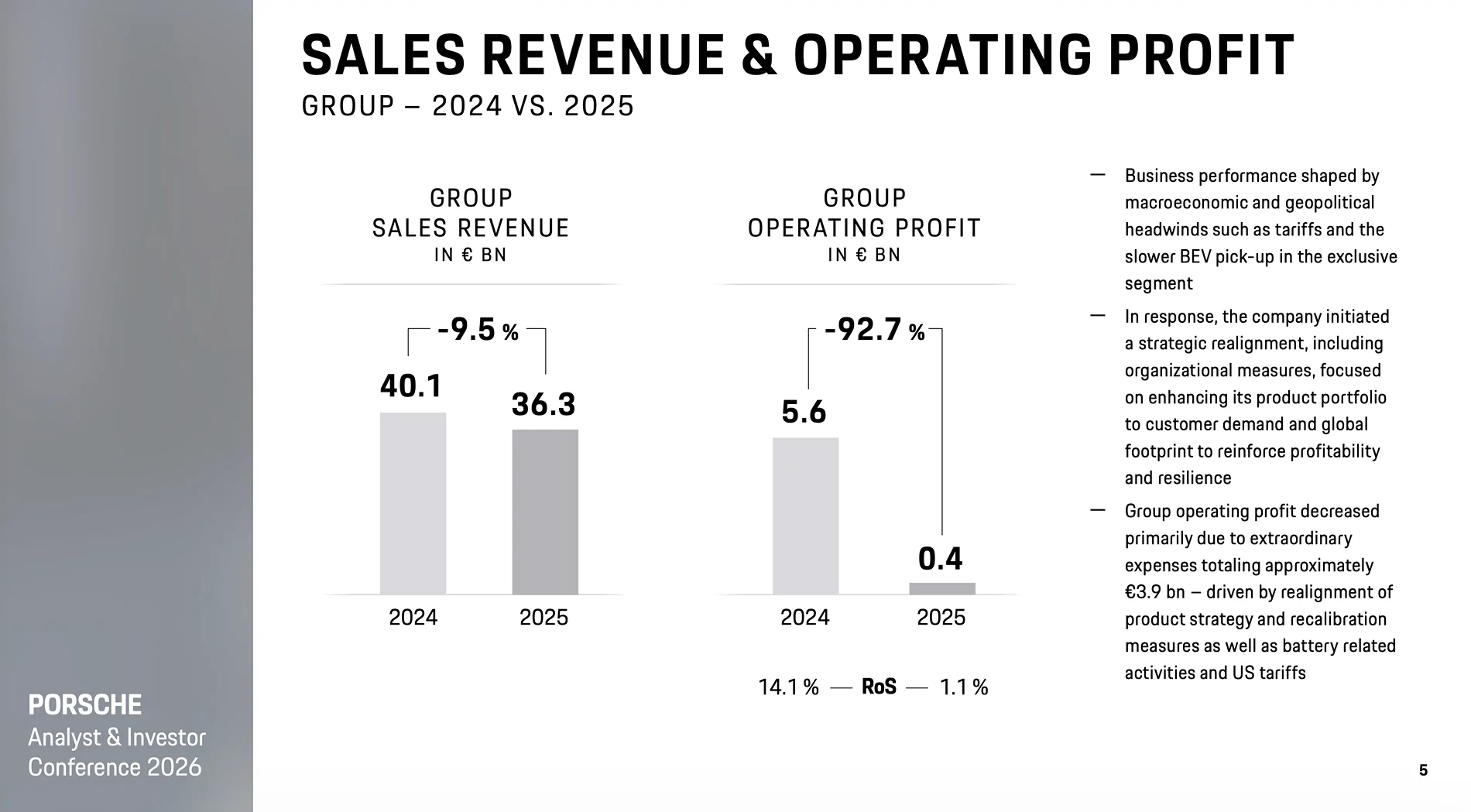
This single slide says it all. They kitchen sinked it and put all the issues on Blume. Clean sheet for Leiter going forward. They guided up and shows recovering profit incrementally. The full briefing is attached.
Car manufacturers must be convinced that the US market elimination of EV incentives and emissions rules and the Chinese competition means structural losses will commence indefinitely.
Although it is inherently suboptimal, BMW has engineered flexible platforms that can produce the same vehicle in ICE, hybrid, and EV, and that has allowed them some flexibility.
BMW is now forging ahead with new dedicated EV platforms, and at least initially has seen success. My opinion is the 400+ mile real world range is a key differentiator. I know that while most people don’t often need the capability, it does a lot to simplify EV long range travel fussiness. It also helps address travel in low temperature conditions.
Porsche, Honda, Ford, Stellantis and others seem to be in retreat when they need to innovate or become irrelevant.
In Porsche’s case sales were down just 2% but they eliminated the 718 with no available replacement, and the ICE Macan in the Euro-zone (due to cybersecurity rules?).
I guess that trending monthly data must have indicated they need to abandon already developed vehicles and cancel or rework them. I would guess many people who had any interest in an EV, pulled their transaction forward to capture the $7500 incentive, which gutted sales for several months hence.
That combined with US Tariff uncertainty and unpredictability made North America a losing proposition. That dynamic is likely to continue for the next 2 years, possibly more.
It does seem more worthwhile to release the 718 EV and also evolve it as necessary, as the investment is largely already expended and can still produce a return.
However I’m just a dope that has little to no visibility into their projections, and what they pitched lacks trend detail and structural cost information.
To see financials like this and the CEO doubling down on making Porsche more exclusive (i.e. expensive) is idiotic. A base Taycan starts at $105k with 400 hp, and a BYD Han L has 1000 hp and costs $30k with far better tech. Subsidy or not, Porsche is just digging their heels in and hoping things improve. Hope is not a strategy.
The US political climate is hot garbage right now with our idiot-in-chief doubling down on more oil and ICE cars. He won't be here forever and hopefully the next leader is more forward thinking. EVs are the future whether anyone wants to admit it or not. Everyone should be working on creating better batteries, better charging infrastructure (including at home), and streamlining manufacturing to cut costs.
I don't think Porsche's strategy update is such a bad thing and certainly it's not too surprising given the realities of where they find themselves.
I also don't think that too much is changing – Porsche are not pulling back from EVs. They are adjusting to a longer adoption timeframe than they hopped for in 2019.
Firstly their 911 ICE product continues to sell very well. The statements made by Porsche are providing reassurance to these buyers that their purchase will be supported in the long term and that Porsche are committed to ICE and hybrid for the long term. You can buy a 911 today with confidence.
They have to support one of their most profitable and best selling models and one they are in no rush to make a BEV version.
When it comes to the rest of the range, Porsche have BEV's in 4-door saloon, medium-sized SUV and large-sized SUV. They have stated that they remain committed to release a 2-door BEV – though it is obvious that is delayed and they have very noticeably not hinted at a release timeframe. If it was very soon, we'd have heard.
They are setting up investor expectations – to no longer be expecting 80% of their car sales in 2030 will be EVs. They no longer think that is likely, but that doesn't mean they are no longer committed to BEVs.
I don't think they "want it all to just go away".
As for pricing, many of the commentators on that topic are from the US – where they have been used to being in the cheapest market for Porsche's for decades. There has never been a market where you could pick up a Porsche for less.
For many of us European's Porsche has always been a very much more expensive proposition. It has never been particularly in reach. Here in Ireland, a 911 Targa starts at €302k (US$347,000) before you add a single option to the build – nearly double the cost it would be in the US.
I think Porsche are signalling that they are going to push the cost of 911s up in the US to European pricing. I think they might even be signalling that they are comfortable with reduced volumes of vehicle deliveries (at individual higher prices).
As for EV's – for sure they face potentially very compelling competition from China and even from other European countries (and in the US, from the likes of Rivian, etc).
Can Porsche continue to differentiate in a marketplace where 750kw/1000hp cars are "the normal"? I know many on this forum think not. But they sold a lot of 911s over the years when cheaper and powerful American muscle cars were widely available and popular.
I think we're in for an interesting time. But if you are enthusiastic about BEV's from Porsche – not sure what you have to be worried about – other than affording them!





 Quality over quantity while expanding on quantity and lowering quality to make cars for less