Sponsored

Taycan Wheel Efficiency

AutobahnGTS

Member
First Name
Lars
Joined
Mar 28, 2023
Threads
1
Messages
23
Reaction score
28
Location
germany
Vehicles
Taycan GTS, Model S 100D, Model 3P
Country flag
Hey there.
I am looking into winter wheels for my Taycan for next season, and for me, the most important factor here is efficiency. Of course I won‘t choose a terribly ugly wheel for a few miles more or less in range, but differences can be much, much greater!

WLTP, the equivalent to the EPA, used in Europe, gives range and efficiency of vehicles in various specs (so ranges of efficiency from the most efficient to least efficient spec possible). However, it is hard to tell what the most efficient spec is, and what lies in between.

I have played around with the range indicator tool on Porsche‘s own website, but can‘t really say it is of much help. The difference between wheels of the same size is around 2-3km in range. For my car, the „S Aero Wheels“ will offer 2k more range than the „Turbo Aero Wheels“. However on the 4S, the gap is the same, but reversed.
If this was about 2 or 3k, I really wouldn’t talk about it in the first place.. Choosing the 21“ Mission E wheels indicates 22km less range than the most efficient 20 inch wheels. And even that is surprisingly low. Looking into other cars, the gaps can be massive, especially at higher speeds.

A few examples: https://jesmb.de/9668/
The difference of the most efficient and the least efficient 20 inch rim is indicated at 44km (771 v 727k) by the WLTP on the EQS 450+. That particular 20“ wheel is also less efficient than most 21“ rims they offer. The most efficient (19“) rim and least efficient (22“) rim are separated by as much as 101km (obviously that‘s not real range, as is 771km, but it might be true relative to the real range, and even be exacerbated at higher speeds).

Same for the Tesla Model S. For WLTP, the range given on the 19“ rim is 723km vs 634km on the 21“.
Smaller wheels are generally more efficient, and more closed wheels are generally more aerodynamic, I get that. But you see that two wheels of the same size can vary vastly in efficiency, hence this thread.

So, long story short: is there any information of which wheels give what range on the Taycan, that is more reliable than their range calculator (where the numbers are reversed depending on which car you choose, and where the 19“ are less efficient than the 20“)? Is there an „agreed upon“ most aero wheel set? Are there any particularly efficient aftermarket wheels?

Thanks in advance.
Sponsored

 

f1eng

Well-Known Member
First Name
Frank
Joined
Aug 19, 2021
Threads
48
Messages
4,765
Reaction score
8,335
Location
Oxfordshire, UK
Vehicles
Taycan CT4S, Ferrari 355, Merc 500E, Prius PHV
Country flag
So, long story short: is there any information of which wheels give what range on the Taycan, that is more reliable than their range calculator (where the numbers are reversed depending on which car you choose, and where the 19“ are less efficient than the 20“)? Is there an „agreed upon“ most aero wheel set? Are there any particularly efficient aftermarket wheels?

Thanks in advance.
I haven’t seen any Taycan specific data but having tested a few F1 wheels for drag there are some clear general indications.

Narrower wheels have less drag, I am sure this is the reason of the wheel choice of the BMW i3, though they were made fun of by non-technically minded enthusiasts.

After that having the side like a flat disc is better than spokes and the more blocked the through flow is the lower the drag (and the worse the brake cooling, probably only important in racing)

So the 19” Taycan wheels being narrower and flatter with smallest holes will be best, the 21” with fewest holes next and the 21” wheels which are for styling not efficiency, like Mission E or Cross Turismo will be the worst.

It will be the same on all models so I am baffled why the range calculator doesn’t show it.
 

mystermykee

Well-Known Member
Joined
Mar 30, 2022
Threads
6
Messages
641
Reaction score
442
Location
Bay Area
Vehicles
9j1, 9y0 hybrid, 992.1
Country flag
I wonder at what point does wheel weight overcome the drag of the wheel? I would love to mount BBS FI-Rs, those suckers are light! But very spokey and holey...heh.
 
OP
OP
AutobahnGTS

AutobahnGTS

Member
First Name
Lars
Joined
Mar 28, 2023
Threads
1
Messages
23
Reaction score
28
Location
germany
Vehicles
Taycan GTS, Model S 100D, Model 3P
Country flag
I wonder at what point does wheel weight overcome the drag of the wheel? I would love to mount BBS FI-Rs, those suckers are light! But very spokey and holey...heh.
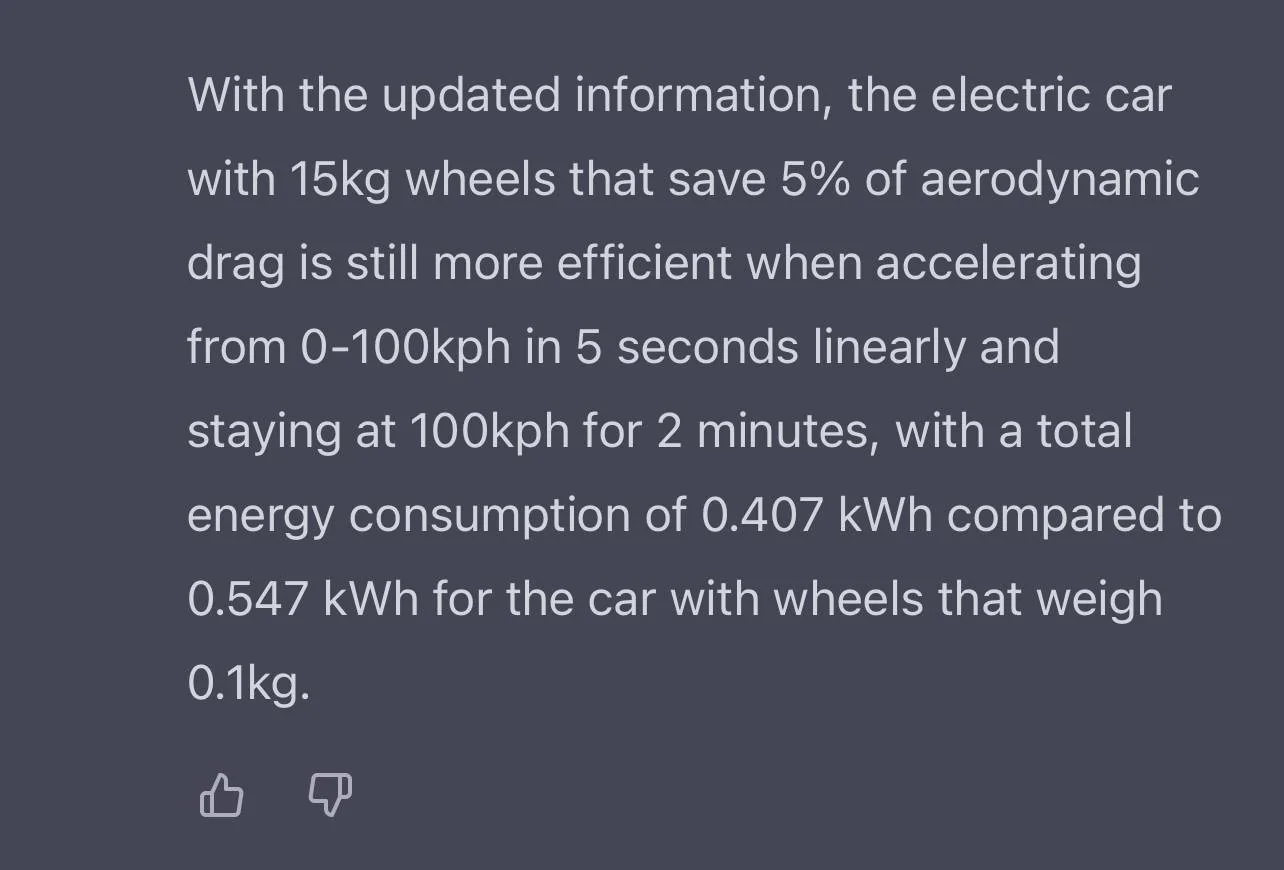
I am not a physicist, but I am a completely obsessed, competitive amateur cyclist. For a million years weight was all that mattered. Basically until the very point where It became feasible to measure the impact of aerodynamics. In cycling, aero trumps weight basically always. The only application where weight becomes more relevant is very steep climbs at around 6% grade for amateurs, and 8% grade for pros. Why the difference? Because pros go as fast on an 8% grade, as strong amateurs do on a 6% grade…

What can we extrapolate from all of this? I highly doubt that there is any weight, at which weight beats aero in terms of efficiency. Cars are significantly faster than bikes, and even for bikes weight is pretty secondary. So with the effects of aerodynamics increasing to the square, whereas the the effects of weight only increase linearly, and aerodynamics mattering ALWAYS, while weight has hardly any impact on efficiency when driving on the flat and not braking and accelerating like crazy (a minimal effect on RR, which is less than 8% of total drag to begin with - the added inertia needed to overcome when accelerating can partly be recouped by regen/ sailing), you‘d probably be less efficient, even if the rims had zero weight.

i know people like to attribute these magical properties to rotating masses and unsprung weight, but my guess is: impossible to gain anything measurable from lighter wheels in normal everyday application.

if someone can correct me, I am more than willing to learn.

Edit:
ChatGPT also agrees, although math problems are not its‘ forte:
Porsche Taycan Taycan Wheel Efficiency 342A748D-E8FC-4A1B-9532-9B2077AC5C3C
 
Last edited:

mystermykee

Well-Known Member
Joined
Mar 30, 2022
Threads
6
Messages
641
Reaction score
442
Location
Bay Area
Vehicles
9j1, 9y0 hybrid, 992.1
Country flag
I am not a physicist, but I am a completely obsessed, competitive amateur cyclist. For a million years weight was all that mattered. Basically until the very point where It became feasible to measure the impact of aerodynamics. In cycling, aero trumps weight basically always. The only application where weight becomes more relevant is very steep climbs at around 6% grade for amateurs, and 8% grade for pros. Why the difference? Because pros go as fast on an 8% grade, as strong amateurs do on a 6% grade…

What can we extrapolate from all of this? I highly doubt that there is any weight, at which weight beats aero in terms of efficiency. Cars are significantly faster than bikes, and even for bikes weight is pretty secondary. So with the effects of aerodynamics increasing to the square, whereas the the effects of weight only increase linearly, and aerodynamics mattering ALWAYS, while weight has hardly any impact on efficiency when driving on the flat and not braking and accelerating like crazy (a minimal effect on RR, which is less than 8% of total drag to begin with - the added inertia needed to overcome when accelerating can partly be recouped by regen/ sailing), you‘d probably be less efficient, even if the rims had zero weight.

i know people like to attribute these magical properties to rotating masses and unsprung weight, but my guess is: impossible to gain anything measurable from lighter wheels in normal everyday application.

if someone can correct me, I am more than willing to learn.

Edit:
ChatGPT also agrees, although math problems are not its‘ forte:
342A748D-E8FC-4A1B-9532-9B2077AC5C3C.webp
Thanks for the informative response! You're right, better aero will always trump weight in terms of efficiency. However, for everyday driving you'll instantly notice the effects of lighter wheels--accel, braking, turn in, cornering etc. The only thing you'll notice with better aero wheels is range.

I was just trying to get a feel where the tradeoff is how light a wheel is compared to how much worse the aero is from say a baseline of Mission E wheels.
 
OP
OP
AutobahnGTS

AutobahnGTS

Member
First Name
Lars
Joined
Mar 28, 2023
Threads
1
Messages
23
Reaction score
28
Location
germany
Vehicles
Taycan GTS, Model S 100D, Model 3P
Country flag
However, for everyday driving you'll instantly notice the effects of lighter wheels--accel, braking, turn in, cornering etc. The only thing you'll notice with better aero wheels is range.
Oh, wow. This is really eerily similar to bicycle forum discussions.
I am really unsure that lighter wheels make a 2200kg car feel that different. But I have never tried myself, so I cannot make an educated comment.

My two cents on aerodynamic wheels over open rims beyond efficiency:
- more silent
- shields brakes from water and debris
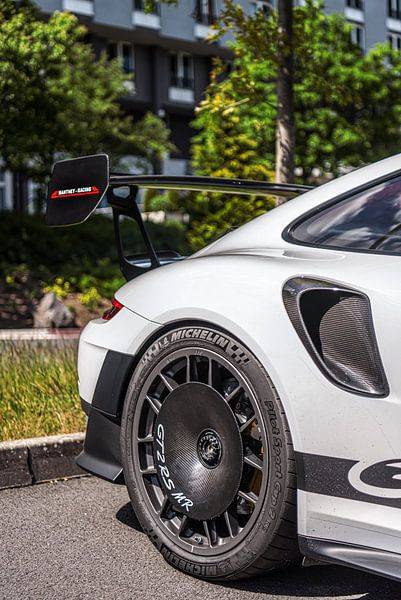
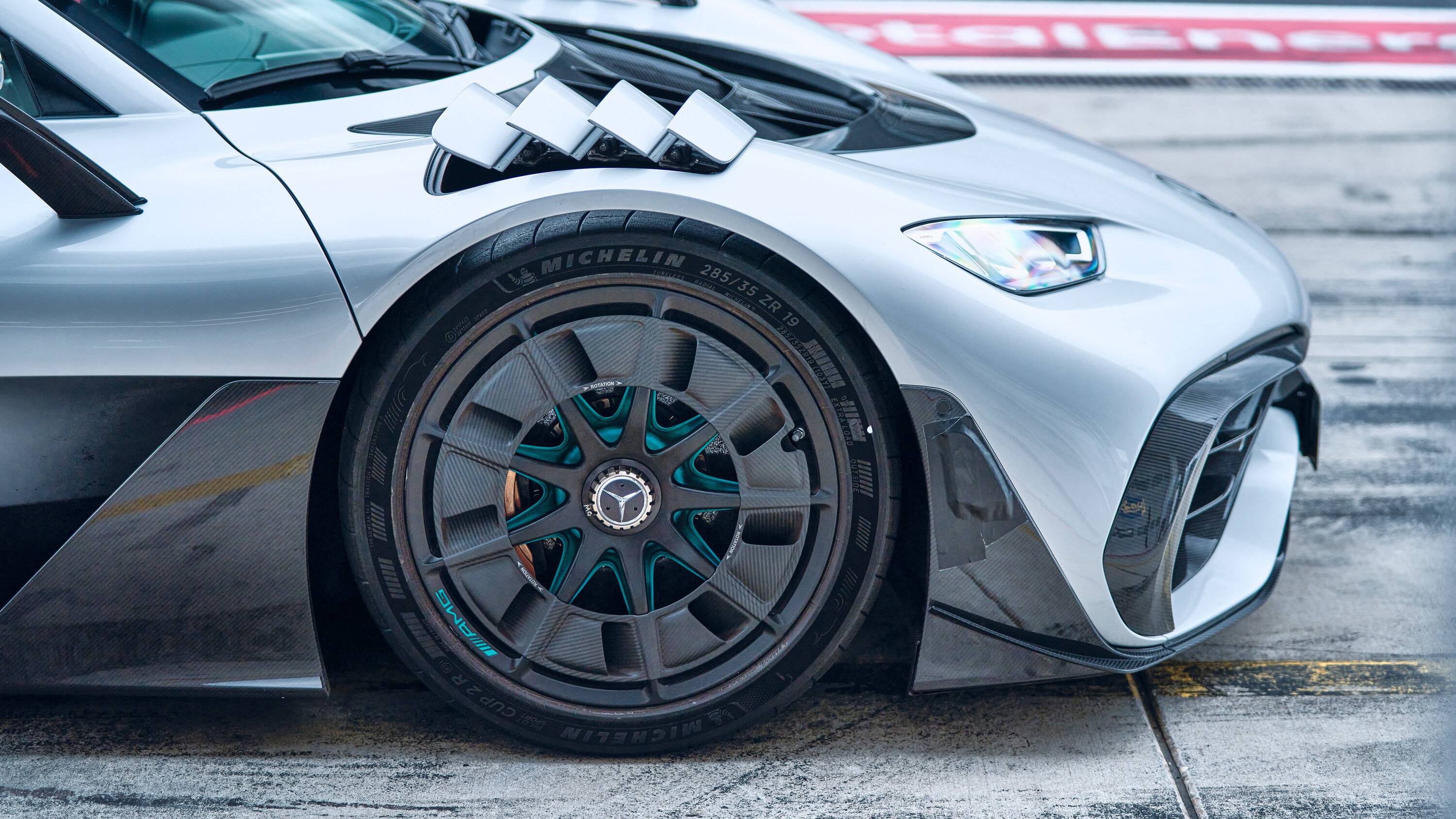
- when not accelerating from low speeds, the added aerodynamic benefit might offset the effects of inertia for acceleration. The two fastest road cars to ever lap the Nordschleife had Aerodynamic wheels/ wheel covers. Although the carbon covers on the Manthey GT2 RS probably hardly added a kg, both iterations added rotational mass. Apparently they figured it was faster still:

Porsche Taycan Taycan Wheel Efficiency 3D98350D-28AA-4AE6-9A8D-F693426AF11D
Porsche Taycan Taycan Wheel Efficiency EF72650E-18B1-4521-887E-F0EAC81A02BF
Sponsored

 
Last edited:


Top