Sponsored

Need a Class Action Lawsuit - Porsche Mobile Charger

Status
Not open for further replies.

whitex

Well-Known Member
Joined
Jul 30, 2021
Threads
87
Messages
8,193
Reaction score
7,236
Location
WA, USA
Vehicles
2023 Taycan TCT, 2024 Q8 eTron P+
Country flag
Could be hiding a time travel device that transports my car to the Cretaceous period and allow the car to be eaten by a T-Rex. That could damage the battery.
I would think battery damage would be the least of the word's problems in this case.
Sponsored


Scotty

Well-Known Member
First Name
Scott
Joined
Oct 7, 2020
Threads
35
Messages
187
Reaction score
230
Location
Los Angeles
Vehicles
Taycan4s
Country flag
here is the question:

Will using Charge Point public EV chargers at my local mall void my EV's battery warranty.

ask them that.
It wont - you are missing the entire issue. The issue only relates to mobile chargers at home not public stations. All public stations operate under a different set of specifications and standards that EV manufacturers have agreed upon. One has nothing to do with the other. Prove me wrong email Porsche re mobil chargers for the home. I will also send them a email lets compare their responses to see if they tell both of us the same thing
There is no difference between a mobile EVSE and a non-mobile EVSE. If you hang it on the wall, it's no longer mobile (also applies to PMC+/PMCC - Porsche sells a box mount).
per Porsche: The charger is designed for use in the private and semi public sector e.g.on private property or in a company parking lot. The Porsche mobile charger over heats/ cant handle 40 amps and must operate at 20 amps and it now takes twice as long to charge the car. In addition it could melt you cars socket. You are hung up on the words Porche uses to describe their charger. They named it a mobile charger because you can move it and take it with you. Fact is it is defective and does not work as designed and sold originally.
 

daveo4EV

Well-Known Member
First Name
David
Joined
Jan 28, 2019
Threads
192
Messages
7,003
Reaction score
10,473
Location
Santa Cruz
Vehicles
Cayenne Hybrid, 911(s) GT3/Convertable
Country flag
All public stations operate under a different set of specifications and standards that EV manufacturers have agreed upon.
incorrect - they all operate on the SAME J-1772 standard as residential mobile/non-mobile EVSE's. There is no alternative standard for them to support - and they support cars as old as the 2011 Nissan Leaf which only has the most basic of J-1772 support and no "newer" hypothetical standard.

the only difference tends to be AC power is 208V for most commercial installs vs. 220-240V for standard North American residential installs.

there is no functional difference between a public L1/L2, mobile EVSE and a wall mounted one - and both effectively use only 3 wires - 2 electrical high voltage lines and 1 electrical ground to connect to the home's grid power supply. The "mobile" distinction refers to if there is a NEMA male plug and it's general size/weight - otherwise it's hung on the wall and hardwired and therefore not mobile.

YOu are sewing confusion by stating Porsche does not support using non-Porsche J-1772 EVSE's and it will void your battery warranty - there is no way this is true or enforceable and given Porsche's recent admission that their version of a J-1772 EVSE sucks is people's only option to have a reliable 9.6 kW EVSE in their home.
 
Last edited:

Scotty

Well-Known Member
First Name
Scott
Joined
Oct 7, 2020
Threads
35
Messages
187
Reaction score
230
Location
Los Angeles
Vehicles
Taycan4s
Country flag
keep in mind:
  • Porsche has known about this issue for at least two years now - https://www.taycanforum.com/forum/threads/nema-14-50-supply-cable-heat-data.1940/
  • the solution is probably a new 15" cable with 8/6 AWG wire instead of the 10 AWG wire
  • they have decided to do nothing even though the cable is modular and easily swapped by design
  • the COG's on a 6/8 AWG wire vs. the 10 AWG wire they are currently supplying has got to be trivial (less than $10 per cable worse case - probably way less)
    • design and new manufacturing would be some upfront costs, but the COG's have got to be trivial once design is approved and in production
  • the European version has far fewer issues with different supply cables - so the core unit may not be horrible
  • this unit is like $3000'ish or 5x the cost of comparable units with no issues
it seems like they don't want to refund the units, and they don't want to fix the units, and they are in this situation because they cheap'd out on 15" of wire that is the wrong AWG specification.

it confuses me why they are not addressing this more directly - and costs for distributing new power supply cables - while not cheap - has got to be cheaper than the labor costs for software updates that they can't do OTA so your vehicle has to be in the dealers service bay for 3 days while a tech babysitting USB-flash drive update proceedures while a 12V external power supply is attached to keep the car alive during the brain transplant.
It would be very helpful when I go to arbitration if you could provide me the reference source that Porsche used 10 awg wire instead of 6/8. Any help in finding reference sources that state 10 awg wire should not have been used . Other then calling you as an expert witness I. would appreciate any help
 

daveo4EV

Well-Known Member
First Name
David
Joined
Jan 28, 2019
Threads
192
Messages
7,003
Reaction score
10,473
Location
Santa Cruz
Vehicles
Cayenne Hybrid, 911(s) GT3/Convertable
Country flag
It would be very helpful when I go to arbitration if you could provide me the reference source that Porsche used 10 awg wire instead of 6/8. Any help in finding reference sources that state 10 awg wire should not have been used . Other then calling you as an expert witness I. would appreciate any help
any reference material is noted in the thread I've linked - including engineering tables showing expected temperature deltas above ambient for variouis AWG wire @ various AMP flows…

from the thread:
  • post #1 shows power supply EVSE temps in 64F ambient conditions after 2 hours of use
  • post #37 shows 10 AWG embossed on the cable
  • post #78 shows a standard EE engineering table with expect temperature rise for variousAWG wire at various loads
    • various forum members who claim to be EE's assert the observed thermal performance of porsche's power supply cable exactly match predictions/expectations/published-standard-engineering-tables for 10 AWG wire at 240V/40 amps - YMMV
  • post #111 Aug. 11, 2020 - is an assertion of an "Offiical" Porscheresponse
    • at that time they acknowledge the issue and recommended using the unit at a lower AMP settings to avoid the thermal issues discussed.
    • customer complaint: your cable gets too hot when used at 40 amps
    • porsche response: don't use our device at 40 amps
other EVSE's sold/manufactured/designed for North American use tend to ship with 6/8 AWG wire - Porsche is almost unique in the North American market with a 9.6 kW/40 amp EVSE shipping with 10 AWG wire for their 50/40 amp power supply cables - JBooster a recent NA entry also uses 10 AWG but uses multiple 10 AWG wires inside the power supply cable for better thermal characteristics according to them…

I have not disassembled a Porsche supply cable to confirm it's internal design - nor would I be qualified to comment if I did.

a thorough read of the afore mentioned thread from 2020 illuminates relatively "informed" discussion of the issue as it was discovered over 2 years ago - it would be my source material for any discussion

conclusions of the thread are that AWG is a poor choice for a 40 AMP 9.6 kW load due to predictable thermal stress under that load, but it's not electrically unsafe and to date I do not believe there is evidence of the power supply cord failing - rather we've had "socket" failures when the cord is combined with a low-qualty/cheap NEMA socket

making the case that 10 AWG wire "is the problem" is going to be an uphill battle as their actual EE experts can assert with authority that there is sufficient margin for electrically safety - and unless you have a power supply cable with melted insulation in your hand - well I don't see it happening in your favor.

my opinion is that yes the cord can be very very very warm/hot - but by itself is not a problem - but it certainly will not help the situation when it gets really really warm/hot and it is also being used in conjunction with a cheap/poorly-fitting/poorly-connected NEMA socket - no single component is "bad" but when combined with each other - well…problems can ensue…

but the socket choice by the owner is _NOT_ Porsche's problem - it's out side their control - and that is the core assertion of this update - that their units are not safe with crappy sockets that they assert are endemic in North American EVSE residential installs…

as to porsche "using" 10 AWG wire - well the AWG wire rating is "embossed/stamped" into the insulation on the power supply cable from porsche - simple inspection of any PMC+/PMCC supply cable will indicate 10 AWG.

as for calling me as an expert witness - I only have a DIY understanding of this stuff from 12 years of EV ownership, but my background/credentials are Computer Science not EE - so I doubt I could be designated as "an expert" - it doesn't mean I'm wrong, it just means I can be undermined due to lack of formal training or any commerical experience in an EE related capacity - I'm a well informed EV enthusiast - but not an expert by any stretch of imagination - and lack deep formal understand of all the characteristics for EE issues - I'd be easily tripped up by any broad questioning

I however feel I have a deep customer level understanding of this single particlular issue and can make assertions based on observed differences in competitive products and easily gathered thermal data using consumer level temperature monitoring devices.

But I'm not qualified nor would make claim that Porsche should not have used 10 AWG wire - my observed data is in my case their supply cable achieves temperatures of at least 166F in normal use (well and safely under the 105C rating on the cable insluation) - and other EVSE's I've used running at similar capacities do not reach similar temperatures vs. the Porsche units. I then speculate maybe a 8/6 gauge wire like the other guys use would offer lower temps…but that's the limit of my understanding.
 
Last edited:


Reg

Well-Known Member
Joined
Nov 17, 2019
Threads
55
Messages
1,352
Reaction score
1,635
Location
West Coast, The Best Coast
Vehicles
Taycan 4S
Country flag
I looked at the warranty for the 2020 Taycan. Here is ALL it says about the battery warranty and charger:

Use of incompatible charging devices.
It does NOT say anything about only using a Porsche PMCC or even only a Porsche approved or whatever other nonsense people claim.

So please re-direct your pitchforks for the service people who are spreading incorrect info, rather than assuming that Porsche Corporate is doing this.
 

daveo4EV

Well-Known Member
First Name
David
Joined
Jan 28, 2019
Threads
192
Messages
7,003
Reaction score
10,473
Location
Santa Cruz
Vehicles
Cayenne Hybrid, 911(s) GT3/Convertable
Country flag
Any help in finding reference sources that state 10 awg wire should not have been used.
none of the EE's on the original thread made the claim that 10 awg wire "should not have been used"

rather use of 10 AWG wire in a power supply cable rated for 240V/40 amp will have an expected temperature delta/rise above ambient that is quite toasty - but not unsafe - and Porsche's use/choice of 105C rated insulation is a particuarily good choice as that is a "gold standard" in that they are "better" than the normal 100C temperature goal…

they are using thin gauge wire for the task, but not unsafe, and then wrapping that wire in insulation that has excellent thermal rating to deal with any excess heat…getting too hot is not "unsafe" - brake pads get really really hot but they are designed to handle the thermal loads…

porsche's choice of 10 AWG wire is a "interesting" decision given predictable thermal characteristics - but claiming it "should not be used" is a more difficult bar to jump over - it's fine as long as combined with the insulation choice the cable itself won't fail…

and to date I'm unaware of supply cables "failing" - but we have melted "sockets" where the cable interfaces with the customer's NEMA sockets - cable problem? or socket problem? Not qualified to comment.

You need to combine the expected temperature rise with your insulation/materials design (for this I am deeply unqualified and lack even a passing DIY credential) since if you choose say 14 AWG wire at 60 amps - but wrap it in insulation that can withstand 400C temperature rise - it's still safe because it won't melt unless it gets above 400C because the insulation will 'contain' the wire and absord the thermal load without failing…

10 AWG wire is a "poor" choice for a mobile EVSE since expected temperature rise is predictably high and therefore the power supply cable can be very hot to the touch.

but it won't fail because Porsche's choice of insulation is rated for 105C (again embossed on the cable insulation)

your assertion of "should not be used" in my mind translates to "will be unsafe if used"

no one is going to make the claim based on the use of 10 AWG wire that's it's unsafe…it's just an interesting choice given it's temperature rise.

with out a melted cable in your hand proving it failed -well it's a very very very high mountain to climb that 10 AWG is the core problem here

and I have always stated it's a "poor" choice, but not an unsafe choice - so far I've not seen any evidence contradicting that.
 
Last edited:

daveo4EV

Well-Known Member
First Name
David
Joined
Jan 28, 2019
Threads
192
Messages
7,003
Reaction score
10,473
Location
Santa Cruz
Vehicles
Cayenne Hybrid, 911(s) GT3/Convertable
Country flag
none of the EE's on the original thread made the claim that 10 awg wire "should not have been used"

rather use of 10 AWG wire in a power supply cable rated for 240V/40 amp will have an expected temperature delta/rise above ambient that is quite toasty - but not unsafe - and Porsche's use/choice of 105C rated insulation is a particuarily good choice as that is a "gold standard" in that they are "better" than the normal 100C temperature goal…

they are using thin gauge wire for the task, but not unsafe, and then wrapping that wire in insulation that has excellent thermal rating to deal with any excess heat…getting too hot is not "unsafe" - brake pads get really really hot but they are designed to handle the thermal loads…

porsche's choice of 10 AWG wire is a "interesting" decision given predictable thermal characteristics - but claiming it "should not be used" is a more difficult bar to jump over - it's fine as long as combined with the insulation choice the cable itself won't fail…

and to date I'm unaware of supply cables "failing" - but we have melted "sockets" where the cable interfaces with the customer's NEMA sockets - cable problem? or socket problem? Not qualified to comment.

You need to combine the expected temperature rise with your insulation/materials design (for this I am deeply unqualified and lack even a passing DIY credential) since if you choose say 14 AWG wire at 60 amps - but wrap it in insulation that can withstand 400C temperature rise - it's still safe because it won't melt unless it gets above 400C because the insulation will 'contain' the wire and absord the thermal load without failing…

10 AWG wire is a "poor" choice for a mobile EVSE since expected temperature rise is predictably high and therefore the power supply cable can be very hot to the touch.

but it won't fail because Porsche's choice of insulation is rated for 105C (again embossed on the cable insulation)

your assertion of "should not be used" in my mind translates to "will be unsafe if used"

no one is going to make the claim based on the use of 10 AWG wire that's it's unsafe…it's just an interesting choice given it's temperature rise.

with out a melted cable in your hand proving it failed -well it's a very very very high mountain to climb that 10 AWG is the core problem here

and I have always stated it's a "poor" choice, but not an unsafe choice - so far I've not seen any evidence contradicting that.
the NEMA 14-50/6-50 supply cables have been in VW/Audi/Porsche supply chain for years (since early hybrids and the 918 spyder) - originally all of those hybrids (and including up to today) are 32 amp EV's - but the cables are an interface to a 50/40 amp circuit - pulling 32 amps (or less) from a 50/40 amp circuit is 100% safe, effective and no issue…and 10 AWG wire for a 32 amp application is also an excellent choice…

the eTron/Taycan is the first EV from VW/Audi/Porsche to push 40 amps across this cable...a cursory review of the pre-existing cable design with 105C rated insulation would probably yield an engineering "response" of yeah it will be fine - won't exceed insulation limits so we're good

no need to redesign the cable…and we can use the warehouse we have full of them for the Taycan's EVSE - and the EVSE itself has always been a 9.6 kW EVSE so we're good to go with this pre-existing cable already in the supply chain…cause we all know how much VW/Audi/Porsche LOVE re-using existing parts from their highly optimized supply chain…

redesigning this cable was/IS the path of MOST resistance and would only have been considered if various qualified EE personal reviewed the specifications and could make a compelling case that that existing cable design/specifications were insufficient to the 50/40/9.6 kW task…and no EE that I've encountered would make the claim that the 10 AWG wire is not sufficient to the task…

it requires a more nuanced review to realize the cable is going to get really really hot (but still not be electrically unsafe or fail) and that might have some bad "perception" issues for people that may expect to handle the power supply cable on a "mobile" EVSE - it's a product design/expectations perception problem, not an electrical safety/failure issue in my opinion.
 
Last edited:


TDinDC

Well-Known Member
Joined
Jun 25, 2022
Threads
21
Messages
1,066
Reaction score
1,277
Location
Washington, DC, USA
Vehicles
'22 Taycan 4S Cross Turismo, '06 Club Coupe (#48)
Country flag
With sincere respect to all, I do not think that this needs to be overthought. From my humble perspective, I think the following is all that matters:

1. Warranty Claim followed by arbitration if necessary is a sensible approach IF you care enough and have the time, which is far less than what would be needed for litigation and more likely to get a favorable result.

2. The sole thing that matters is that Porsche recommends that you only use 50% of the capacity they advertised when you bought it. Had you known that they were only recommending 50% of capacity, you would not have bought, because the capacity claim carries an implicit endorsement that the product can be used up to its full capacity.

3. It is irrelevant whether I could override the 50% limit because Porsche is recommending that I do not do so.

4. Porsche cannot both expect me to rely on their recommendations and ignore them in order to get the capacity I purchased and expected to enjoy. For this reason, the actual ability of the product to perform is utterly irrelevant.

5. Either change the product so that you can again recommend that it is safe to use the capacity I thought I was buying or give me a refund.

That's all you need for arbitration. I wouldn't even talk about anything beyond this if they asked, because the recommendation is all that matters.
 

Scandinavian

Well-Known Member
First Name
Peter
Joined
Nov 3, 2019
Threads
52
Messages
3,904
Reaction score
3,549
Location
France
Vehicles
Taycan T, Aston Martin DB9, Porsche 996 C4 Cab, i4
Country flag
It wont - you are missing the entire issue. The issue only relates to mobile chargers at home not public stations. All public stations operate under a different set of specifications and standards that EV manufacturers have agreed upon. One has nothing to do with the other. Prove me wrong email Porsche re mobil chargers for the home. I will also send them a email lets compare their responses to see if they tell both of us the same thing
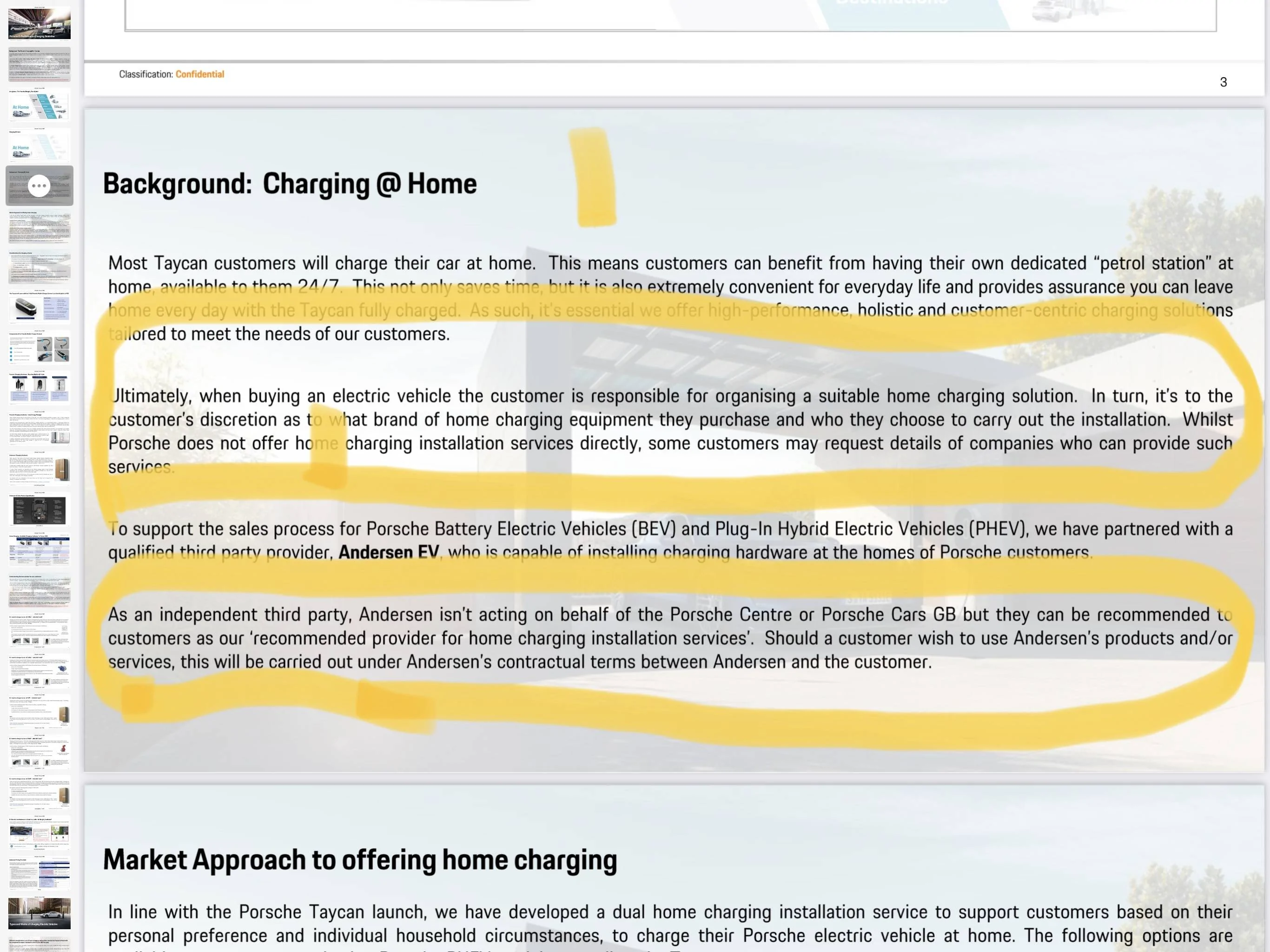
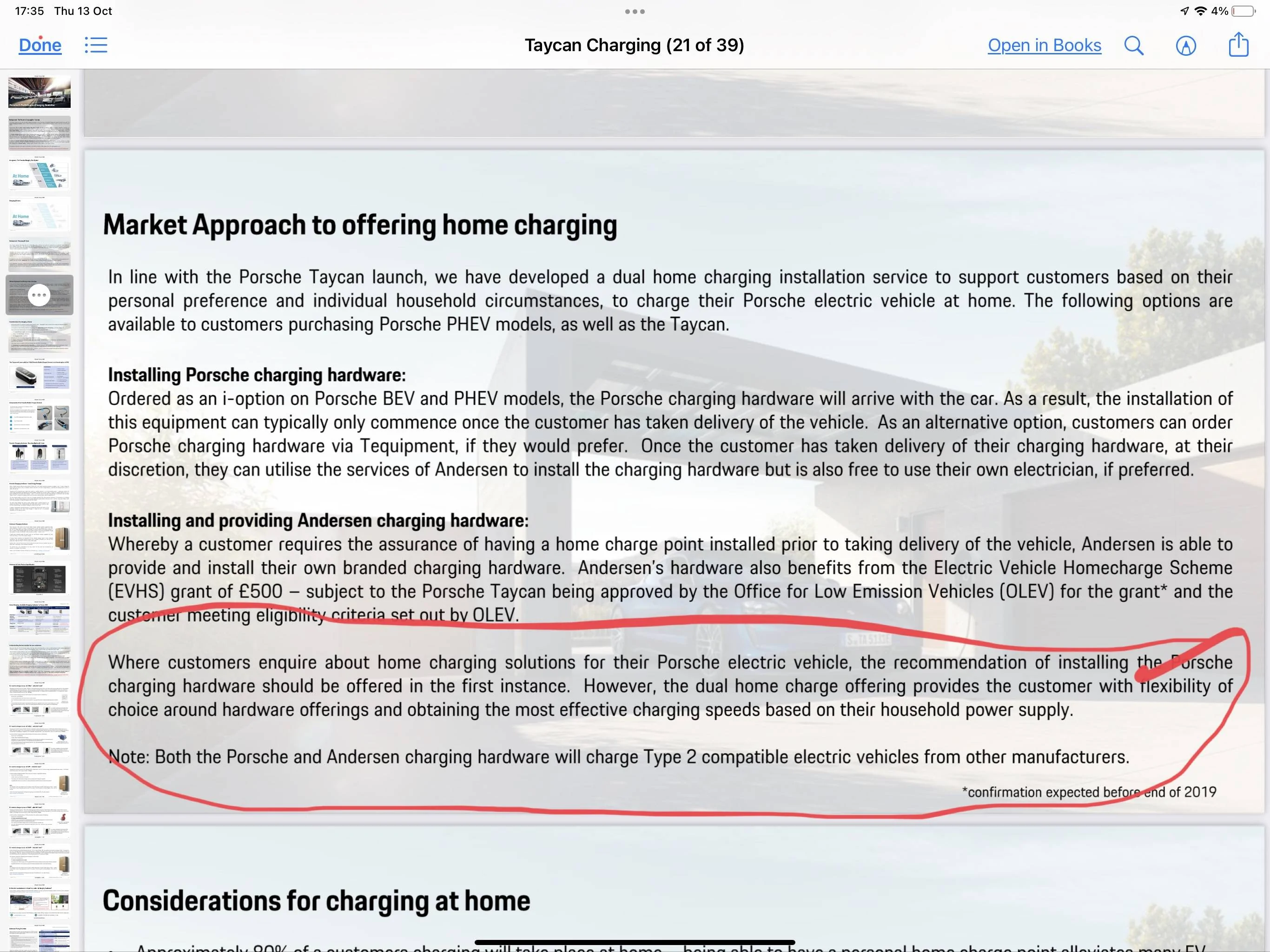
Just to show you how standardised the EVSE hardware is! Here is part of a Porsche presentation from the UK from 2019. I have taken two screen shots. Porsche UK and their dealers probably knew they had zero clue about home charging and had a recommendation to use Andersen EVSE for installation. Andersen in the UK just the other day went into bankruptcy and there seems to be a number of Porsche customers that went that route. In the slides there are three statements,
1. Porsche clearly state that ultimately it is the customers decision what home charging equipment the customer uses
2. They recommend Andersen to do an early installation before the car is delivered
3. They also state very clearly that both the Andersen and Porsche EVSE can charge any compatible EV!

There is absolutely nothing anywhere where Porsche are saying that the main battery warranty will be void if you use another home charger apart from Porsche. If your service manager states that, ask for it in writing.


Porsche Taycan Need a Class Action Lawsuit - Porsche Mobile Charger 3E203847-58D0-4FB4-89A1-0E135436072C
Porsche Taycan Need a Class Action Lawsuit - Porsche Mobile Charger E2D619C4-01D4-433A-B731-7D0767994AC4
 

Reg

Well-Known Member
Joined
Nov 17, 2019
Threads
55
Messages
1,352
Reaction score
1,635
Location
West Coast, The Best Coast
Vehicles
Taycan 4S
Country flag
With sincere respect to all, I do not think that this needs to be overthought....

3. Porsche is recommending that I do not do so.
Very good summary.

But I would just modify that statement to say "Porsche says there is a risk of fire if I do so". They have a little fire icon on the sticker they add. I know that is a bit more dramatic, but that certainly caught my attention far more than "recommended not to do".

For example, they also recommend not charging to 100% for battery longevity, but if you lease the car, you may not care about the longevity...but everyone should care about the potential for fire ;)
 

daveo4EV

Well-Known Member
First Name
David
Joined
Jan 28, 2019
Threads
192
Messages
7,003
Reaction score
10,473
Location
Santa Cruz
Vehicles
Cayenne Hybrid, 911(s) GT3/Convertable
Country flag
Porsche's EVSE has always run too hot for my tastes…that doesn't mean it's unsafe
Other EVSE's I've owned do not run as hot as the Porsche EVSE for identical charging loads

Porsche's EVSE running hot but charging my vehicle to set % at set time is an identical result to other EVSE's running cooler and charging my EV to set % at set time…

up until Porsche nerf'd their EVSE the fact that it ran hotter was inconsequential to it's operation since it performed it's role

it was a curiosity that it was sooo much hotter for the same task vs others - but not unsafe or debilitating

but I never liked it - and because of it (and other issues) the PMC+/PMCC was never my recommended EVSE for anyone IRL or on the forums

but it was "included" with the vehicle "for free" so there was no reason to spend more/extra money on an alternate EVSE

but for me personally I prefer products that can do the job and not get too hot doing it - I once swapped an amplifier because it heated up my AV cabinet too much for one that did the same job but the cabinet temperature was much lower - was the lower temp amplifier better? proably not? Was the "too hot" amplifier unsafe -most definately it was safe - but I didn't like opening the cabinet and having a wave of heat greet me - so I swapped it for something less thermally challenging…

I've never felt the North American PMC+/PMCC is a quality product

this recent change doesn't help that opinion.

I prefer EVSE's that run cooler…

my recommendation has always been get an EVSE from someone other than Porsche - their North American product has always been a bit wonky.

Porsche has made some design choices for their North American product - their product runs hotter than the competition - but until recently that was only a perception issue vs. a functional issue…with the latest OTA update it's now a functional issue.

Porsche made their choices, the devices operates as it operates -I still do not believe it's grossly unsafe - anymore than any other EVSE when installed with a crappy/$2 NEMA plug-socket

but I never liked it or it's thermal profile…but it can do it's job and get as hot as it gets and 99.9% it's thermal profile will not matter - and most people never even notice as long as their vehicle is charged in the morning…

but for me - personally - I've made the choice to spend money on alternate EVSE's and once of the characteristics I value is their thermal performance - does it honestly matter - probably not…but it makes me happy that my elecrical devices don't get excessively warm while performing their duties.
 
Last edited:

Reg

Well-Known Member
Joined
Nov 17, 2019
Threads
55
Messages
1,352
Reaction score
1,635
Location
West Coast, The Best Coast
Vehicles
Taycan 4S
Country flag
There is absolutely nothing anywhere where Porsche are saying that the main battery warranty will be void if you use another home charger apart from Porsche. If your service manager states that, ask for it in writing.
The warranty for the battery only states:

Use of incompatible charging devices.
You don't even need to cite some presentation, just show them the actual warranty from Porsche.
 

TDinDC

Well-Known Member
Joined
Jun 25, 2022
Threads
21
Messages
1,066
Reaction score
1,277
Location
Washington, DC, USA
Vehicles
'22 Taycan 4S Cross Turismo, '06 Club Coupe (#48)
Country flag
Very good summary.

But I would just modify that statement to say "Porsche says there is a risk of fire if I do so". They have a little fire icon on the sticker they add. I know that is a bit more dramatic, but that certainly caught my attention far more than "recommended not to do".

For example, they also recommend not charging to 100% for battery longevity, but if you lease the car, you may not care about the longevity...but everyone should care about the potential for fire ;)
This is reasonable but not needed due to two important differences:

1. the recommendations about battery charging have not changed

2. they recommend that you do not regularly charge above 80%, but they recommend that you never use more than 50% of charger.

These are critical from my perspective
 

Reg

Well-Known Member
Joined
Nov 17, 2019
Threads
55
Messages
1,352
Reaction score
1,635
Location
West Coast, The Best Coast
Vehicles
Taycan 4S
Country flag
This is reasonable but not needed due to two important differences:

1. the recommendations about battery charging have not changed

2. they recommend that you do not regularly charge above 80%, but they recommend that you never use more than 50% of charger.

These are critical from my perspective
My point is there is a big difference between "not recommended" due to an inefficient outcome (lower battery life) and a fire.
Sponsored

 
Status
Not open for further replies.


Top