cometguy
Well-Known Member
- Joined
- Oct 18, 2018
- Threads
- 7
- Messages
- 358
- Reaction score
- 326
- Location
- New England, USA
- Vehicles
- '21 Taycan CT4; '18 Panamera 4 ST E-Hybrid (past); Cayenne 4 Electric (planned)

- Thread starter
- #1
I just completed a road trip from New England to Minnesota and back in my 2021 CT4, to see lots of family. I'm impressed with how well the DCFC infrastructure is being built out so very quickly (many of the sites I visited are less than a year old) and at how well they work, generally. I'm going to post more details on this thread in the near future regarding the actual charging sessions, as time permits, but I thought I'd give my first overall impressions here now.
First, the first-generation Taycan is a great road-tripper (as I noted in my 1900-mile road-trip report last month here). I hate that I only get 220-240 miles of range now in warm spring weather at 70 mph, but I never experienced anything approaching range anxiety -- despite DCFC stations being rather sparse in some areas that I traveled. The lack of range anxiety comes from being prepared ahead of time: I mapped out my westbound charging stops a week before I left on my trip, and I followed them without deviation all the way to Minnesota (with one exception: I added in the West Salem site out of curiosity as it was on my way and I needed to stop to use the restroom, even though I didn't need to charge then). My eastbound charging stops were planned on short notice (after I got to MN) because I had to make an initially unplanned family stop in NYC on the way home.
Kudos to PlugShare for this, without which I would be lost. I always post my charging reports on PlugShare to help others (and for me to refer to for future trips), because the reports of others help me also to choose where to stop and where not to stop.
I was able to charge all the way to Minnesota using my phone twice to initiate charging or to pay (Circle K), and on the way home I used my iPhone only twice to initiate charging (once at a Shell Recharge and once at a Tesla Magic Docks site -- both of which worked without issue).
I stopped at two hotels with onsite 240-volt charging; I couldn't get the Blink charger to work at one, but found out later that my credit card attached to the account had expired. The Tesla destination charger at my last hotel worked fine at no cost (plug-and-charge, no need for an app), and I keep a NACS-to-CCS adapter in my car for such possibilities on the road.
On this trip, I used EA much less than I did on my NC trip last month (percentage-wise), and I was impressed with most of the stops. EA worked fine when I used it, with one exception: plug-and-charge has always worked for me at EA, but at one site homeward bound this past week, plug-and-charge didn't work, and it took a while to get the reader to accept my Visa credit card (had to change chargers, too).
I note that at one station along the Ohio Turnpike on the way home (I-80), there was only one bar of reception on my Verizon Wireless iPhone -- not enough to even access PlugShare to post my report; if I'd had to use a phone app to charge there, I'd have been screwed.
My goal is to always charge without using my iPhone, whenever possible (and I'm able to do that 90%-95% of the time now, thankfully) -- plug-and-charge at EA, and RFID or credit cards everywhere else.
I have four RFID cards so far (Chargepoint, EVgo, Blink, Francis Energy), and they work better and faster and more easily than any phone app including Tesla's. What would be great, short of universal plug-and-charge, would be to have a universal RFID card for all stations. Using a smartphone/app to charge a car is just plain unacceptable as a requirement for the masses (and for me), just as it would be for pumping gas at a gas station.
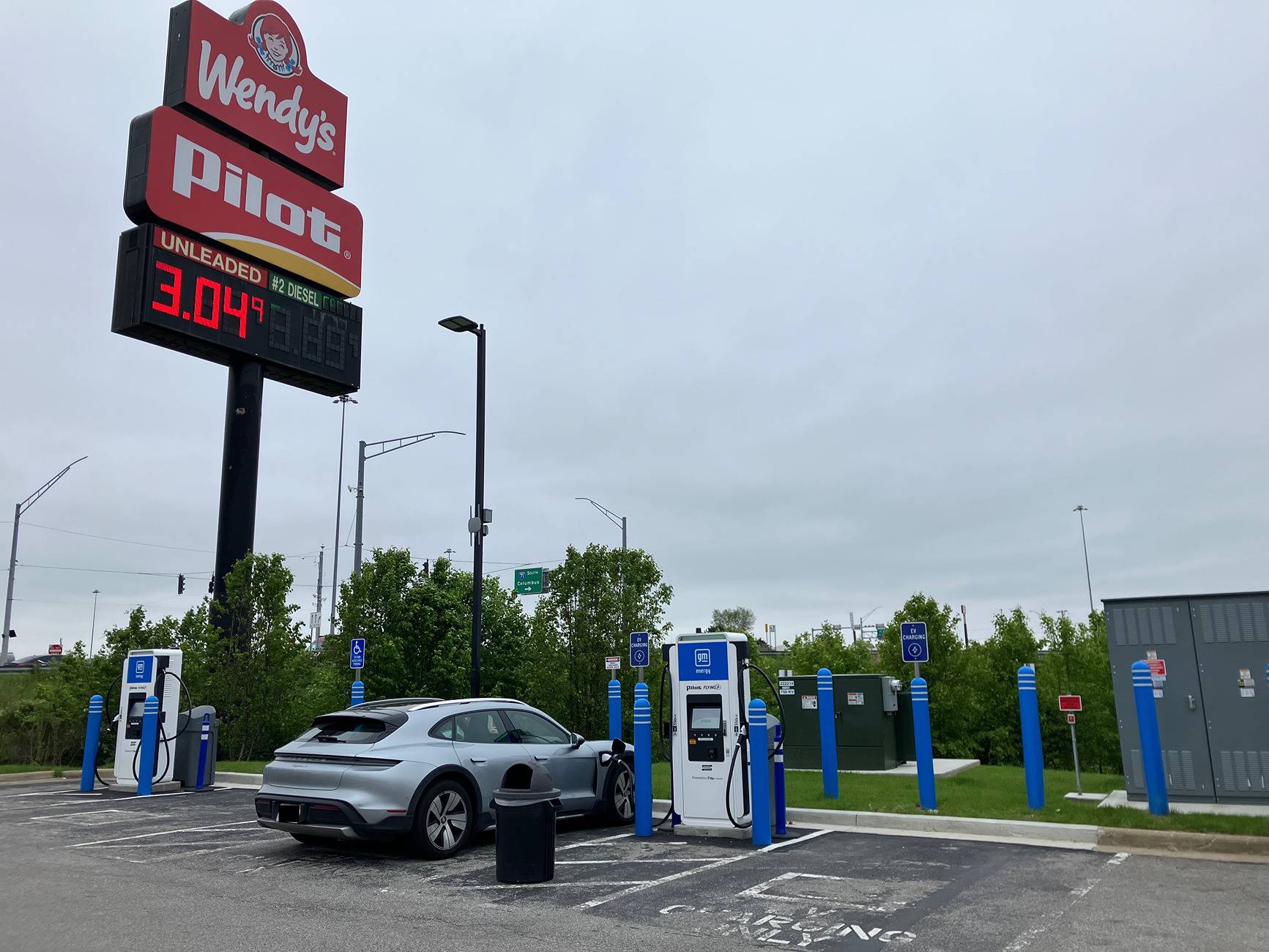
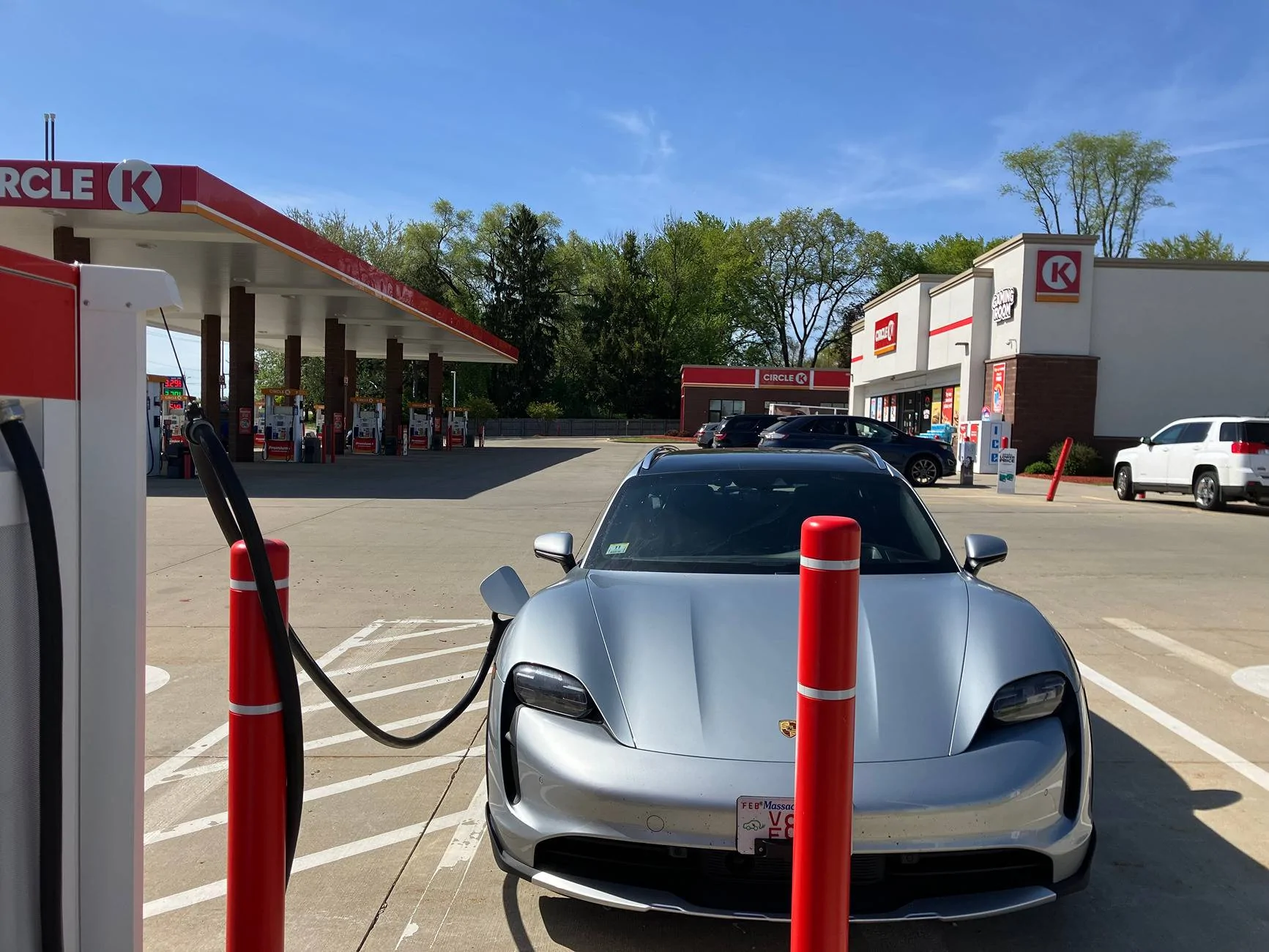
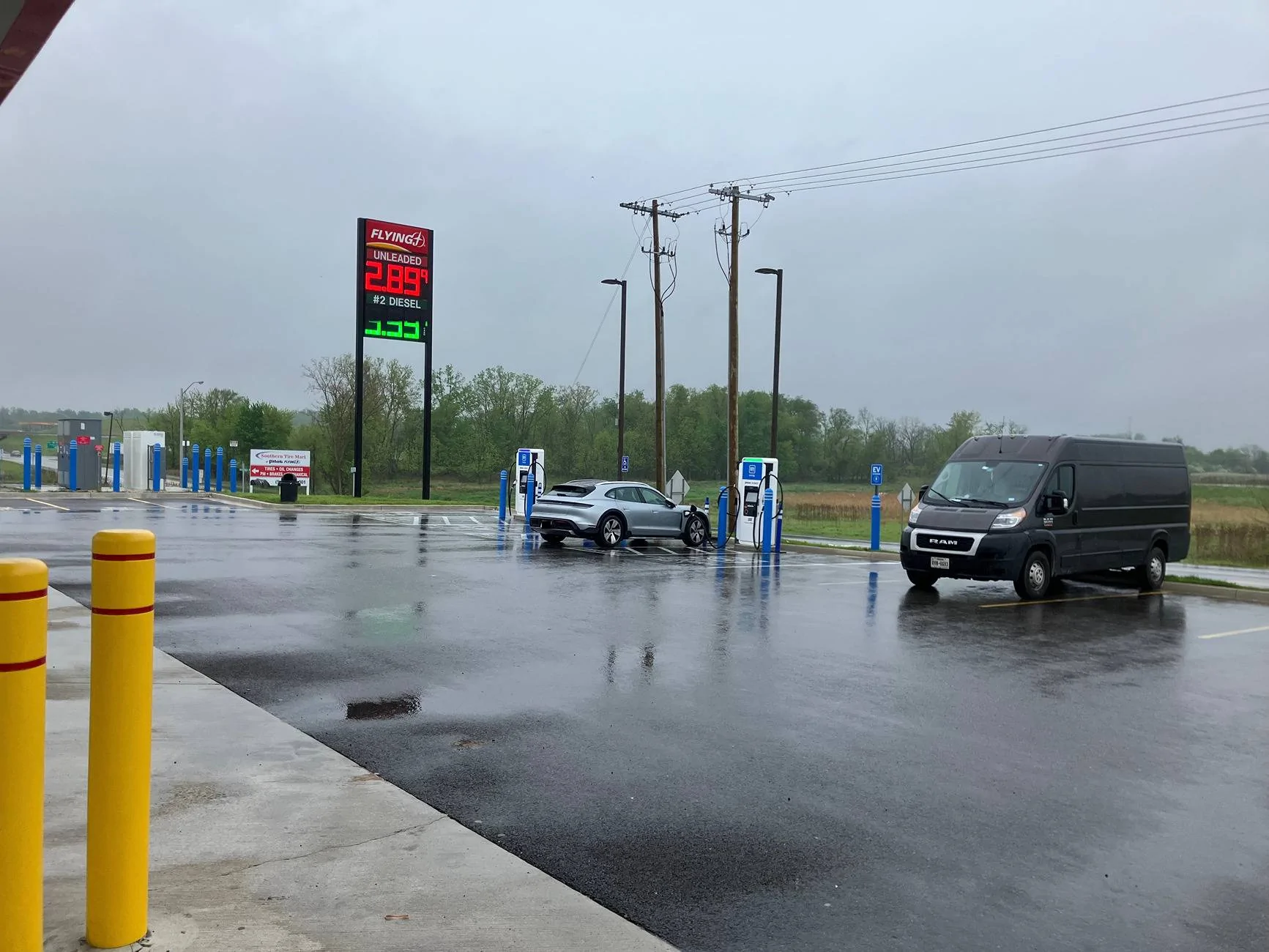
My favorite sites are the now-plentiful gas-station DCFC sites, which I used mostly on this trip: Flying J, Pilot, Shell, Love's Travel Center, Circle K, Kwik Trip (Kwik Charge, as they call their DCFC stations)... Many of these have canopies, all have 24/7 amenities because they're 24/7 manned gas stations, and they're close to Interstate and US Highways (unlike many EA stations, which are at Walmarts some distance off the main highways). Judging by how new most of these appear to be, the state of road-tripping with a BEV is night-and-day different now in May 2025 than it was one year ago (or even 6 months ago!). Things are moving super-fast in the deployment of DCFC sites at gas stations, in particular.
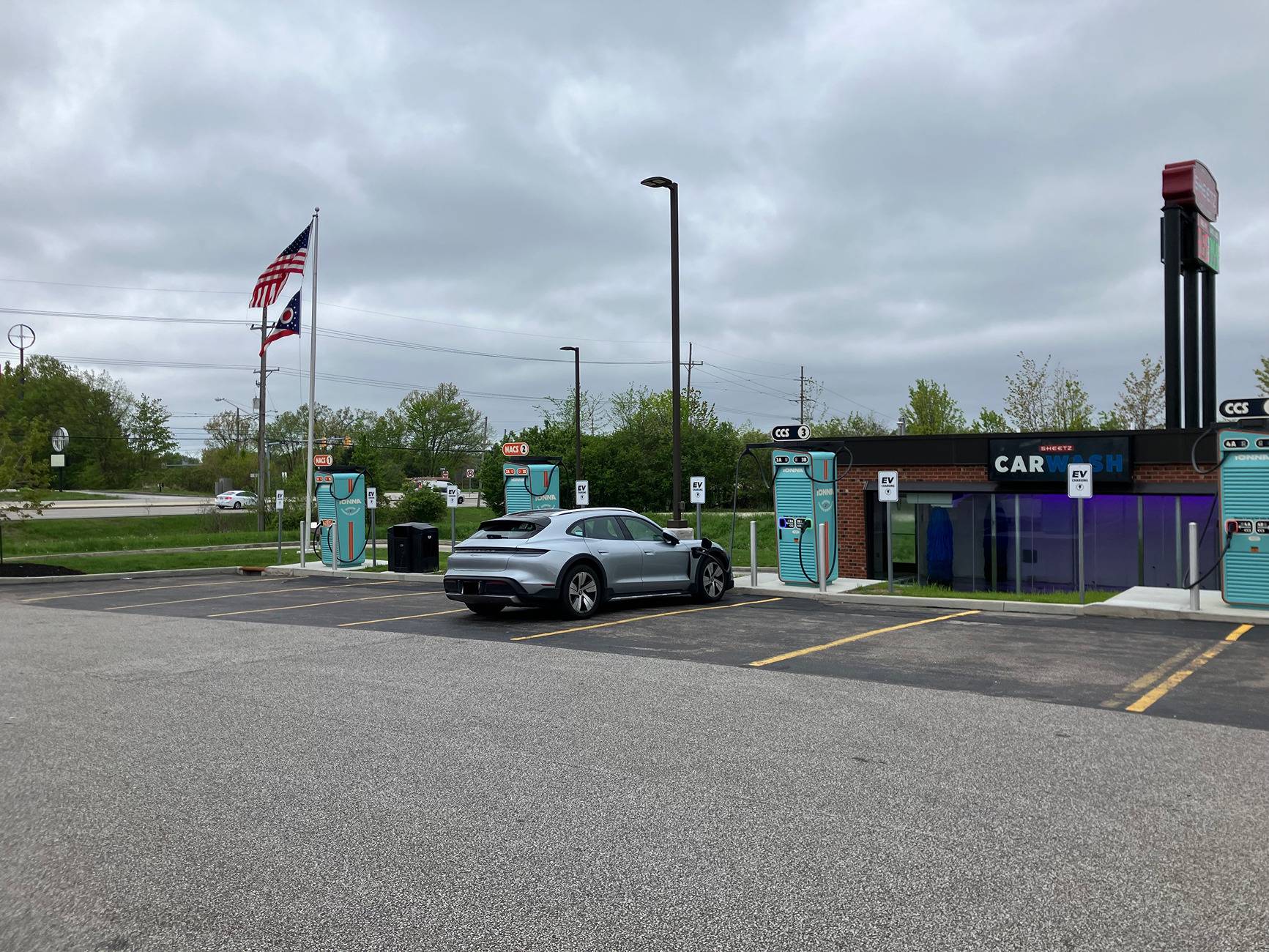
I also visited my second Ionna station on this trip -- in Willoughby, Ohio. Like the one in Scranton that I visited last month, it had no canopy, and it is more finicky and difficult to initiate charging at than almost all of the above stations that I previously mentioned. Kyle Conner and other YouTubers are going over-the-top on promoting Ionna, and it's great to get all the DCFC stations that we can get everywhere, but I'd plan for almost any of the above DCFC stations to stop and charge at on a road trip before I will stop at an Ionna -- because they tend to be easier to use, tend to be closer to the main highway, and have 24/7 manned stations with much better amenities. Ionna is currently offering much-lower prices per kWh, which is their main current benefit. But Ionna will fail as a company, in my view, if they don't start asking some major gas stations with lots of real estate and 24/7 attendants/amenities along major highways to partner with in building their DCFC stations. The gas-station model is THE model for DCFC stations if the masses are to adopt BEVs in the next decade. Stand-alone Tesla-like charging pumps "in the middle of nowhere" are unacceptable except for emergencies (like maybe in the middle of rural New Mexico or Montana).
My biggest gripe at numerous DCFC sites is the charging cables not being long enough, or the placement of the bays with respect to the cables for our Taycans being very poor. Older EA and EVgo stations tend to be the worst in this regard; most if not all the newer stations seem to be way better (often both in terms of cable length and placement within the parking bay). I wish that PlugShare would put in a date that each station was erected (and a date when new charging boxes are installed, as well).
I had no range anxiety because I never dropped below 20% SoC by design. This meant stopping every 1.5-1.75 hours on average to charge, but I really got to look forward to those stops to get out and stretch my legs and use the restroom, get something to eat or drink, wipe bugs off the windshield, etc., and I'd use that time to check email, post to PlugShare, and put my next stop into my navigation systems (Porsche navigation and Google Maps on my iPhone).
I was flustered with the Porsche navigation being finicky much of the time. As I said before, I have to type in addresses because the voice recognition sucks (unlike the voice recognition in my 2018 and 2019 Porsches, which was MUCH better; don't know what happened). And the ability to do things with the Porsche navigation is not very flexible or useful (or intuitive); I can't set the minimum desired charge at each charge stop for multiple stops, so I have to use a combination of PlugShare and Google Maps to plan out my stops (and override whatever Porsche navigation is trying to suggest). And the zoom-in/zoom-out feature in the Porsche navigation sucks (in my 2018 and 2019 Porsches, there was a wheel/dial that I could turn to zoom in and out quickly on the map, instead of having to peck away at the + and - signs on the touchscreen in incredibly frustratimg fashion). And if I turn on my CarPlay to project the GoogleMaps navigation, the Porsche navigation often resets, and when I switch back to it (for comparison, or to check on estimated SoC upon arrival), I'll often have to re-enter the destination again). Sigh...
Thoughts on the car itself: the seats are great, and no back pain from the long trip. Ventilated seats came in handy on a couple of hot, sunny days. The ACC is really excellent, and I use it most of the time on road trips (but rarely ever when around home); it really reduces fatigue and was excellent in pouring rain when I trusted the car's braking instincts much better than my own. Things that stood out on this particular trip as annoying: (1) that pesky blind spot; I have my mirrors pointed out as far as they'll go, and I still have an SUV-sized blind spot in the adjacent lane between my interior rear-view-mirror sight and my side-mirror sight (the mirror LCA lights don't always light up when somebody is there, it seems). (2) the leg well for driver is cramped for me when sitting for 8 hours a day there (I'm 5'8", and can't imagine how difficult it would be for somebody over 6' tall); I do move the seat backwards and forwards over a day to let the legs stretch more, but then I can't put the back seats down for more useful storage. (3) that glass roof... ugh... it certainly makes the car hotter on sunny days, and the inability to close it is frustrating. I noticed that when the sun is overhead, I have to wear my baseball cap or the solar glare will annoy me from above. How I wish I had an all-metal roof in my Taycan! (4) windshield wipers: there's no intermittent steady mode; i.e., the "intermittent" mode is where the car decides if there's enough rain on the windshield to wipe, and at what interval/speed (but the car's software is constantly changing the intermittent speed in frustrating ways that don't gel with the rain on the windshield, and you can't get the car to set the intermittent speed and stay at that speed). So there are only two set, steady speeds ("normal" and fast). My other cars have had intermittent wiper speeds where you set the speed and it keeps going at that speed regardless of what the car might sense. I kept having to work the wiper stalk manually at times with light rain. (5) I don't like keeping my key fob in my pants pocket, so I throw it into the storage bay under the climate-controls display panel; sometimes the car complains that it can't detect the key there ... so where does Porsche want us to put our key fobs?! I'm using my two cupholders for drinks/phone. (6) that poorly designed glove box is way too tiny and way too oddly shaped; it's hard even keeping the instructions booklets there, let alone anything else. None of my previous Porsches had so poorly designed glove box and center-storage compartment, by a long shot. Not sure what the Taycan designers were thinking. I did get a sun-visor extender that I attached to my driver-side sun visor for when the sun is out the side window, to block its glare out; that came in handy numerous times on this trip.
My trip was I-90 from New England to Cleveland, then south to US 30 from Mansfield, Ohio, to Valparaiso, Indiana, then basically I-90 to MN. I drove home a different way (I-94 and I-80) because I went through NYC to visit family there. I'll post charging details, stats, and some photos in the near future here.
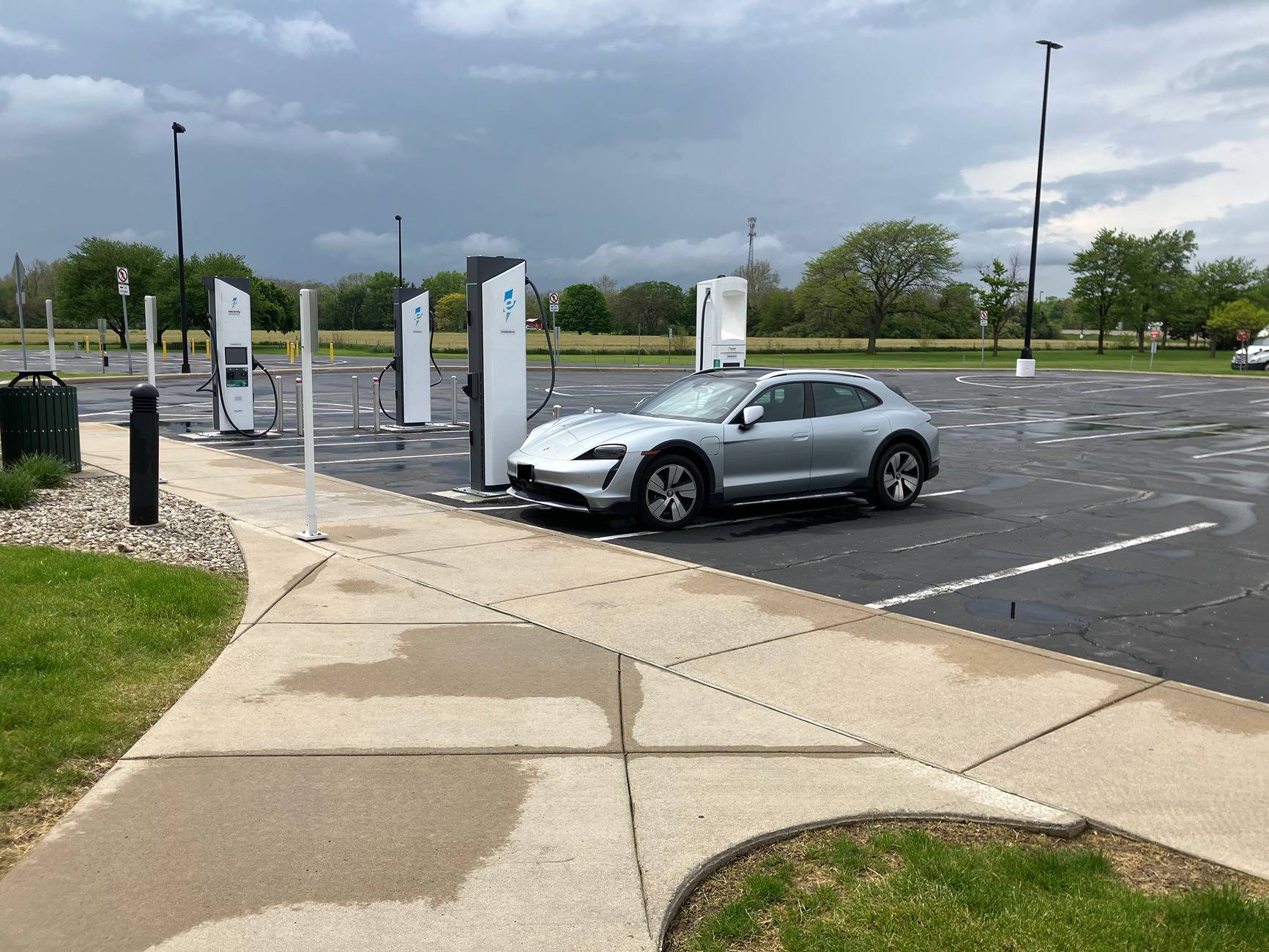
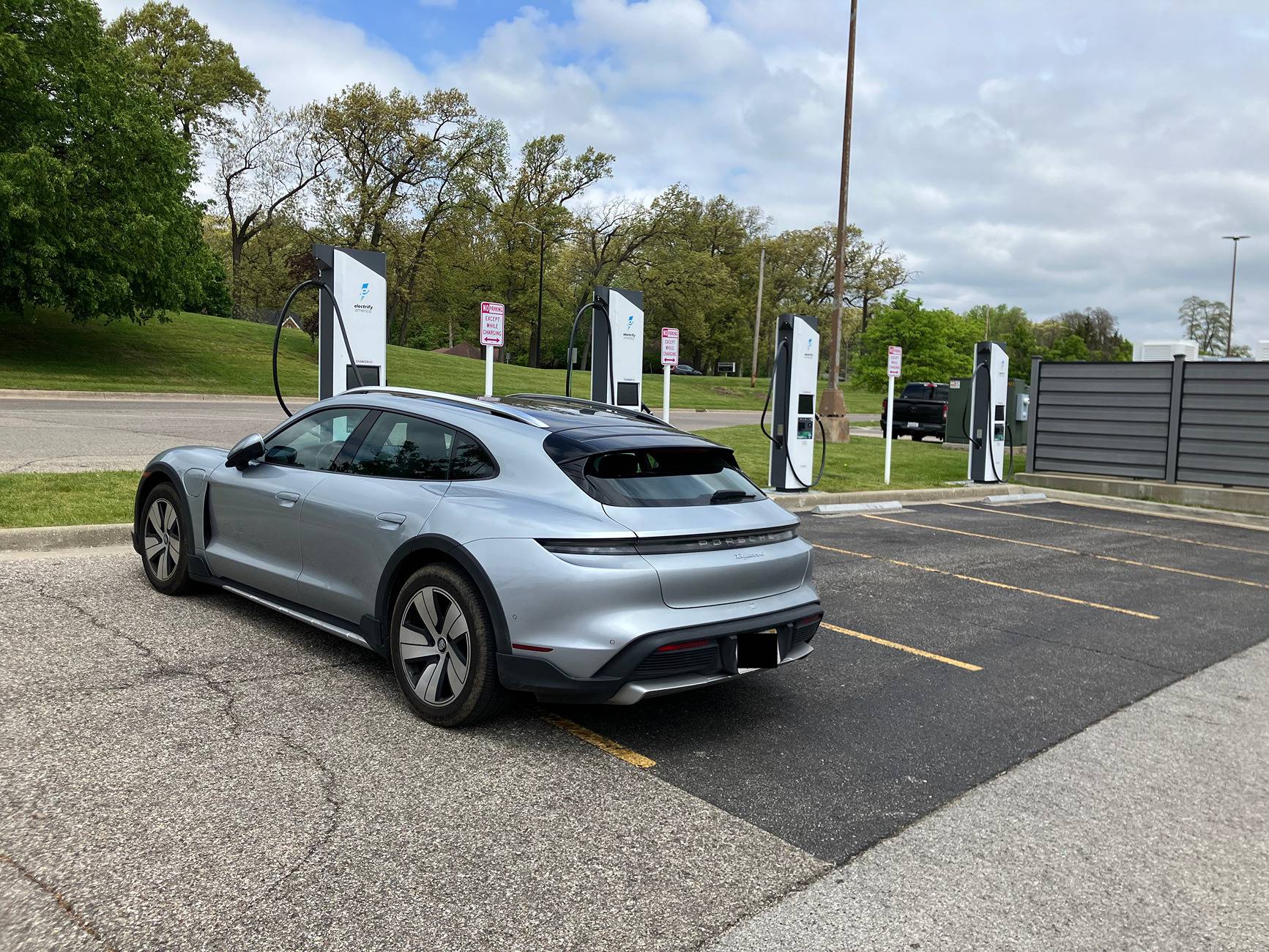
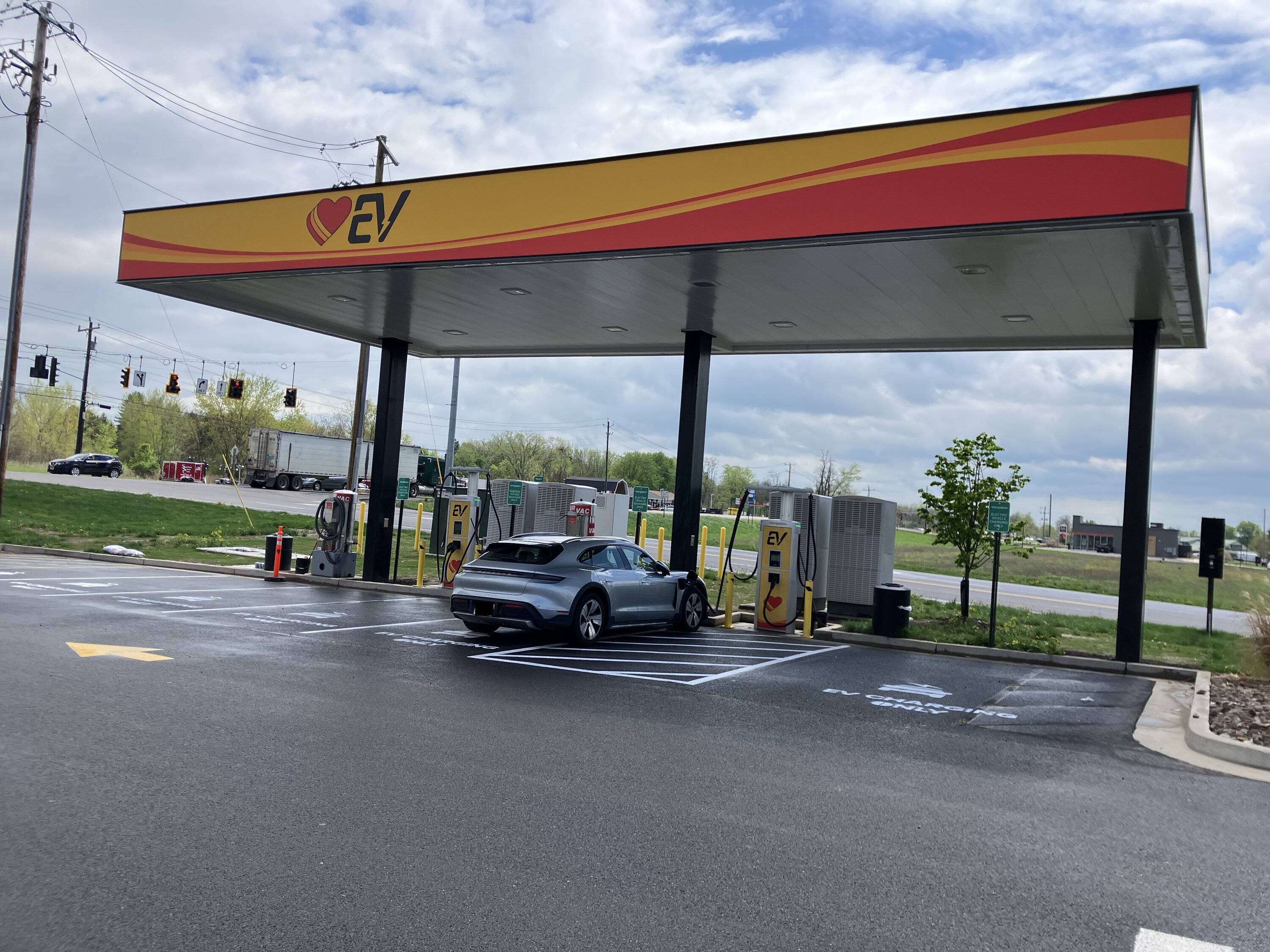
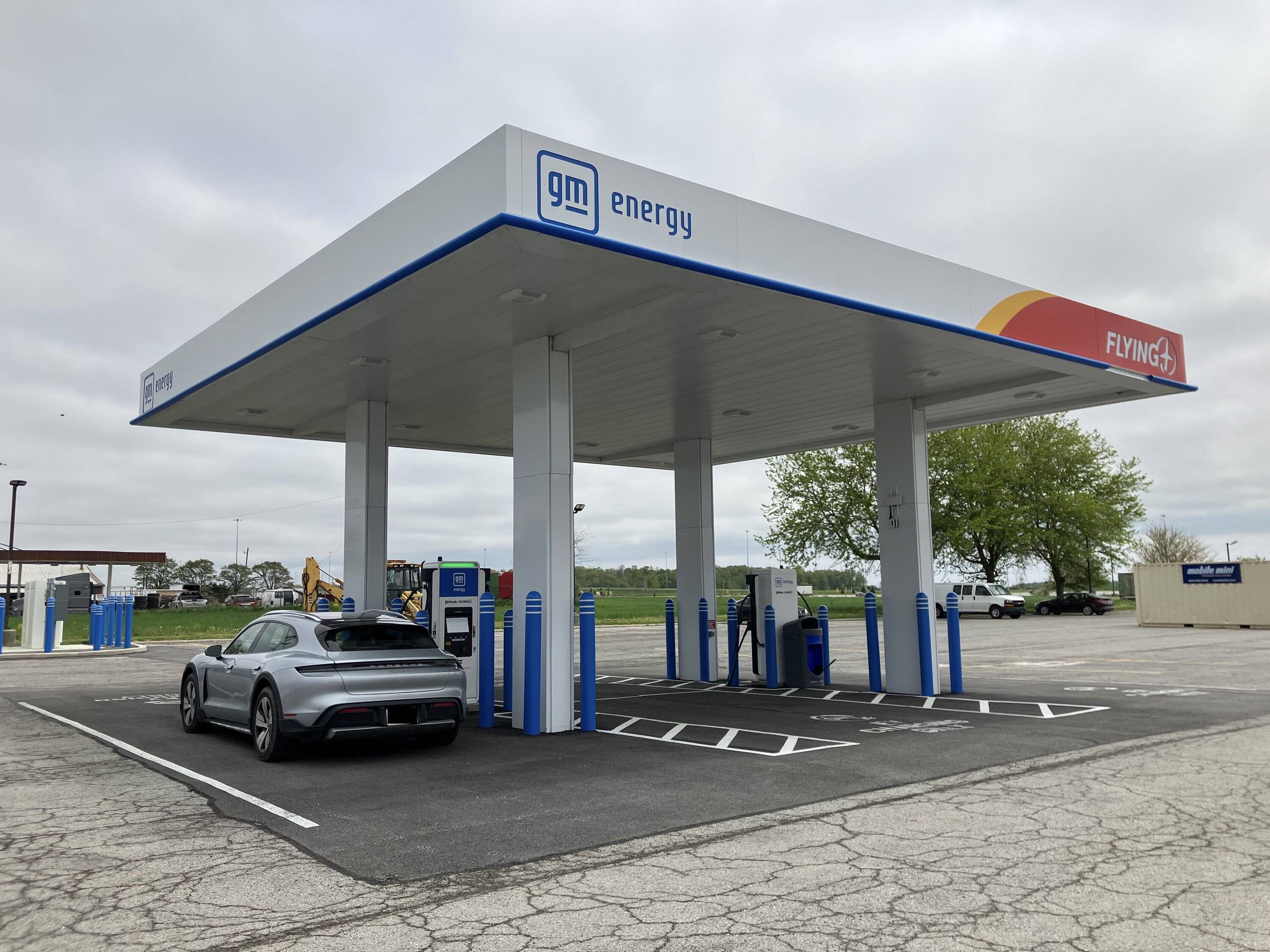
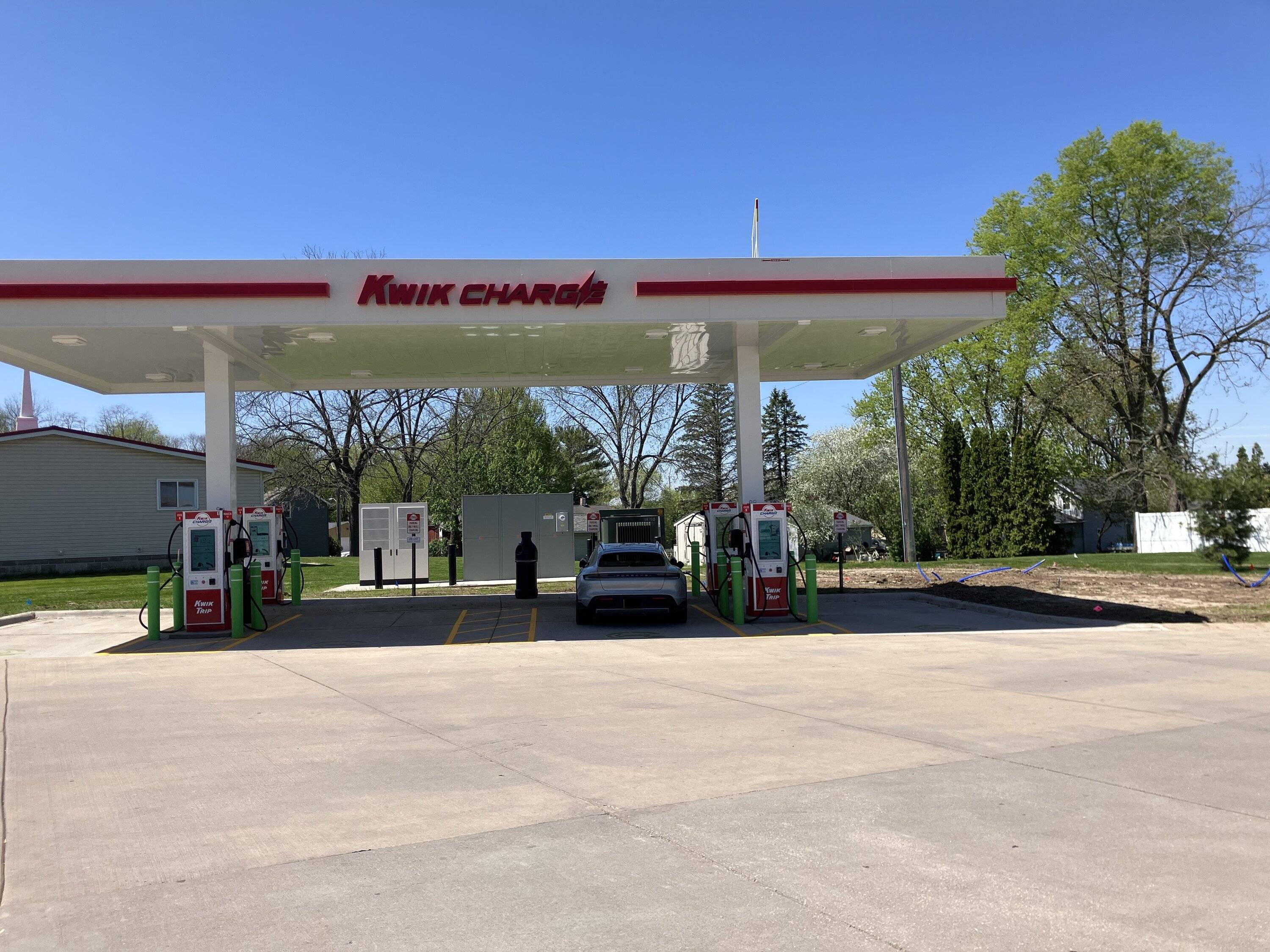
First photos below :
(1) at a Love's Travel Stop in Waterloo, NY (Chargepoint RFID)
(2) at a Flying J gas station in Beaverdam, OH (EVgo RFID)
(3) at a Kwik Charge (Kwik Trip gas station) in West Salem, WI (credit card)
Notice how I'm the only car charging in these photos; this was quite common on this trip.
Out of 28 or 29 DCFC stations that I charged at on this trip, I had only one short wait at one of the stations (EA/Cheektowaga, NY).

First, the first-generation Taycan is a great road-tripper (as I noted in my 1900-mile road-trip report last month here). I hate that I only get 220-240 miles of range now in warm spring weather at 70 mph, but I never experienced anything approaching range anxiety -- despite DCFC stations being rather sparse in some areas that I traveled. The lack of range anxiety comes from being prepared ahead of time: I mapped out my westbound charging stops a week before I left on my trip, and I followed them without deviation all the way to Minnesota (with one exception: I added in the West Salem site out of curiosity as it was on my way and I needed to stop to use the restroom, even though I didn't need to charge then). My eastbound charging stops were planned on short notice (after I got to MN) because I had to make an initially unplanned family stop in NYC on the way home.
Kudos to PlugShare for this, without which I would be lost. I always post my charging reports on PlugShare to help others (and for me to refer to for future trips), because the reports of others help me also to choose where to stop and where not to stop.
I was able to charge all the way to Minnesota using my phone twice to initiate charging or to pay (Circle K), and on the way home I used my iPhone only twice to initiate charging (once at a Shell Recharge and once at a Tesla Magic Docks site -- both of which worked without issue).
I stopped at two hotels with onsite 240-volt charging; I couldn't get the Blink charger to work at one, but found out later that my credit card attached to the account had expired. The Tesla destination charger at my last hotel worked fine at no cost (plug-and-charge, no need for an app), and I keep a NACS-to-CCS adapter in my car for such possibilities on the road.
On this trip, I used EA much less than I did on my NC trip last month (percentage-wise), and I was impressed with most of the stops. EA worked fine when I used it, with one exception: plug-and-charge has always worked for me at EA, but at one site homeward bound this past week, plug-and-charge didn't work, and it took a while to get the reader to accept my Visa credit card (had to change chargers, too).
I note that at one station along the Ohio Turnpike on the way home (I-80), there was only one bar of reception on my Verizon Wireless iPhone -- not enough to even access PlugShare to post my report; if I'd had to use a phone app to charge there, I'd have been screwed.
My goal is to always charge without using my iPhone, whenever possible (and I'm able to do that 90%-95% of the time now, thankfully) -- plug-and-charge at EA, and RFID or credit cards everywhere else.
I have four RFID cards so far (Chargepoint, EVgo, Blink, Francis Energy), and they work better and faster and more easily than any phone app including Tesla's. What would be great, short of universal plug-and-charge, would be to have a universal RFID card for all stations. Using a smartphone/app to charge a car is just plain unacceptable as a requirement for the masses (and for me), just as it would be for pumping gas at a gas station.
My favorite sites are the now-plentiful gas-station DCFC sites, which I used mostly on this trip: Flying J, Pilot, Shell, Love's Travel Center, Circle K, Kwik Trip (Kwik Charge, as they call their DCFC stations)... Many of these have canopies, all have 24/7 amenities because they're 24/7 manned gas stations, and they're close to Interstate and US Highways (unlike many EA stations, which are at Walmarts some distance off the main highways). Judging by how new most of these appear to be, the state of road-tripping with a BEV is night-and-day different now in May 2025 than it was one year ago (or even 6 months ago!). Things are moving super-fast in the deployment of DCFC sites at gas stations, in particular.
I also visited my second Ionna station on this trip -- in Willoughby, Ohio. Like the one in Scranton that I visited last month, it had no canopy, and it is more finicky and difficult to initiate charging at than almost all of the above stations that I previously mentioned. Kyle Conner and other YouTubers are going over-the-top on promoting Ionna, and it's great to get all the DCFC stations that we can get everywhere, but I'd plan for almost any of the above DCFC stations to stop and charge at on a road trip before I will stop at an Ionna -- because they tend to be easier to use, tend to be closer to the main highway, and have 24/7 manned stations with much better amenities. Ionna is currently offering much-lower prices per kWh, which is their main current benefit. But Ionna will fail as a company, in my view, if they don't start asking some major gas stations with lots of real estate and 24/7 attendants/amenities along major highways to partner with in building their DCFC stations. The gas-station model is THE model for DCFC stations if the masses are to adopt BEVs in the next decade. Stand-alone Tesla-like charging pumps "in the middle of nowhere" are unacceptable except for emergencies (like maybe in the middle of rural New Mexico or Montana).
My biggest gripe at numerous DCFC sites is the charging cables not being long enough, or the placement of the bays with respect to the cables for our Taycans being very poor. Older EA and EVgo stations tend to be the worst in this regard; most if not all the newer stations seem to be way better (often both in terms of cable length and placement within the parking bay). I wish that PlugShare would put in a date that each station was erected (and a date when new charging boxes are installed, as well).
I had no range anxiety because I never dropped below 20% SoC by design. This meant stopping every 1.5-1.75 hours on average to charge, but I really got to look forward to those stops to get out and stretch my legs and use the restroom, get something to eat or drink, wipe bugs off the windshield, etc., and I'd use that time to check email, post to PlugShare, and put my next stop into my navigation systems (Porsche navigation and Google Maps on my iPhone).
I was flustered with the Porsche navigation being finicky much of the time. As I said before, I have to type in addresses because the voice recognition sucks (unlike the voice recognition in my 2018 and 2019 Porsches, which was MUCH better; don't know what happened). And the ability to do things with the Porsche navigation is not very flexible or useful (or intuitive); I can't set the minimum desired charge at each charge stop for multiple stops, so I have to use a combination of PlugShare and Google Maps to plan out my stops (and override whatever Porsche navigation is trying to suggest). And the zoom-in/zoom-out feature in the Porsche navigation sucks (in my 2018 and 2019 Porsches, there was a wheel/dial that I could turn to zoom in and out quickly on the map, instead of having to peck away at the + and - signs on the touchscreen in incredibly frustratimg fashion). And if I turn on my CarPlay to project the GoogleMaps navigation, the Porsche navigation often resets, and when I switch back to it (for comparison, or to check on estimated SoC upon arrival), I'll often have to re-enter the destination again). Sigh...
Thoughts on the car itself: the seats are great, and no back pain from the long trip. Ventilated seats came in handy on a couple of hot, sunny days. The ACC is really excellent, and I use it most of the time on road trips (but rarely ever when around home); it really reduces fatigue and was excellent in pouring rain when I trusted the car's braking instincts much better than my own. Things that stood out on this particular trip as annoying: (1) that pesky blind spot; I have my mirrors pointed out as far as they'll go, and I still have an SUV-sized blind spot in the adjacent lane between my interior rear-view-mirror sight and my side-mirror sight (the mirror LCA lights don't always light up when somebody is there, it seems). (2) the leg well for driver is cramped for me when sitting for 8 hours a day there (I'm 5'8", and can't imagine how difficult it would be for somebody over 6' tall); I do move the seat backwards and forwards over a day to let the legs stretch more, but then I can't put the back seats down for more useful storage. (3) that glass roof... ugh... it certainly makes the car hotter on sunny days, and the inability to close it is frustrating. I noticed that when the sun is overhead, I have to wear my baseball cap or the solar glare will annoy me from above. How I wish I had an all-metal roof in my Taycan! (4) windshield wipers: there's no intermittent steady mode; i.e., the "intermittent" mode is where the car decides if there's enough rain on the windshield to wipe, and at what interval/speed (but the car's software is constantly changing the intermittent speed in frustrating ways that don't gel with the rain on the windshield, and you can't get the car to set the intermittent speed and stay at that speed). So there are only two set, steady speeds ("normal" and fast). My other cars have had intermittent wiper speeds where you set the speed and it keeps going at that speed regardless of what the car might sense. I kept having to work the wiper stalk manually at times with light rain. (5) I don't like keeping my key fob in my pants pocket, so I throw it into the storage bay under the climate-controls display panel; sometimes the car complains that it can't detect the key there ... so where does Porsche want us to put our key fobs?! I'm using my two cupholders for drinks/phone. (6) that poorly designed glove box is way too tiny and way too oddly shaped; it's hard even keeping the instructions booklets there, let alone anything else. None of my previous Porsches had so poorly designed glove box and center-storage compartment, by a long shot. Not sure what the Taycan designers were thinking. I did get a sun-visor extender that I attached to my driver-side sun visor for when the sun is out the side window, to block its glare out; that came in handy numerous times on this trip.
My trip was I-90 from New England to Cleveland, then south to US 30 from Mansfield, Ohio, to Valparaiso, Indiana, then basically I-90 to MN. I drove home a different way (I-94 and I-80) because I went through NYC to visit family there. I'll post charging details, stats, and some photos in the near future here.
First photos below :
(1) at a Love's Travel Stop in Waterloo, NY (Chargepoint RFID)
(2) at a Flying J gas station in Beaverdam, OH (EVgo RFID)
(3) at a Kwik Charge (Kwik Trip gas station) in West Salem, WI (credit card)
Notice how I'm the only car charging in these photos; this was quite common on this trip.
Out of 28 or 29 DCFC stations that I charged at on this trip, I had only one short wait at one of the stations (EA/Cheektowaga, NY).
Sponsored
Last edited: