prj
Well-Known Member
- Joined
- Jan 14, 2025
- Threads
- 8
- Messages
- 1,803
- Reaction score
- 2,414
- Location
- Estonia
- Website
- www.mapev.net
- Vehicles
- Taycan CT 4 - 2026

- Thread starter
- #1
1. Introduction
This is a post in a series, which will shed more light on some of the inner workings of the Taycan.
You can find Parts 1, 3 & 4 here:
Part 1: MapEV Diag
Part 3: The Quest for the Perfect Tune
Part 4: The J1.2 Powertrain
In this part I will focus on the factory setup powertrain. The questions explored here are not in as much mechanical, as electronical.
What are the exact limitations of the batteries? What are the limitations of the motors? How much is the power and torque limited artificially by the ASG?
I will attempt to answer these questions here and include actual real data.
2. The Architecture
From the traction side, the 4WD J1's have a front and rear motor with a two speed gearbox on the rear axle. Each motor has an inverter and a control unit for the inverter. These control units are Bosch Invcon controllers, which are responsible for delivering requested torque and controlling the motors through the inverters.
From the battery side, there is the battery control unit, which from a motive perspective, is responsible for providing the available power and limiting the Invcon controller output to not exceed the current battery discharge limit.
Tying all that together is the ASG, which translates the driver request to torque, handles refinement characteristics, controls the gearbox actuator controller and the sport differential, and outputs the torque request to the inverter controllers. You could call it the powertrain coordinator. It does not really control anything directly, but rather orchestrates the whole powertrain to work together as one.
3. The Inverter Controllers
The Bosch Invcon units are responsible for taking the ASG torque request and converting this torque request into torque by driving the inverters. They are also responsible for protecting the inverter electronics and the motors from overcurrent, excessive heat and so on.
The inverter controllers have a base programmed torque curve, which gets limited by internal thermal protection, and by the battery controller not to exceed the maximum allowed discharge power, and finally communicated to the ASG. The Inverter controller will never output more torque/draw more current than this limitation, no matter what the ASG requests on the bus.
There are four different inverter-motor combinations. And thus also four different inverter controllers. I have measured all of these combinations using calibration level datalogging software I have created for the ASG.
3.1. Front motor/inverter - Taycan Turbo S
This motor/inverter combination is used only on the Taycan Turbo S. Besides having significantly higher torque limit of 400Nm, it also has a special launch control mode. When (and only when) launch control is activated in the ECU, the torque is additionally boosted by 10% to 440 Nm.
Here is the maximum output graph of the Taycan Turbo S front inverter as seen by the ASG. The dashed line shows the maximum output in launch control mode. The graph is taken at close to 100% SoC:

The X axis is motor RPM. 6000 RPM is roughly 100km/h.
3.2. Front motor/inverter - All other models
With the smaller 300A inverter, the maximum torque is 300Nm. There is no launch mode, the torque is the same regardless of whether race start is active in the ECU or not. As visible from the graph, the power output is exactly the same, albeit the Turbo S inverter has an advantage until about 105km/h, when their outputs converge. From 0-60km/h the Turbo S inverter has 46.7% more torque on tap.
Below is the graph for the 300A variant, as seen by the ASG near 100% SoC:
3.3. Rear Motor/Inverter - Turbo S, Turbo, GTS, Etron GT RS
The bigger one of the rear motors/inverters. The standard torque limit is 550Nm. During race start activation in the ASG, the torque limit is increased to 610 Nm. The peak power output is about 525 PS.
Below is the graph for the maximum possible output, as seen by the ASG near 100% SoC:
3.4. Rear Motor/Inverter - 4S, 4, Etron GT, RWD(?)
The smaller motor. I am not 100% sure about the RWD variant, because I have not had the chance to test one yet. But judging by the advertised torque output and shift points it checks out.
The maximum torque is 340Nm, surprisingly there is a launch control mode, which bumps the torque up to 360Nm. The maximum power output is 480 PS, which means on the Taycan RWD it runs flat out in launch control.
The small motor is actually very capable. Due to the 2 speed gearbox, it is possible to extract the maximum power from 83km/h. The larger motor/inverter combo makes just 9.4% more power, but 69.4% more torque.
3.5. Summary
The most important takeaway from this, is that you are always paying for the torque when going to the next motor/inverter. The maximum power is quite similar between all the variants, but because we have motors revving to 16000 rpm and the maximum power at high revs with the smaller motor, there is a massive difference between 0-60km/h.
4. The battery
I will not be as in-depth here as in the previous chapter, but I will give some numbers for the battery capability.
The peak allowed draw from the battery itself is over 600 kW, but because the powertrain is not 100% efficient, the maximum power output out of the motors is less.
For the bigger battery:
At 100% SoC the large battery is capable of delivering about 800 PS.
At 95% SoC this drops to 790 PS.
At 85% SoC the Porsche specified power of 760 PS in the Turbo S is delivered.
At 75% SoC, the maximum power is closer to 725 PS, and it keeps dropping the lower the SoC gets.
This is why the "big daddy" variants are limited to 625 PS outside of launch mode - to give them consistent power without regard for the SoC.
The smaller battery is not as capable, I also did not make as many measurements with it, but:
At 100% SoC the small battery is capable of delivering about 660 PS.
At 80% SoC this drops to 630 PS.
5. Maximum performance curves
This post would not be complete without the total power potential of each model. Before you even ask - these are the actual true maximums. No matter what Tuner Y or Tuner X is telling you.
These are also not what the cars are running from factory, with the exception of the Turbo S and Taycan RWD (with the larger battery) in launch control. Yes, the Turbo S will do 800 PS at 100% SoC completely without any modifications in launch control .
1. It is impossible to increase the total power past these maximums in the larger rear motor cars without installing a different battery and BMS.
2. It is impossible to increase the total torque past these maximums without re-flashing the invcon units and compromising the inverter reliability.
3. It is possible to safely increase the power and torque to these limits, because indeed, Porsche already does this on the Taycan Turbo S and the Taycan RWD from factory. So there is no danger to the motors, or the batteries.
4. It is impossible to have full launch torque without reverse engineering the program code in the ECU and patching it. You can never have the full LC torque only by editing the calibration. No tuners do this at the moment. More about this in Part 3.
Finally, please note that these curves do not take in account the gearbox on the rear axle. Consider them maximum performance in second gear. It is also possible to plot the first gear performance by multiplying the RPM x2 for the rear motor.
5.1. Taycan Turbo S
Maximum 800 PS / 1050 Nm in launch control, 800 PS / 950 Nm outside. At 100% SoC.
5.2. Taycan Turbo / Taycan GTS / Etron GT RS
Maximum 800 PS / 910 Nm in launch control, 800 PS / 850 Nm outside. At 100% SoC.
5.3. Taycan 4S, Taycan 4 - Performance Battery Plus
Maximum 730 PS / 660 Nm in launch control, 730 PS / 640 Nm outside. At 75-100% SoC.
5.4. Taycan 4S - Performance Battery
This graph was taken at about 80% SoC. I do not have a full 100% SoC graph for this battery.
Maximum 660 PS / 660Nm in launch control, 660 PS / 640 Nm outside. At 100% SoC.
At 80% SoC: 630 PS / 660 Nm in launch control, 620 PS / 640 Nm outside.
5.5. Taycan RWD - Either battery type
The RWD Taycan manages 480 PS and 340 Nm outside launch control and 480 PS and 360 Nm with launch control.
6. Conclusion
This should give some insight into the actual capabilities of the J1 platform with some real numbers. I also hope that some more critical thinking is created towards arbitrary numbers thrown around by certain companies.
Finally, all this data is reported by the ASG, if you have the ability to inject some code into the firmware to gain access to the roughly 33000 loggable parameters inside. I do this for a living.
In Part 3 I delve deep into the ASG control electronics and what is possible to improve beyond lifting the torque to the maximum allowed by the inverter controllers and the battery management.
7. Bonus
Here is a small informal video of the inverter controller torque limits changing on the flexray bus depending on the launch control status:
This is a post in a series, which will shed more light on some of the inner workings of the Taycan.
You can find Parts 1, 3 & 4 here:
Part 1: MapEV Diag
Part 3: The Quest for the Perfect Tune
Part 4: The J1.2 Powertrain
In this part I will focus on the factory setup powertrain. The questions explored here are not in as much mechanical, as electronical.
What are the exact limitations of the batteries? What are the limitations of the motors? How much is the power and torque limited artificially by the ASG?
I will attempt to answer these questions here and include actual real data.
2. The Architecture
From the traction side, the 4WD J1's have a front and rear motor with a two speed gearbox on the rear axle. Each motor has an inverter and a control unit for the inverter. These control units are Bosch Invcon controllers, which are responsible for delivering requested torque and controlling the motors through the inverters.
From the battery side, there is the battery control unit, which from a motive perspective, is responsible for providing the available power and limiting the Invcon controller output to not exceed the current battery discharge limit.
Tying all that together is the ASG, which translates the driver request to torque, handles refinement characteristics, controls the gearbox actuator controller and the sport differential, and outputs the torque request to the inverter controllers. You could call it the powertrain coordinator. It does not really control anything directly, but rather orchestrates the whole powertrain to work together as one.
3. The Inverter Controllers
The Bosch Invcon units are responsible for taking the ASG torque request and converting this torque request into torque by driving the inverters. They are also responsible for protecting the inverter electronics and the motors from overcurrent, excessive heat and so on.
The inverter controllers have a base programmed torque curve, which gets limited by internal thermal protection, and by the battery controller not to exceed the maximum allowed discharge power, and finally communicated to the ASG. The Inverter controller will never output more torque/draw more current than this limitation, no matter what the ASG requests on the bus.
There are four different inverter-motor combinations. And thus also four different inverter controllers. I have measured all of these combinations using calibration level datalogging software I have created for the ASG.
3.1. Front motor/inverter - Taycan Turbo S
This motor/inverter combination is used only on the Taycan Turbo S. Besides having significantly higher torque limit of 400Nm, it also has a special launch control mode. When (and only when) launch control is activated in the ECU, the torque is additionally boosted by 10% to 440 Nm.
Here is the maximum output graph of the Taycan Turbo S front inverter as seen by the ASG. The dashed line shows the maximum output in launch control mode. The graph is taken at close to 100% SoC:
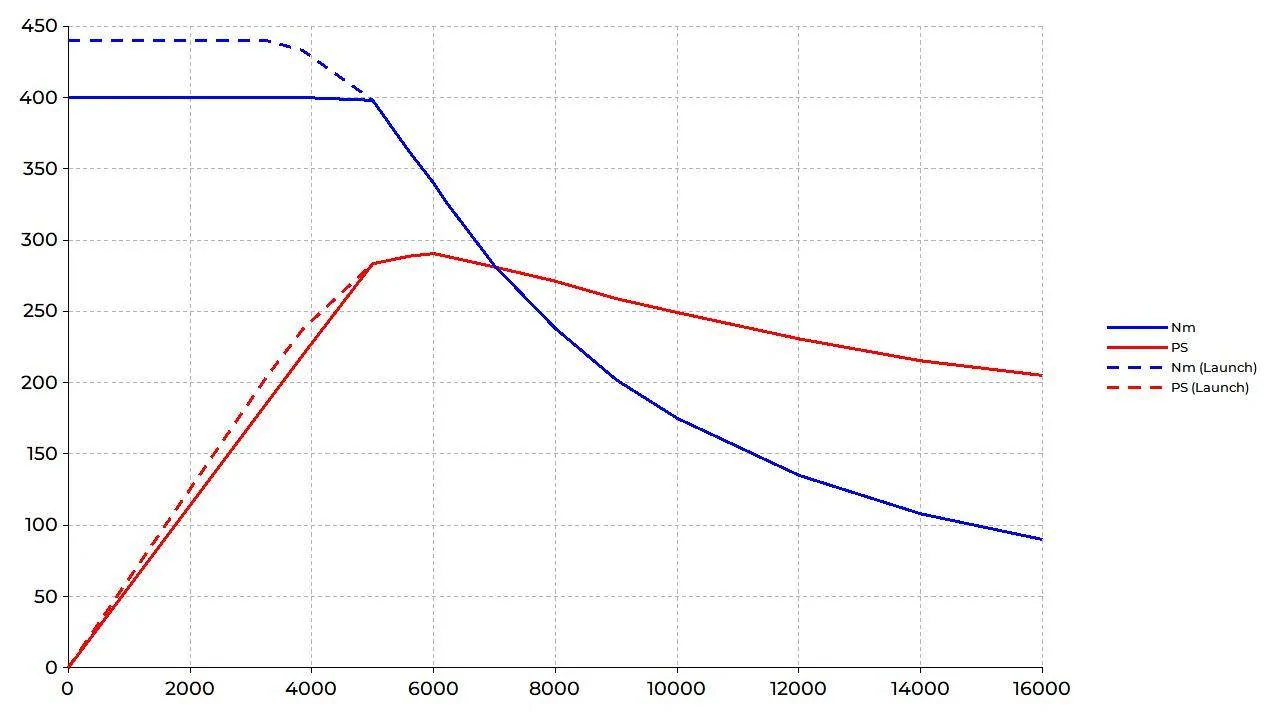
The X axis is motor RPM. 6000 RPM is roughly 100km/h.
3.2. Front motor/inverter - All other models
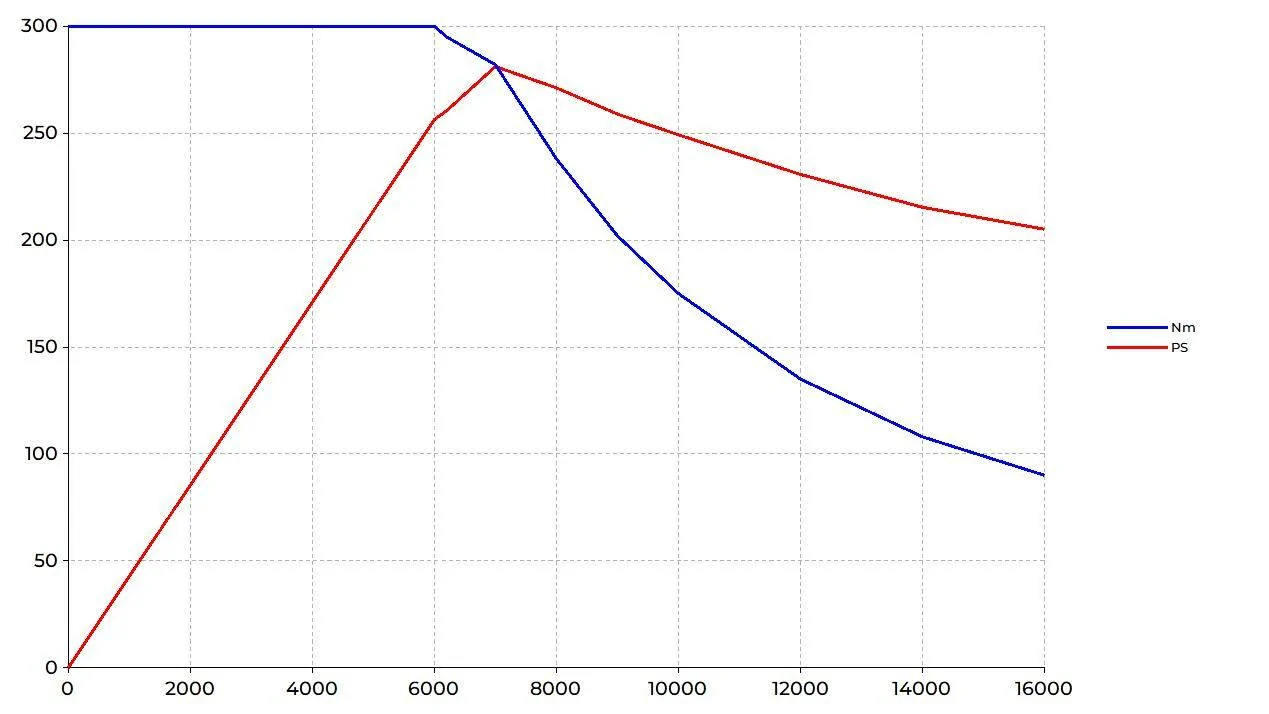
With the smaller 300A inverter, the maximum torque is 300Nm. There is no launch mode, the torque is the same regardless of whether race start is active in the ECU or not. As visible from the graph, the power output is exactly the same, albeit the Turbo S inverter has an advantage until about 105km/h, when their outputs converge. From 0-60km/h the Turbo S inverter has 46.7% more torque on tap.
Below is the graph for the 300A variant, as seen by the ASG near 100% SoC:
3.3. Rear Motor/Inverter - Turbo S, Turbo, GTS, Etron GT RS
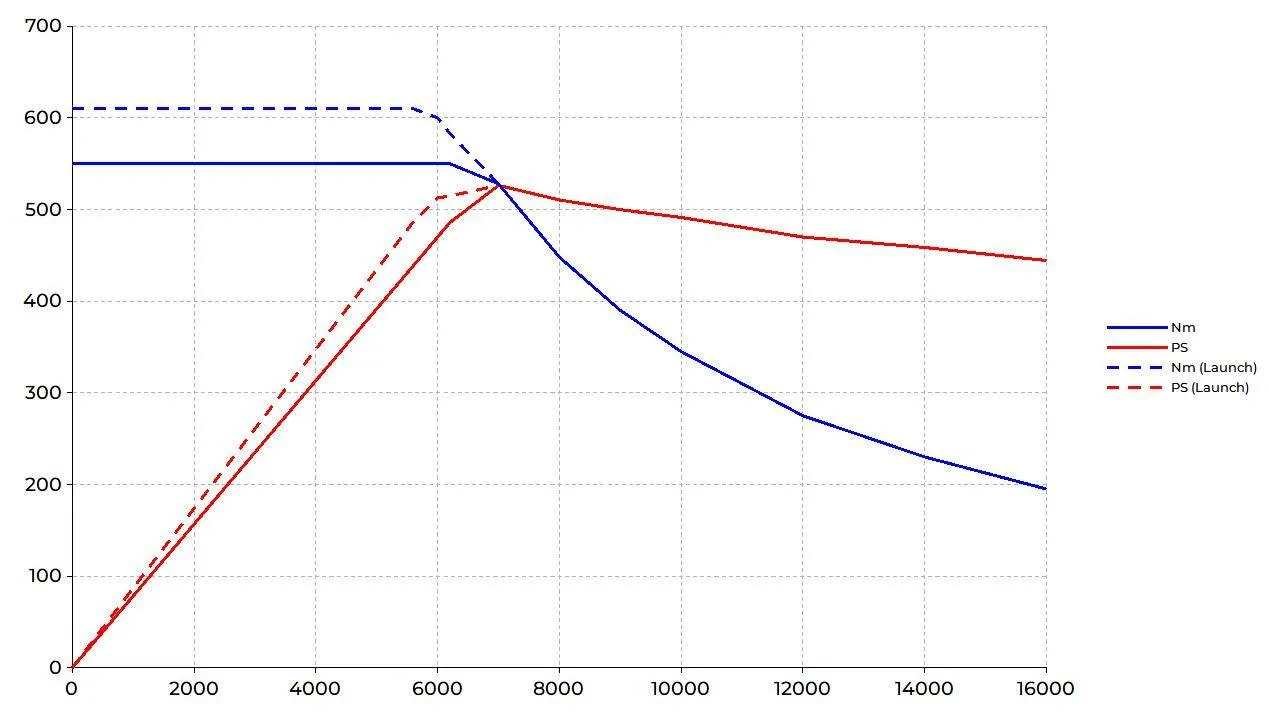
The bigger one of the rear motors/inverters. The standard torque limit is 550Nm. During race start activation in the ASG, the torque limit is increased to 610 Nm. The peak power output is about 525 PS.
Below is the graph for the maximum possible output, as seen by the ASG near 100% SoC:
3.4. Rear Motor/Inverter - 4S, 4, Etron GT, RWD(?)
The smaller motor. I am not 100% sure about the RWD variant, because I have not had the chance to test one yet. But judging by the advertised torque output and shift points it checks out.
The maximum torque is 340Nm, surprisingly there is a launch control mode, which bumps the torque up to 360Nm. The maximum power output is 480 PS, which means on the Taycan RWD it runs flat out in launch control.
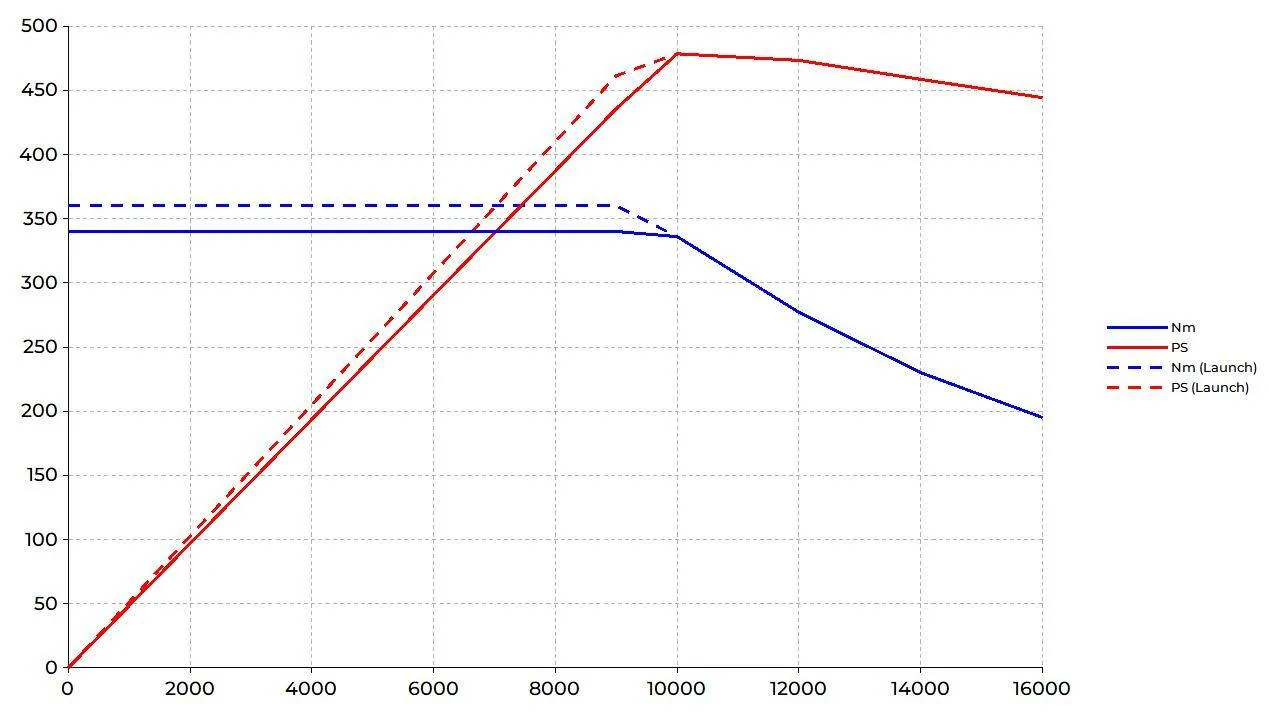
The small motor is actually very capable. Due to the 2 speed gearbox, it is possible to extract the maximum power from 83km/h. The larger motor/inverter combo makes just 9.4% more power, but 69.4% more torque.
3.5. Summary
The most important takeaway from this, is that you are always paying for the torque when going to the next motor/inverter. The maximum power is quite similar between all the variants, but because we have motors revving to 16000 rpm and the maximum power at high revs with the smaller motor, there is a massive difference between 0-60km/h.
4. The battery
I will not be as in-depth here as in the previous chapter, but I will give some numbers for the battery capability.
The peak allowed draw from the battery itself is over 600 kW, but because the powertrain is not 100% efficient, the maximum power output out of the motors is less.
For the bigger battery:
At 100% SoC the large battery is capable of delivering about 800 PS.
At 95% SoC this drops to 790 PS.
At 85% SoC the Porsche specified power of 760 PS in the Turbo S is delivered.
At 75% SoC, the maximum power is closer to 725 PS, and it keeps dropping the lower the SoC gets.
This is why the "big daddy" variants are limited to 625 PS outside of launch mode - to give them consistent power without regard for the SoC.
The smaller battery is not as capable, I also did not make as many measurements with it, but:
At 100% SoC the small battery is capable of delivering about 660 PS.
At 80% SoC this drops to 630 PS.
5. Maximum performance curves
This post would not be complete without the total power potential of each model. Before you even ask - these are the actual true maximums. No matter what Tuner Y or Tuner X is telling you.
These are also not what the cars are running from factory, with the exception of the Turbo S and Taycan RWD (with the larger battery) in launch control. Yes, the Turbo S will do 800 PS at 100% SoC completely without any modifications in launch control .
1. It is impossible to increase the total power past these maximums in the larger rear motor cars without installing a different battery and BMS.
2. It is impossible to increase the total torque past these maximums without re-flashing the invcon units and compromising the inverter reliability.
3. It is possible to safely increase the power and torque to these limits, because indeed, Porsche already does this on the Taycan Turbo S and the Taycan RWD from factory. So there is no danger to the motors, or the batteries.
4. It is impossible to have full launch torque without reverse engineering the program code in the ECU and patching it. You can never have the full LC torque only by editing the calibration. No tuners do this at the moment. More about this in Part 3.
Finally, please note that these curves do not take in account the gearbox on the rear axle. Consider them maximum performance in second gear. It is also possible to plot the first gear performance by multiplying the RPM x2 for the rear motor.
5.1. Taycan Turbo S
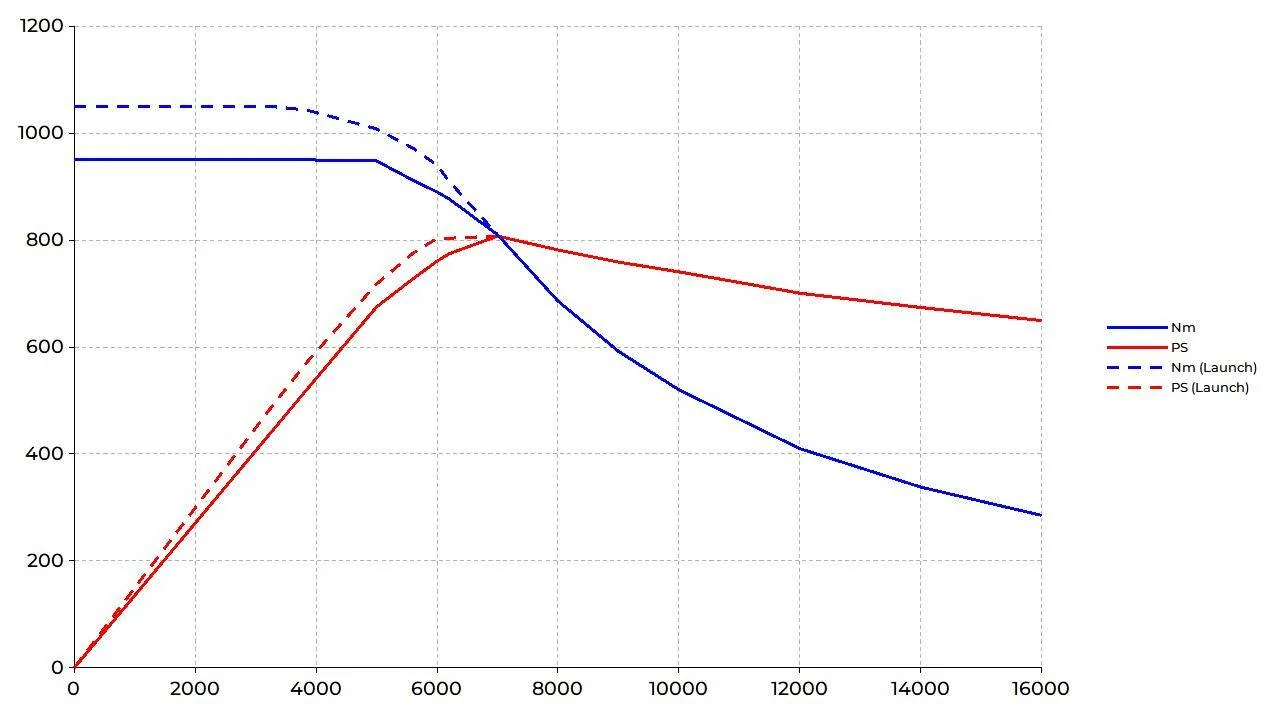
Maximum 800 PS / 1050 Nm in launch control, 800 PS / 950 Nm outside. At 100% SoC.
5.2. Taycan Turbo / Taycan GTS / Etron GT RS
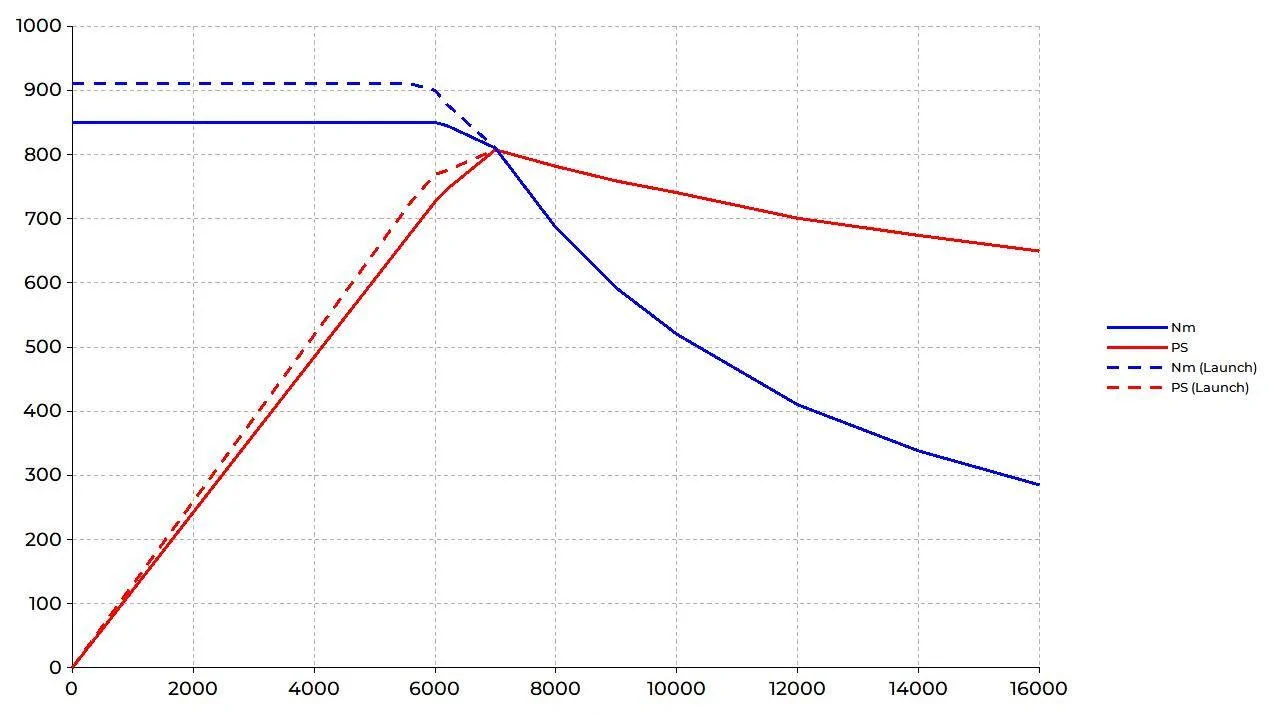
Maximum 800 PS / 910 Nm in launch control, 800 PS / 850 Nm outside. At 100% SoC.
5.3. Taycan 4S, Taycan 4 - Performance Battery Plus
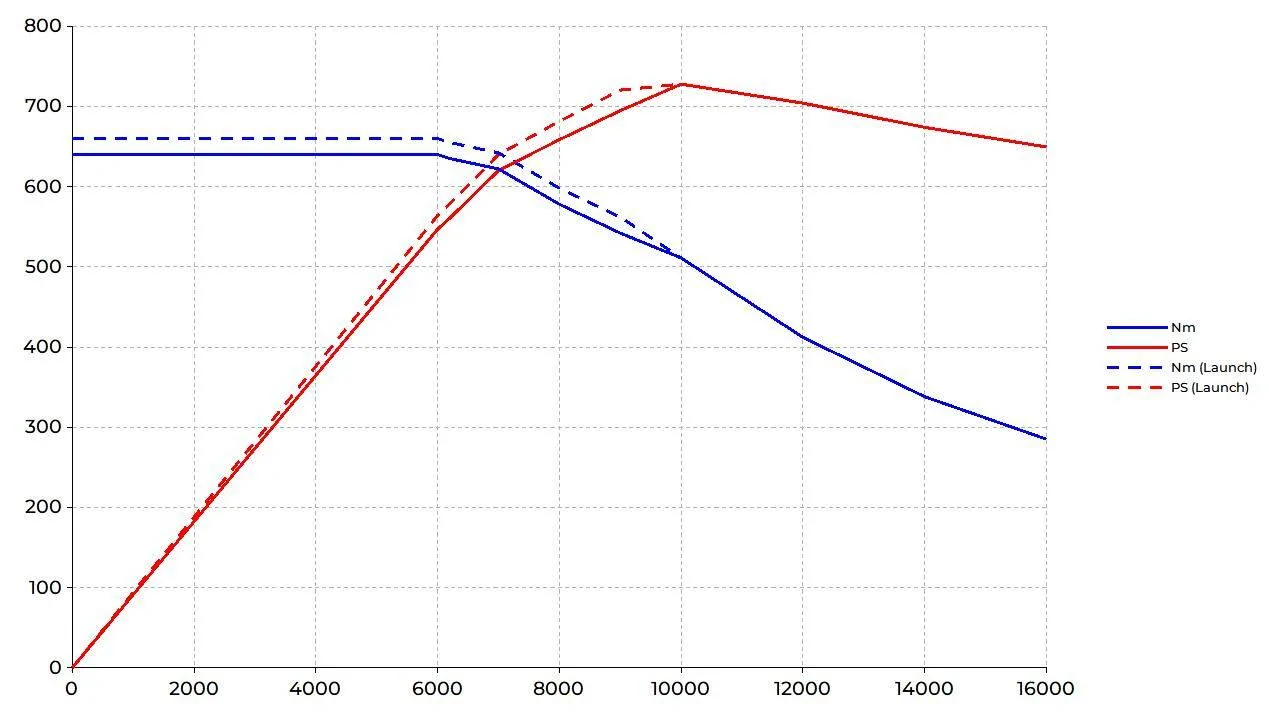
Maximum 730 PS / 660 Nm in launch control, 730 PS / 640 Nm outside. At 75-100% SoC.
5.4. Taycan 4S - Performance Battery
This graph was taken at about 80% SoC. I do not have a full 100% SoC graph for this battery.
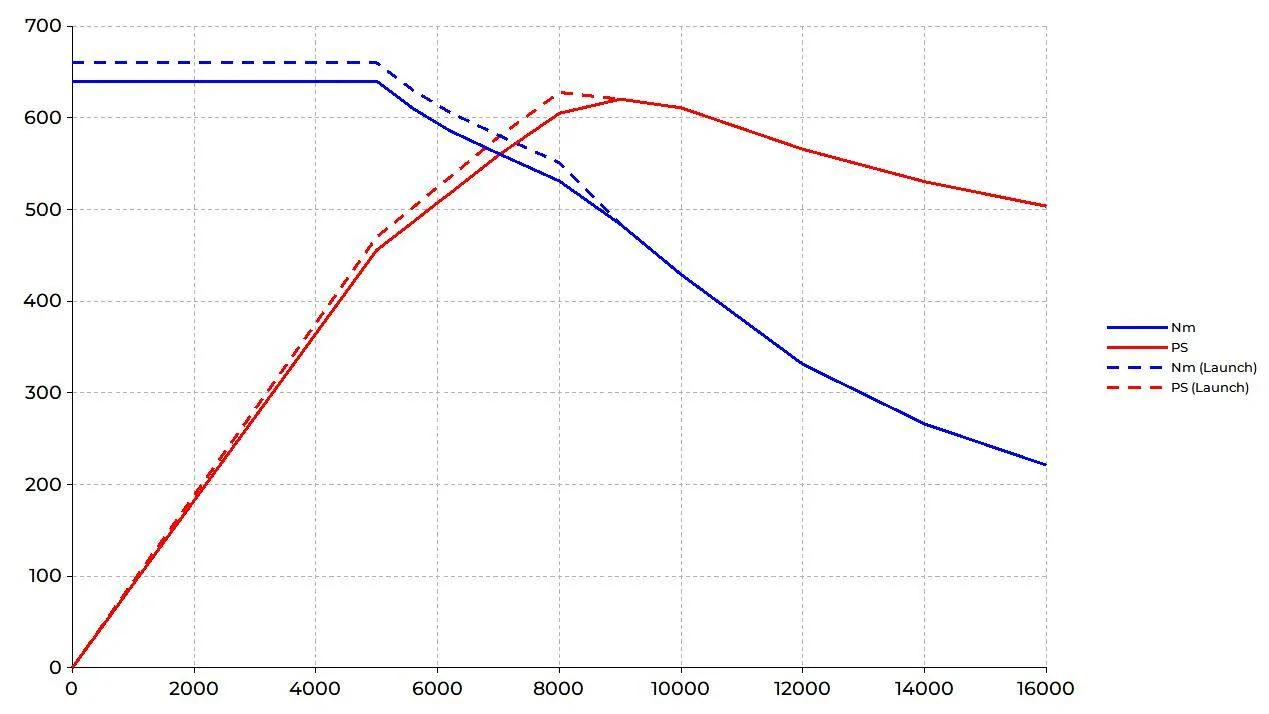
Maximum 660 PS / 660Nm in launch control, 660 PS / 640 Nm outside. At 100% SoC.
At 80% SoC: 630 PS / 660 Nm in launch control, 620 PS / 640 Nm outside.
5.5. Taycan RWD - Either battery type
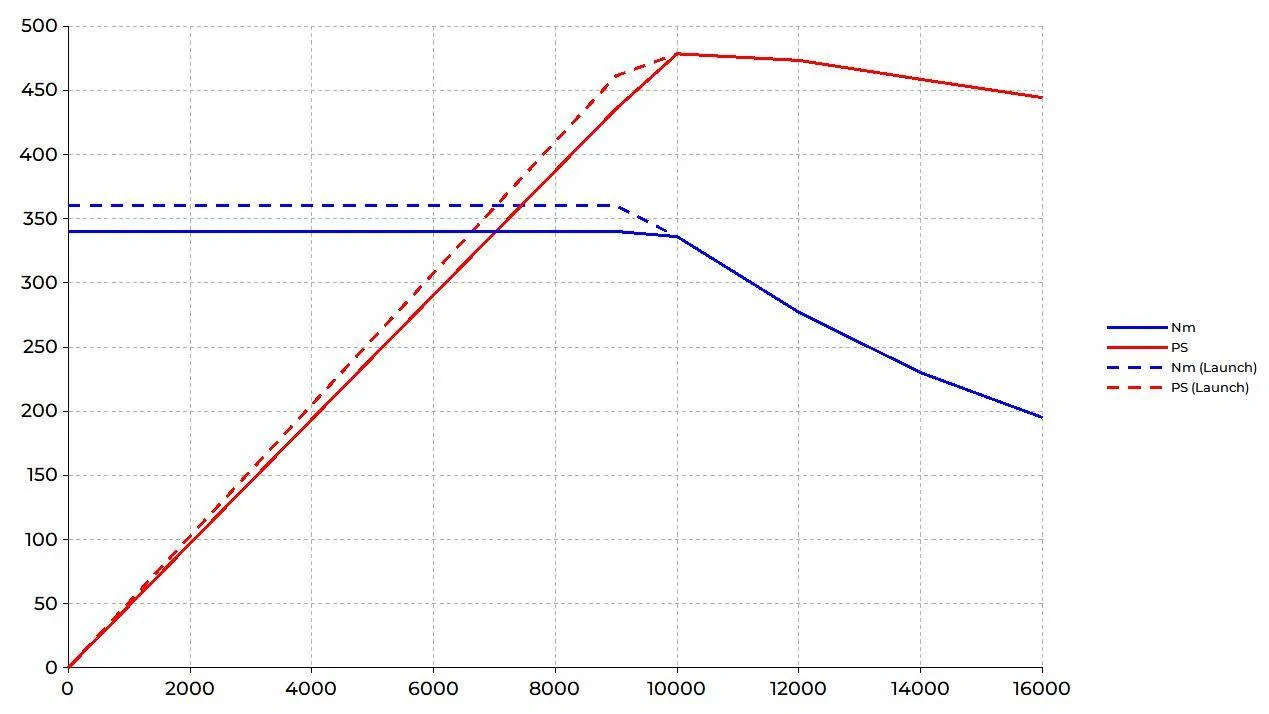
The RWD Taycan manages 480 PS and 340 Nm outside launch control and 480 PS and 360 Nm with launch control.
6. Conclusion
This should give some insight into the actual capabilities of the J1 platform with some real numbers. I also hope that some more critical thinking is created towards arbitrary numbers thrown around by certain companies.
Finally, all this data is reported by the ASG, if you have the ability to inject some code into the firmware to gain access to the roughly 33000 loggable parameters inside. I do this for a living.
In Part 3 I delve deep into the ASG control electronics and what is possible to improve beyond lifting the torque to the maximum allowed by the inverter controllers and the battery management.
7. Bonus
Here is a small informal video of the inverter controller torque limits changing on the flexray bus depending on the launch control status:
Sponsored
Last edited:



 Appreciate the breakdown by car trim/spec.