Sponsored

Electric Vehicles Are Way, Way More Energy-Efficient Than Internal Combustion Vehicles - MotorTrend Article

snstevens

Well-Known Member
First Name
Sam
Joined
Jul 10, 2020
Threads
31
Messages
1,334
Reaction score
1,739
Location
Kirkland, WA United States
Vehicles
Taycan 4S
Country flag
<UPDATE - After reading the comments to my original post, I dug into the source of the images and found information from a DOE website that can be found at this post below. It appears that data comes from the Department of Energy, and the percentages shown are for a Combined Drive Cycle which is a weighted average of the Drive Cycle for City Driving and Highway Driving.>

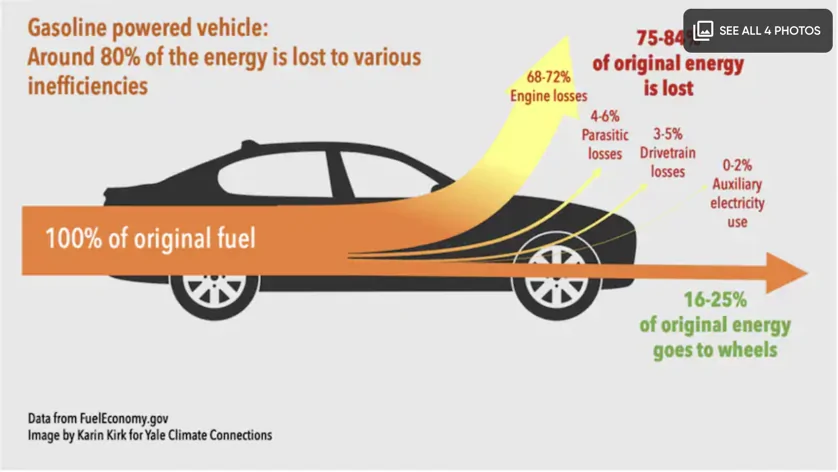
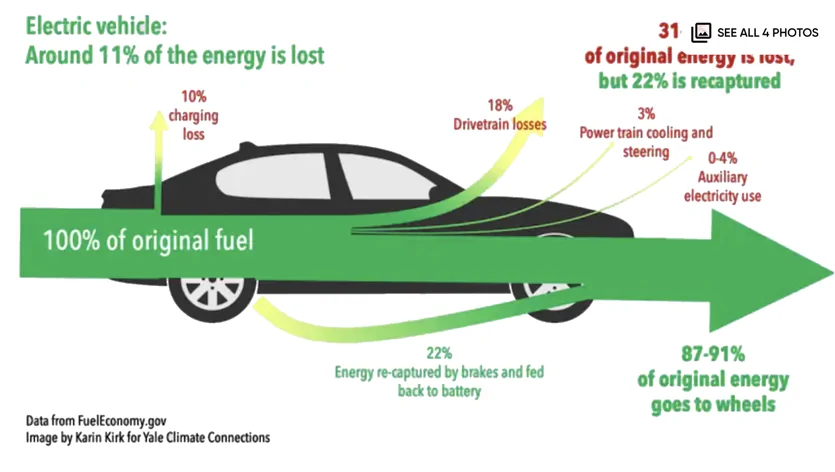
These two graphics capture the essence of the article.

Porsche Taycan Electric Vehicles Are Way, Way More Energy-Efficient Than Internal Combustion Vehicles - MotorTrend Article 1690758140154

Porsche Taycan Electric Vehicles Are Way, Way More Energy-Efficient Than Internal Combustion Vehicles - MotorTrend Article 1690758157422


They also compare the grid impact for total energy required and compare Coal-fired plants to Nat Gas plants.

"Even if the grid were entirely fueled by coal, 31% less energy would be needed to charge EVs than to fuel gasoline cars. If EVs were charged by natural gas, the total energy demand for highway transportation would fall by nearly half. Add in hydropower or other renewables, and the result gets even better, saving up to three-fourths of the energy currently used by gasoline-powered vehicles," according to Yale Climate Connections. Right now, all of that energy is getting lost mostly to heat."
Sponsored

 
Last edited:

trogger

Well-Known Member
Joined
Feb 16, 2023
Threads
11
Messages
53
Reaction score
44
Location
San Francisco Bay Area
Vehicles
'24 CT 4S
Country flag
This doesn’t make sense. If 18% of the original energy goes to drivetrain losses in the electric case (seems reasonable), then recuperation can’t get that back, so there’s no way it is more than 82% efficient. This is weird math at best.
 

trogger

Well-Known Member
Joined
Feb 16, 2023
Threads
11
Messages
53
Reaction score
44
Location
San Francisco Bay Area
Vehicles
'24 CT 4S
Country flag
Not arguing with the overall conclusion, just the way the numbers are presented is inconsistent. Percentages of percentages often get complicated. Could be that that is the losses of the stuff that isn’t recuperated, but the way it is presented doesn’t add up (literally).
 

violuma

Well-Known Member
Joined
Jul 21, 2023
Threads
3
Messages
451
Reaction score
676
Location
San Carlos, CA
Vehicles
2024 RWD
Country flag
This is weird math at best.
The only way I can see it adding up is for all the numbers to have been measured independently, and then presented as percentages of the original energy input to the system. So the denominator on that 22% is not "how much energy the regen braking system saw", but rather "how much energy the system started with".

Which, as you point out, is a weird number that doesn't correspond to any aspect of the system itself. It does make the specific calculation being attempted here easier to do, though, because you don't have to worry about summing infinite series (drivetrain losses will hit us each trip through the drivetrain).

The cited underlying numbers from DOE/EPA do specifically describe that 22% regen addback as "net", so maybe that is what is going on.


OP
OP
snstevens

snstevens

Well-Known Member
First Name
Sam
Joined
Jul 10, 2020
Threads
31
Messages
1,334
Reaction score
1,739
Location
Kirkland, WA United States
Vehicles
Taycan 4S
Country flag
Not arguing with the overall conclusion, just the way the numbers are presented is inconsistent. Percentages of percentages often get complicated. Could be that that is the losses of the stuff that isn’t recuperated, but the way it is presented doesn’t add up (literally).
I agree with you, and I'll have to look at the article referenced by @violuma to see if I can get my arms around that.

At the same time I think the article is going in the right general direction with its conclusions and I found it thought provoking.
 

tigerbalm

Well-Known Member
First Name
Damien
Joined
Oct 11, 2020
Threads
94
Messages
3,514
Reaction score
7,912
Location
Dublin, Ireland
Website
www.targatrips.com
Vehicles
911 Targa 4 GTS, Fiat 500 EV. Sold: Taycan Turbo S, Taycan 4S; Panamera Turbo S
Country flag
This doesn’t make sense. If 18% of the original energy goes to drivetrain losses in the electric case (seems reasonable), then recuperation can’t get that back, so there’s no way it is more than 82% efficient. This is weird math at best.
Is it that the same drive-train that results in 18% of energy losses is also capable of generating energy via recuperation. So a loss producing component is also a source of energy. Therefore, when combined it's not as loss producing as it might initially seem ?
 
OP
OP
snstevens

snstevens

Well-Known Member
First Name
Sam
Joined
Jul 10, 2020
Threads
31
Messages
1,334
Reaction score
1,739
Location
Kirkland, WA United States
Vehicles
Taycan 4S
Country flag
One of the references in the link provided by @violuma is only 1 page long and contains the following explanation of how regeneration effects factors in —

Regenerative Braking for Electrified Powertrain Vehicles
With the introduction of regenerative braking, some energy is recovered and reused instead of being dissipated as heat. The braking system literally produces electricity by using the kinetic energy of the vehicle to turn a generator (the electric motor can usually serve as the generator) which replenishes the battery.​
High Cycle Efficiencies for Electric Vehicles
The electrical losses of the battery and electric motor drive train (battery-to-wheels) in electric vehicles is generally only 10%–20%. Because of the way cycle energy efficiency is defined, the efficiency can be quite high and can even exceed 100% for electric vehicles operating on certain drive cycles. An efficiency exceeding 100% means that over a drive cycle, the fuel energy used was less than the required forward tractive energy (work) to push the vehicle through the cycle. It takes a cycle with a large amount of regenerative braking to produce a value exceeding 100%.​

I think this helps the figures make more sense. Clearly the actual energy consumed depends on elevation being gained or lost, and how much braking is occurring.


Dee

Well-Known Member
First Name
Dee
Joined
Dec 14, 2018
Threads
78
Messages
3,499
Reaction score
4,039
Location
The Netherlands
Vehicles
A lot
Country flag
It's just plain wrong to get 22% of that 31% loss back by regen.
So total efficiency is 100%-31 to 35%*=69 to 65%.
Regen doesn't play a roll here as it has never left the system.

*including 0-4% auxiliary electric use.
 
Last edited:

Jhenson29

Well-Known Member
First Name
Jeremy
Joined
Feb 9, 2021
Threads
37
Messages
3,014
Reaction score
4,650
Location
St. Louis, MO
Vehicles
2022 Macan S; 2021 Taycan 4S
Country flag
I’m having a harder time understanding anyone’s confusion than I am the infographic.

There’s more energy going out than what was put in minus losses because some of the energy is going out more than once.
 

DougFrisk

Well-Known Member
First Name
Doug
Joined
Oct 24, 2022
Threads
4
Messages
380
Reaction score
588
Location
Duluth MN
Vehicles
No longer awaiting a 4CT
Country flag
This doesn’t make sense. If 18% of the original energy goes to drivetrain losses in the electric case (seems reasonable), then recuperation can’t get that back, so there’s no way it is more than 82% efficient. This is weird math at best.
They are different things. Drivetrain losses are losses. They don't come back. What the 22% represents is power that was used to accelerate the car that is recovered through recouperation and reused again. It's essentially costless energy.
 

bluedonkey

Well-Known Member
First Name
John
Joined
Apr 20, 2021
Threads
3
Messages
115
Reaction score
91
Location
Alameda, CA
Vehicles
Taycan 4S
Country flag
They are different things. Drivetrain losses are losses. They don't come back. What the 22% represents is power that was used to accelerate the car that is recovered through recouperation and reused again. It's essentially costless energy.

It is pretty hard to get an infographic that represents all the losses here (there are also losses, in both cases, to drag and rolling resistance). As others have commented, the percentages can lead to confusion unless you're clear about denominator - hopefully, all the percentages are relative to the original energy coming in. If you look at where they drew the arrow for the regen, I think that makes it clearer, but I would still like to know whether it was 22% of what reached the wheels or 22% of the original energy added.
 

Jhenson29

Well-Known Member
First Name
Jeremy
Joined
Feb 9, 2021
Threads
37
Messages
3,014
Reaction score
4,650
Location
St. Louis, MO
Vehicles
2022 Macan S; 2021 Taycan 4S
Country flag
but I would still like to know whether it was 22% of what reached the wheels or 22% of the original energy added.
It’s not explicit, but everything suggests that it’s the original energy.

And I’m not sure it’s relevant. They have to be making an average or other assumptions in either case (I didn’t ready the article, maybe they say). But in specific use cases, it may be much higher or lower. It could be near zero if you accelerate once, drive at a constant speed, and decelerate once. It may be much higher with lots of frequent decelerations such that the output energy exceeds the original input energy. I didn’t run any numbers, but I don’t think that’s that hard to imagine.
Sponsored


Top