Sponsored

Taycan Problem - potential catastrophic tire failure

acull2000

Well-Known Member
Joined
Sep 17, 2024
Threads
0
Messages
56
Reaction score
21
Location
Warwickshire
Vehicles
Taycan GTS
Country flag
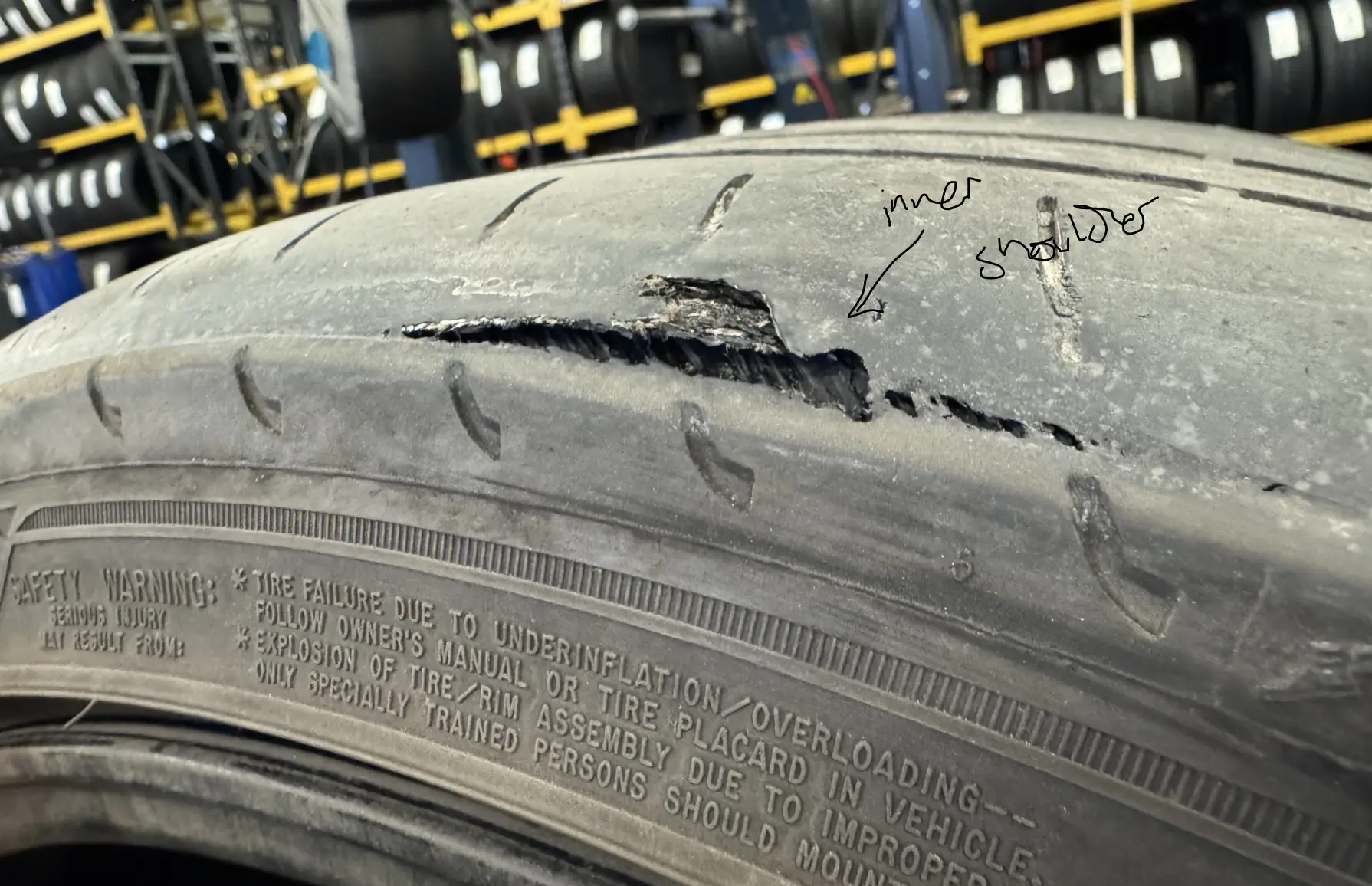
Is there anyone else not experiencing this issue? What car/tires/wheel size are you running? Maybe we can figure out the trend here.
I
If this is the case, then shame on Porsche. Selling a car with a suspension adjustment that, if chosen, will result in a catastrophic tire failure is about as bad as you can get from an engineering standpoint. I'm not as sure as you about the cause... Has anyone done an alignment measurement in the lowered position?
You can't officially adjust the front camber (though it must be set/regulated from the factory by virtue of the bolt positions) - only balance it out from left to right:
https://www.taycanforum.com/forum/threads/geometry-done-at-center-gravity.28453/post-427940
Porsche claim to have resolved an initial build issue (excessive camber) by presumably adding slotted joints in the BiW:
https://static.nhtsa.gov/odi/tsbs/2021/MC-10187852-0001.pdf

@TaycanRob showed camber angle increased by 0.345° between normal and range (-22mm) on a 2025 Turbo:
https://www.taycanforum.com/forum/t...l-catastrophic-tire-failure.16788/post-311337
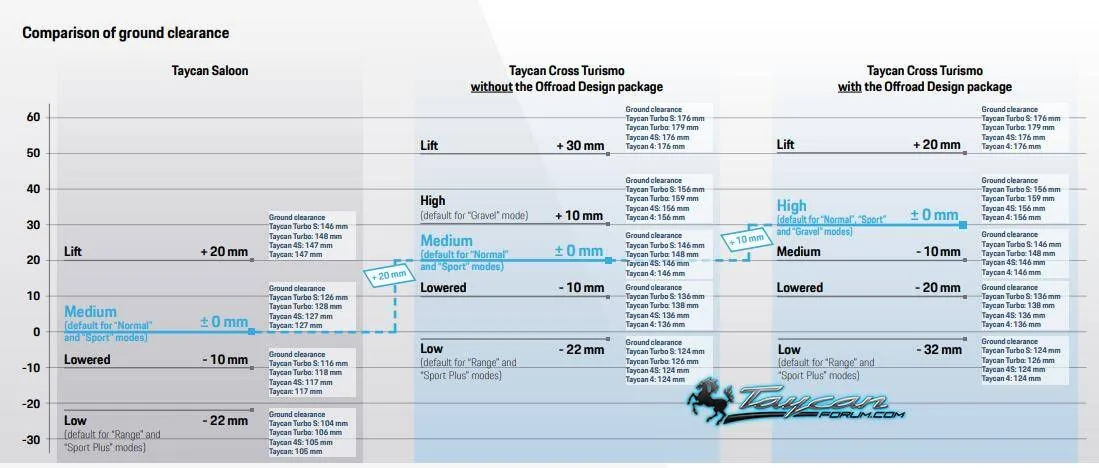
Porsche Taycan Taycan Problem - potential catastrophic tire failure 1765903608101-b5
Sponsored

 
Last edited:
OP
OP
Vim Schrotnock

Vim Schrotnock

Well-Known Member
First Name
Vim
Joined
Oct 20, 2018
Threads
37
Messages
1,269
Reaction score
1,886
Location
Cincinnati
Vehicles
GTB1 Race Cayman, Taycan Turbo S
Country flag
.345 deg increase in camber doesn't strike me as enough to cause inner sidewall failure. Possibly the toe adjustment is off - I guess there is a special tool required, and inner sidewall is very sensitive to toe adjustment. I'd ask more experienced minds to weigh in here.

You can't officially adjust the camber (though it must be set/regulated from the factory by virtue of the bolt positions).

@TaycanRob showed camber angle increased by 0.345° between normal and range (-22mm) on a 2025 Turbo:
https://www.taycanforum.com/forum/t...l-catastrophic-tire-failure.16788/post-311337

1765903608101-b5.webp
 
Last edited:

SteveDC

Well-Known Member
First Name
Steve
Joined
Apr 22, 2021
Threads
23
Messages
211
Reaction score
124
Location
Mid-Atlantic
Vehicles
Taycan 4S, 308QV
Country flag
Thanks so much for these references. I was using the door sticker information, figuring it was specific to my vehicle‘s weight and configuration.
 

acull2000

Well-Known Member
Joined
Sep 17, 2024
Threads
0
Messages
56
Reaction score
21
Location
Warwickshire
Vehicles
Taycan GTS
Country flag
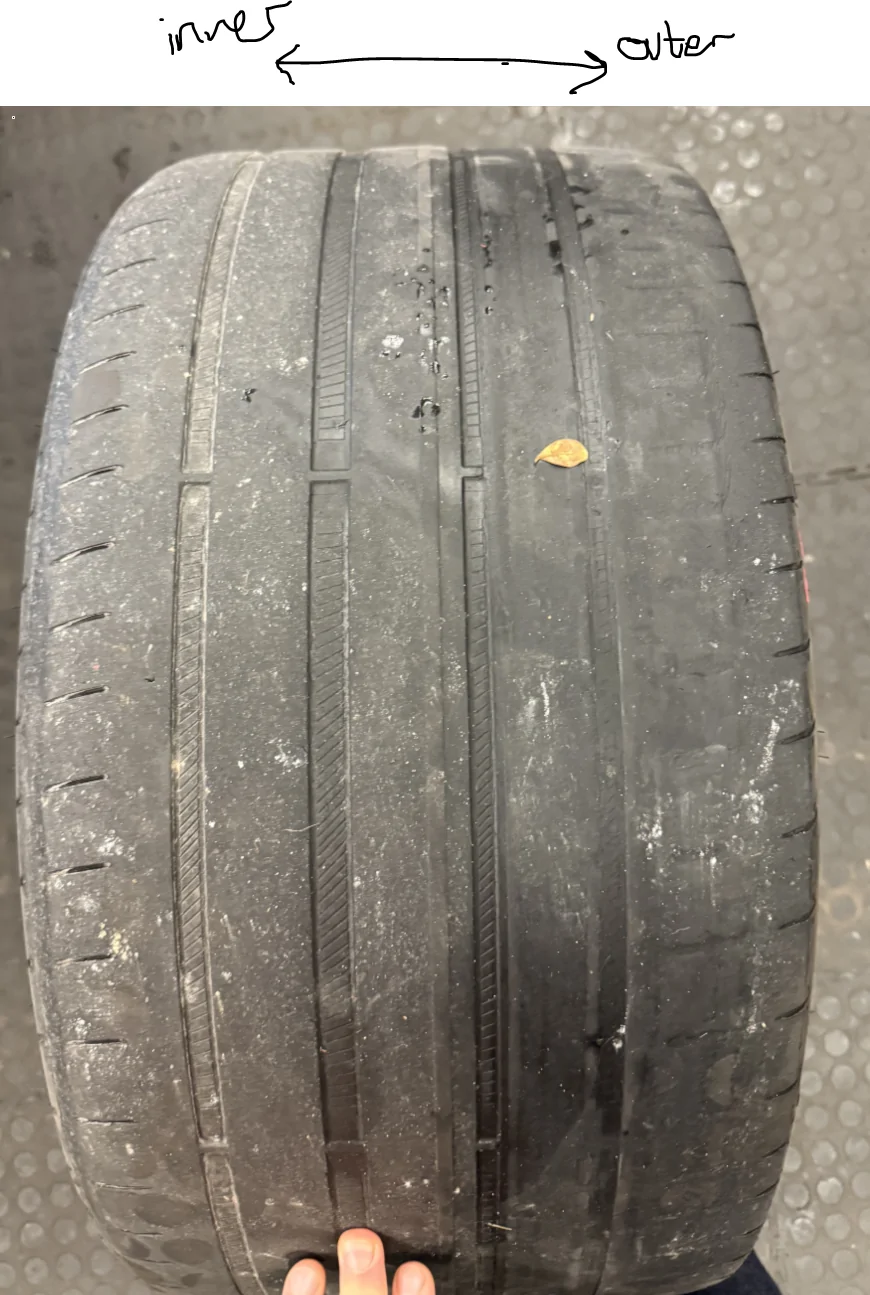
I had both rear tyres replaced today and wonder if my findings show excessive tyre shoulder wear is not due to camber settings? To explain:

Both (original) tyres were well worn (to legal limit-ish) having done now ~16,000miles. The wear was 'relatively even' but not perfectly even:
- the left rear showed 1-2mm more tread wear on the inside of the tyre (indicating negative camber as we'd expect). There was inner shoulder wear causing delamination most the way round the tyre.
- the right rear showed 1-2mm more tread wear on the outside of the tyre (indicating positive camber), yet still the tyre had significant inner shoulder wear (not as much as the other, but enough to show cords and tread delamination).

So even if you (wrongly) set up your car with positive rear camber, the inner shoulders will still wear prematurely.

Going to speak to some specialists about doing geo's (as my right rear is clearly wrong) but I'm loosing faith adjusting camber will ever prevent the problem (particularly as on the front, you can't reduce camber, only balance it):
https://www.taycanforum.com/forum/threads/geometry-done-at-center-gravity.28453/
 
OP
OP
Vim Schrotnock

Vim Schrotnock

Well-Known Member
First Name
Vim
Joined
Oct 20, 2018
Threads
37
Messages
1,269
Reaction score
1,886
Location
Cincinnati
Vehicles
GTB1 Race Cayman, Taycan Turbo S
Country flag
I had both rear tyres replaced today and wonder if my findings show excessive tyre shoulder wear is not due to camber settings? To explain:

Both (original) tyres were well worn (to legal limit-ish) having done now ~16,000miles. The wear was 'relatively even' but not perfectly even:
- the left rear showed 1-2mm more tread wear on the inside of the tyre (indicating negative camber as we'd expect). There was inner shoulder wear causing delamination most the way round the tyre.
- the right rear showed 1-2mm more tread wear on the outside of the tyre (indicating positive camber), yet still the tyre had significant inner shoulder wear (not as much as the other, but enough to show cords and tread delamination).

So even if you (wrongly) set up your car with positive rear camber, the inner shoulders will still wear prematurely.

Going to speak to some specialists about doing geo's (as my right rear is clearly wrong) but I'm loosing faith adjusting camber will ever prevent the problem (particularly as on the front, you can't reduce camber, only balance it):
https://www.taycanforum.com/forum/threads/geometry-done-at-center-gravity.28453/
I have to agree - if it was a camber problem, you’d see uneven tread wear. I didn’t see that on my tires, and haven’t seen it on posters tires. Something very strange…


OP
OP
Vim Schrotnock

Vim Schrotnock

Well-Known Member
First Name
Vim
Joined
Oct 20, 2018
Threads
37
Messages
1,269
Reaction score
1,886
Location
Cincinnati
Vehicles
GTB1 Race Cayman, Taycan Turbo S
Country flag
From my buddy Claude:

Taycan Inner Shoulder Tire Failure — Root Cause Analysis

The Problem:


Rear tires with even tread wear (5-8mm across the full width) are failing catastrophically at the inner shoulder, with cords exposed or sidewall separation. This wear is often invisible from outside the vehicle and only discovered on a lift. Multiple owners across different model years, wheel sizes, and tire brands have reported this issue.

Why It's NOT Simple Camber Misalignment:

If static negative camber were the cause, the inner edge of the tread would wear faster than the outer — classic uneven tread wear. That's not what's happening. The tread wears evenly while the shoulder/sidewall junction fails.

The Actual Cause — Dynamic System Interaction:

The failure results from the combination of two systems working together:

  1. Air Suspension Height Changes
    • Camber shifts from approximately -1.8° at normal height to -2.5° at lowest setting
    • The car constantly adjusts height (auto-lowering at highway speeds, mode changes, bump absorption)
    • Each transition creates lateral scrubbing forces at the inner shoulder as the wheel pivots inward while the tire is rolling
  2. Rear-Axle Steering (RAS)
    • RAS makes continuous small toe adjustments during normal driving
    • With the wheel already cambered inward, the inner shoulder carries more load
    • When RAS adjusts toe, the tire pivots around an offset point near the loaded inner edge
    • This creates a lever arm effect that concentrates twisting/shearing forces at the inner shoulder — not the tread face
The Failure Mechanism:

  • Negative camber pre-loads the inner shoulder with higher vertical force
  • RAS makes toe adjustments (even fractions of a degree)
  • The heavily loaded inner edge resists pivoting and gets dragged laterally
  • Shearing forces concentrate at the shoulder/sidewall junction
  • Thousands of repetitions per drive create fatigue failure
  • Tread blocks roll normally and wear evenly — the damage is isolated to the shoulder
Why Standard Alignment Checks Miss This:

  • Dealers typically check alignment in Normal mode at static ride height
  • Owners often drive in Sport/Low/Range modes with more aggressive camber
  • Alignment may be within spec at one height but out of spec at another
  • Static measurements cannot capture dynamic forces from RAS activity and suspension transitions
Contributing Factors:

  • Vehicle weight (~5,000 lbs / 2,300 kg) amplifies scrubbing forces
  • Wide, low-profile tires have stiffer sidewalls that concentrate stress at the shoulder
  • Frequency of height transitions (highway driving with auto-lowering)
  • Rear-axle steering equipped vehicles appear more susceptible
Recommendations:

  1. Request alignment in the ride height mode you actually drive in
  2. Inspect inner shoulders regularly — this wear is not visible without lifting the car
  3. Consider filing an NHTSA complaint to document the issue
  4. Some owners report success running higher pressures (42/40 psi front/rear) and flipping tires inside-out at 10-12k miles
Conclusion:

This is a system integration issue between the Taycan's suspension geometry and rear-axle steering — not a simple alignment problem. The dynamic interaction between camber changes and RAS toe adjustments creates fatigue loading at the inner shoulder that does not appear in standard tread wear patterns or static alignment measurements.
 

figure1a

Well-Known Member
Joined
Nov 8, 2022
Threads
3
Messages
209
Reaction score
143
Location
San Diego
Vehicles
Taycan Turbo S
Country flag
I have to agree - if it was a camber problem, you’d see uneven tread wear. I didn’t see that on my tires, and haven’t seen it on posters tires. Something very strange…
Most people in these threads DO have uneven tread wear. If you have it on both inner and outer, then your tires are just underinflated.
 

figure1a

Well-Known Member
Joined
Nov 8, 2022
Threads
3
Messages
209
Reaction score
143
Location
San Diego
Vehicles
Taycan Turbo S
Country flag
From my buddy Claude:

Taycan Inner Shoulder Tire Failure — Root Cause Analysis

The Problem:


Rear tires with even tread wear (5-8mm across the full width) are failing catastrophically at the inner shoulder, with cords exposed or sidewall separation. This wear is often invisible from outside the vehicle and only discovered on a lift. Multiple owners across different model years, wheel sizes, and tire brands have reported this issue.

Why It's NOT Simple Camber Misalignment:

If static negative camber were the cause, the inner edge of the tread would wear faster than the outer — classic uneven tread wear. That's not what's happening. The tread wears evenly while the shoulder/sidewall junction fails.

The Actual Cause — Dynamic System Interaction:

The failure results from the combination of two systems working together:

  1. Air Suspension Height Changes
    • Camber shifts from approximately -1.8° at normal height to -2.5° at lowest setting
    • The car constantly adjusts height (auto-lowering at highway speeds, mode changes, bump absorption)
    • Each transition creates lateral scrubbing forces at the inner shoulder as the wheel pivots inward while the tire is rolling
  2. Rear-Axle Steering (RAS)
    • RAS makes continuous small toe adjustments during normal driving
    • With the wheel already cambered inward, the inner shoulder carries more load
    • When RAS adjusts toe, the tire pivots around an offset point near the loaded inner edge
    • This creates a lever arm effect that concentrates twisting/shearing forces at the inner shoulder — not the tread face
The Failure Mechanism:

  • Negative camber pre-loads the inner shoulder with higher vertical force
  • RAS makes toe adjustments (even fractions of a degree)
  • The heavily loaded inner edge resists pivoting and gets dragged laterally
  • Shearing forces concentrate at the shoulder/sidewall junction
  • Thousands of repetitions per drive create fatigue failure
  • Tread blocks roll normally and wear evenly — the damage is isolated to the shoulder
Why Standard Alignment Checks Miss This:

  • Dealers typically check alignment in Normal mode at static ride height
  • Owners often drive in Sport/Low/Range modes with more aggressive camber
  • Alignment may be within spec at one height but out of spec at another
  • Static measurements cannot capture dynamic forces from RAS activity and suspension transitions
Contributing Factors:

  • Vehicle weight (~5,000 lbs / 2,300 kg) amplifies scrubbing forces
  • Wide, low-profile tires have stiffer sidewalls that concentrate stress at the shoulder
  • Frequency of height transitions (highway driving with auto-lowering)
  • Rear-axle steering equipped vehicles appear more susceptible
Recommendations:

  1. Request alignment in the ride height mode you actually drive in
  2. Inspect inner shoulders regularly — this wear is not visible without lifting the car
  3. Consider filing an NHTSA complaint to document the issue
  4. Some owners report success running higher pressures (42/40 psi front/rear) and flipping tires inside-out at 10-12k miles
Conclusion:

This is a system integration issue between the Taycan's suspension geometry and rear-axle steering — not a simple alignment problem. The dynamic interaction between camber changes and RAS toe adjustments creates fatigue loading at the inner shoulder that does not appear in standard tread wear patterns or static alignment measurements.
If Claude's diagnosis were accurate, every single Taycan would exhibit this issue. It is only a small percentage and almost all of those have verified that they run their car in the lowest suspension setting which is more indicative of camber creating the uneven wear.


acull2000

Well-Known Member
Joined
Sep 17, 2024
Threads
0
Messages
56
Reaction score
21
Location
Warwickshire
Vehicles
Taycan GTS
Country flag
From my buddy Claude:

Taycan Inner Shoulder Tire Failure — Root Cause Analysis

The Problem:


Rear tires with even tread wear (5-8mm across the full width) are failing catastrophically at the inner shoulder, with cords exposed or sidewall separation. This wear is often invisible from outside the vehicle and only discovered on a lift. Multiple owners across different model years, wheel sizes, and tire brands have reported this issue.

Why It's NOT Simple Camber Misalignment:

If static negative camber were the cause, the inner edge of the tread would wear faster than the outer — classic uneven tread wear. That's not what's happening. The tread wears evenly while the shoulder/sidewall junction fails.

The Actual Cause — Dynamic System Interaction:

The failure results from the combination of two systems working together:

  1. Air Suspension Height Changes
    • Camber shifts from approximately -1.8° at normal height to -2.5° at lowest setting
    • The car constantly adjusts height (auto-lowering at highway speeds, mode changes, bump absorption)
    • Each transition creates lateral scrubbing forces at the inner shoulder as the wheel pivots inward while the tire is rolling
  2. Rear-Axle Steering (RAS)
    • RAS makes continuous small toe adjustments during normal driving
    • With the wheel already cambered inward, the inner shoulder carries more load
    • When RAS adjusts toe, the tire pivots around an offset point near the loaded inner edge
    • This creates a lever arm effect that concentrates twisting/shearing forces at the inner shoulder — not the tread face
The Failure Mechanism:

  • Negative camber pre-loads the inner shoulder with higher vertical force
  • RAS makes toe adjustments (even fractions of a degree)
  • The heavily loaded inner edge resists pivoting and gets dragged laterally
  • Shearing forces concentrate at the shoulder/sidewall junction
  • Thousands of repetitions per drive create fatigue failure
  • Tread blocks roll normally and wear evenly — the damage is isolated to the shoulder
Why Standard Alignment Checks Miss This:

  • Dealers typically check alignment in Normal mode at static ride height
  • Owners often drive in Sport/Low/Range modes with more aggressive camber
  • Alignment may be within spec at one height but out of spec at another
  • Static measurements cannot capture dynamic forces from RAS activity and suspension transitions
Contributing Factors:

  • Vehicle weight (~5,000 lbs / 2,300 kg) amplifies scrubbing forces
  • Wide, low-profile tires have stiffer sidewalls that concentrate stress at the shoulder
  • Frequency of height transitions (highway driving with auto-lowering)
  • Rear-axle steering equipped vehicles appear more susceptible
Recommendations:

  1. Request alignment in the ride height mode you actually drive in
  2. Inspect inner shoulders regularly — this wear is not visible without lifting the car
  3. Consider filing an NHTSA complaint to document the issue
  4. Some owners report success running higher pressures (42/40 psi front/rear) and flipping tires inside-out at 10-12k miles
Conclusion:

This is a system integration issue between the Taycan's suspension geometry and rear-axle steering — not a simple alignment problem. The dynamic interaction between camber changes and RAS toe adjustments creates fatigue loading at the inner shoulder that does not appear in standard tread wear patterns or static alignment measurements.

I don't believe Claude as:
1) I don't have RWS on my GTS (but the tyres that just came off tell me there is something very wrong)
2) The air suspension does not 'constantly' adjust height - only when going through set points etc. I don't see how this is any worse than normal bump/roll camber (which may be the root cause), but not because of air suspension - which is usually just trying to reach a set-point.

I agree with Claude's recommendations, but wouldn't flip tyres (against tyre design) and personally will be running higher pressures.
 

acull2000

Well-Known Member
Joined
Sep 17, 2024
Threads
0
Messages
56
Reaction score
21
Location
Warwickshire
Vehicles
Taycan GTS
Country flag
If Claude's diagnosis were accurate, every single Taycan would exhibit this issue. It is only a small percentage and almost all of those have verified that they run their car in the lowest suspension setting which is more indicative of camber creating the uneven wear.
Surely can't be camber - here's a (badly set up) tyre (with wear indicative of positive camber) that also exhibits the excessive inner should wear.


Porsche Taycan Taycan Problem - potential catastrophic tire failure 1767113322835-77
Porsche Taycan Taycan Problem - potential catastrophic tire failure 1767113354450-gy
 

prj

Well-Known Member
Joined
Jan 14, 2025
Threads
7
Messages
1,756
Reaction score
2,322
Location
Estonia
Website
www.mapev.net
Vehicles
Taycan CT 4 - 2026
Country flag
Please don't paste LLM slop, it's completely useless.

The clue is in Porsche consistently increasing the recommended tyre pressure - I am thinking the sidewall might not be up to the task...

Running closer to the max pressure will most likely help.
 
OP
OP
Vim Schrotnock

Vim Schrotnock

Well-Known Member
First Name
Vim
Joined
Oct 20, 2018
Threads
37
Messages
1,269
Reaction score
1,886
Location
Cincinnati
Vehicles
GTB1 Race Cayman, Taycan Turbo S
Country flag
Running high tire pressure might ameliorate the problem, but we still don’t have the cause. Could it be rws? Anyone see this problem without it?
 

Fish Fingers

Well-Known Member
Joined
Feb 20, 2021
Threads
50
Messages
2,528
Reaction score
3,279
Location
UK
Vehicles
Sold
Country flag
I had the problem and didn't have rear wheel steering.

I also had a RWD without Sport Chrono, so there was no Sport Plus setting and I very seldom used it in Low ride height or Range mode.


Top