Sponsored

New 4S, Low Range…

AmpedUp

Well-Known Member
First Name
Ryan
Joined
Mar 24, 2021
Threads
7
Messages
87
Reaction score
74
Location
Mesa, Arizona
Vehicles
Taycan Turbo S, Toyota 4Runner
Country flag
I think I managed to do that. Basically I simply want to charge up to 75% and stop. So what I do is set a profile to 75%, then a timer for anything over 75% (I do 80) that is set for some day in the far future ( I set it on 2035). This way the car starts charging immediately once plugged in to hit the minimum 75%; the timer then stops it from charging the incremental 5% until the timer date, which essentially won’t be met.

I lose the ability to set climate but I’m in a garage so not too worried about that.
Yes, that's what setting a minimum charge will do. The problem is that when set up this way the car starts charging immediately. If that is during peak rates, I don't want it to do that. I want it to wait until peak rates begin at 11pm.
Sponsored


laua

Well-Known Member
First Name
M
Joined
Apr 23, 2022
Threads
4
Messages
173
Reaction score
217
Location
USA
Vehicles
XC90, V60, CT4S incoming
Country flag
Yes, that's what setting a minimum charge will do. The problem is that when set up this way the car starts charging immediately. If that is during peak rates, I don't want it to do that. I want it to wait until peak rates begin at 11pm.
Ah sorry I missed the peak rates part. You’re right I tried to do the same thing earlier but wasn’t able to achieve it (use the timer to start a delayed charge while also stopping at a specific charge level), absent a smart EVSE.
 

AmpedUp

Well-Known Member
First Name
Ryan
Joined
Mar 24, 2021
Threads
7
Messages
87
Reaction score
74
Location
Mesa, Arizona
Vehicles
Taycan Turbo S, Toyota 4Runner
Country flag
It still doesn't solve @AmpedUp 's scenario, which is to not start charging upon plugging in, but start charging immediately upon entering the preferred charging interval. I don't think that can be achieved with the built-in controls and for a random starting SoC.

Having said that, the requirement is an odd one, IMHO: I get the need for a delayed start, but not the latter part - to start immediately after. (Sorry, thought this horse was still twitching.)
Yup, exactly, does not solve the problem. The reason I want it to start right away is because I want my car charged ASAP (subject to charging with off-peak rates). Maybe a pair of scenarios will illustrate why this matters:

Scenario 1 (not desirable, way it works now): Charges based on timer function settings
Say I pull into my garage with 25% SoC and plug in at 6pm. Off-peak rates start at 8pm, but nothing happens at 8pm. The car sits there waiting for the 5am 85% timer to get closer. My child wakes up at 1am weazing and unable to breathe... we need to go to the hospital right away, and my car still hasn't started charging! Why? Because I have an 80amp charger that only takes about 3.25 hours to charge the car, so it wouldn't start charging until 1:45am. So I need to stop at a non-functional EA charger on the way to the hospital.

Scenario 2 (desirable, way it should work): Charges based on preferred hours and maximum
Say I pull into my garage with 25% SoC and plug in at 6pm (same as scenario 1). Off-peak rates start at 8pm. At 8pm the car begins charging. At 11:15pm the car is at my desired maximum 85% and stops charging. My child wakes up at 1am weazing and unable to breathe... we need to go to the hospital right away, and my car is charged. We don't need to stop at a non-functional EA charger on the way to the hospital.

In scenario 1, I need to know the next time I intend to drive my car. In scenario 2, it will be more ready more quickly in case I need to use my car unexpectedly. Both scenarios benefit from off-peak rates. Scenario 1 is therefore undeniably better.

It's not at all an "odd requirement". Why on earth would I ever want my charger to wait to charge once my preferred charging window begins? Why would I want my car to be less prepared to drive? The only scenario I can even think of where that makes any sense at all is the rare instance I'm leaving for a road trip and don't want the car sitting at 100% SoC for longer than required (to optimize the battery life). In that rare instance, you might use a timer to target 100% at a specific time and charge up that last 15%.

Another pair of scenarios that illustrate the limitations of the current timer function...

Scenario 1 (potentially not desirable, way it works now): Charges based on timer function settings
Say I pull into the garage at my vacation home with 25% SoC and plug in at 4pm. Off-peak rates start at 8pm and end at 5am, so I have preferred charging times set from 8pm to 5am, and a timer set to 85% at 5am to try to take advantage of off-peak rates. I decided to forego a high-speed charger at my cabin, and I charge at 12 amps 120v. The car calculates that there is no way to reach 85% by 5am, so it starts charging right away at 4pm when I plugged in. I don't want to pay peak rates.

Scenario 2 (potentially desirable if my priority is not charging on-peak, it should provide the option to forego timer by offering another way to limit the charge that isn't timer based): Charges only based on preferred hours subject to a maximum charge
Say I pull into the garage at my vacation home with 25% SoC and plug in at 4pm. Off-peak rates start at 8pm and end at 5am, so I have preferred charging times set from 8pm to 5am, and a maximum SoC of 85%. I decided to forego a high-speed charger at my cabin, and I charge at 12 amps 110v. The car doesn't start charging right away when I plug in. At 8pm, it starts charging and stops at 5am. I pick up 12 kWh of charge, or to about 40%, but at least I didn't pay peak rates.

So again, no way to limit the charge without a timer, but the timer might cause it to charge outside the desired timeframe and cost me extra. Maybe I'm at my cabin for three nights and slow but off-peak rates is what I'd rather do. Unfortunately, timers don't allow you to do that.
 
Last edited:

Mr. 2021 Taycan

Well-Known Member
Joined
Feb 1, 2021
Threads
11
Messages
159
Reaction score
194
Location
Florida
Vehicles
2021 Taycan 4S
Country flag
I have the large battery. Just did a 100% charge and my 4S showed 290 miles of range. Drove 135 miles averaging 60 MPH at about 75 degrees F. About 75% highway driving at 75 mph. Range now shows as 152. Consumption display showed 30 kWh per 100 miles on the highway.

I conclude that the numbers the car displays are very accurate and that I can count on at least 250 miles of highway driving between charges.
 

Alfa

Active Member
Joined
Aug 5, 2023
Threads
2
Messages
37
Reaction score
9
Location
USA
Vehicles
Taycan ST
Country flag
There is the cheaper electrons during the night use case, but what’s even more useful is the free electrons use case when you produce your own on the roof. And these are very common use cases, much more common than the road trip in cold weather scenario.


WasserGKuehlt

Well-Known Member
Joined
Sep 7, 2022
Threads
5
Messages
2,066
Reaction score
2,456
Location
WA
Vehicles
4CT, 996C2, MacanS
Country flag
Yup, exactly, does not solve the problem. The reason I want it to start right away is because I want my car charged ASAP (subject to charging with off-peak rates). Maybe a pair of scenarios will illustrate why this matters:

[...]
It's not at all an "odd requirement". Why on earth would I ever want my charger to wait to charge once my preferred charging window begins? Why would I want my car to be less prepared to drive?
Well, you either want to be prepared, or you don't. You are arguing both sides of the issue, and, begging your pardon, that strikes me as disingenuous. In your own examples, the unforeseen emergency could materialize itself before your interval starts, and I'm not sure how you'd reconcile that with your demand for readiness ASAP.

If you're worried about unplanned trips, eat the frog (charge to 50% at any rate upon plugging in) and chalk it up to the cost of peace of mind. The modeling of the charging functionality fully supports that scenario. Half a Taycan's battery at peak rate is still $16 or so - and that's counting from 0 SoC. (I do get the concern about overloading the home's electrical installation - that's not what I'm addressing here - only the 'peak rate' argument.)
 

Alfa

Active Member
Joined
Aug 5, 2023
Threads
2
Messages
37
Reaction score
9
Location
USA
Vehicles
Taycan ST
Country flag
@WasserGKuehlt That argument breaks down in the solar use case, because you want to start as soon as the sun produces enough extra energy to charge the car for free and NOT wait until the last minute to start changing, because the sun is unpredictable due to cloud cover.
 

WasserGKuehlt

Well-Known Member
Joined
Sep 7, 2022
Threads
5
Messages
2,066
Reaction score
2,456
Location
WA
Vehicles
4CT, 996C2, MacanS
Country flag
@WasserGKuehlt That argument breaks down in the solar use case, because you want to start as soon as the sun produces enough extra energy to charge the car for free and NOT wait until the last minute to start changing, because the sun is unpredictable due to cloud cover.
I fail to understand how a static/time-driven scheduling model (ie what the app/car supports out of the box) could possibly accommodate your weather-dependent scenario. Incidentally, that's exactly what a HEM would do.


AmpedUp

Well-Known Member
First Name
Ryan
Joined
Mar 24, 2021
Threads
7
Messages
87
Reaction score
74
Location
Mesa, Arizona
Vehicles
Taycan Turbo S, Toyota 4Runner
Country flag
Well, you either want to be prepared, or you don't. You are arguing both sides of the issue, and, begging your pardon, that strikes me as disingenuous. In your own examples, the unforeseen emergency could materialize itself before your interval starts, and I'm not sure how you'd reconcile that with your demand for readiness ASAP.

If you're worried about unplanned trips, eat the frog (charge to 50% at any rate upon plugging in) and chalk it up to the cost of peace of mind. The modeling of the charging functionality fully supports that scenario. Half a Taycan's battery at peak rate is still $16 or so - and that's counting from 0 SoC. (I do get the concern about overloading the home's electrical installation - that's not what I'm addressing here - only the 'peak rate' argument.)
My thermostat has a savings slider on it. It has five savings settings for time-of-use peak hours.
- Maximum (4 degrees pre-cooling, 3 degrees setback)
- Enhanced (4 degrees pre-cooling, 2 degrees setback)
- Balanced (3 degrees pre-cooling, 1 degree setback)
- Basic (2 degrees pre-cooling, 0 degree setback)
- Minimum (1 degree pre-cooling, 0 degree setback)

On the car, I'm looking for the equivalent of the "balanced" level of savings. I'm willing to sacrifice some driving readiness for some savings... but that doesn't mean I am willing to do all my charging on-peak to be able to do so. Just as I am unwilling to sit in swealtering heat by turning my A/C completely off. It also means I want the car to charge right away if I plug in at 5% because I expect a minimum level of readiness, just as I expect a reasonable temperature in my home even when savings are active. You are arguing that I should only have the choice to turn the savings feature off completely (e.g., charge right away no matter what) and that there is no room for "balanced". Just as my thermostat allows me to turn on some savings at the cost of some comfort or a lot of savings at the cost of a lot of comfort, I should be able to turn on savings for my vehicle charging at the sacrifice of some readiness (be that 25% or 50% or whatever I want)... just like how most of us sacrifice some range for battery life (by limiting the charge to 80% or 90% or whatever works for each owner). My choice doesn't need to be binary.

Even if you disagree with all of the above and really feel that I shouldn't have the option to sacrifice some driving readiness for electricity savings... the bottom line is that a timer delays the start of charging. We all agree that is what is does. Given that is what a timer does, is it better for the charge to start when preferred charging times start, or is it better for the charge to start at the last possible moment that will still hopefully allow the target to be reached in time - assuming there are no problems such as power outages overnight or miscalculation of how long it will take - before the timer goes off and the car needs to be charged? To me, it is 100% obvious that it is better to start sooner rather than later. There is no reason and no benefit for waiting until the last possible moment to start charging.

Forgetting whether or not you agree with my constraints (e.g., I only want to charge off peak once 25% is met), can we at least agree that it is worse to charge at the last possible moment to hit the set goal than charging as soon as my constraints allow charging to begin to meet my set goal? I don't see how you could argue delaying until the last moment is anything other than a worse approach.
 

WasserGKuehlt

Well-Known Member
Joined
Sep 7, 2022
Threads
5
Messages
2,066
Reaction score
2,456
Location
WA
Vehicles
4CT, 996C2, MacanS
Country flag
My thermostat has a savings slider on it. It has five savings settings for time-of-use peak hours.
- Maximum (4 degrees pre-cooling, 3 degrees setback)
- Enhanced (4 degrees pre-cooling, 2 degrees setback)
- Balanced (3 degrees pre-cooling, 1 degree setback)
- Basic (2 degrees pre-cooling, 0 degree setback)
- Minimum (1 degree pre-cooling, 0 degree setback)

On the car, I'm looking for the equivalent of the "balanced" level of savings.
That's a frightfully smart thermostat, I doubt any EV's charging software could match that.. ? (Only partially kidding.)

I'm willing to sacrifice some driving readiness for some savings... but that doesn't mean I am willing to do all my charging on-peak to be able to do so. Just as I am unwilling to sit in swealtering heat by turning my A/C completely off. It also means I want the car to charge right away if I plug in at 5% because I expect a minimum level of readiness, just as I expect a reasonable temperature in my home even when savings are active. You are arguing that I should only have the choice to turn the savings feature off completely (e.g., charge right away no matter what) and that there is no room for "balanced".
Sorry, I didn't say that - neither that you should do all your charging at peak, nor that there is no room for 'balanced'. The way your requirement was expressed, it sounded - to me, at least - as if you wanted to charge as much/as fast as possible, but only after x o'clock. (And I hope I phrased my critique clearly enough.) Now we know you're looking for 'balanced', although I still don't get why 'frontloading' is preferable. (More below.)

Even if you disagree with all of the above and really feel that I shouldn't have the option to sacrifice some driving readiness for electricity savings... the bottom line is that a timer delays the start of charging. We all agree that is what is does. Given that is what a timer does, is it better for the charge to start when preferred charging times start, or is it better for the charge to start at the last possible moment that will still hopefully allow the target to be reached in time - assuming there are no problems such as power outages overnight or miscalculation of how long it will take - before the timer goes off and the car needs to be charged? To me, it is 100% obvious that it is better to start sooner rather than later. There is no reason and no benefit for waiting until the last possible moment to start charging.

Forgetting whether or not you agree with my constraints (e.g., I only want to charge off peak once 25% is met), can we at least agree that it is worse to charge at the last possible moment to hit the set goal than charging as soon as my constraints allow charging to begin to meet my set goal? I don't see how you could argue delaying until the last moment is anything other than a worse approach.
Ah, now we're having a different conversation. Before it was "Porsche is wrong, this is how it should work", and we are now discussing explicit design choices. It's a trade-off - pure and simple. The same way you're asking why the car doesn't start charging at the beginning of the interval, someone else could ask "why rush and finish charging ahead of time?". There is definitely an advantage to the 'greedy' approach - the reasons you enumerated, such as the possibility of an outage later, or an impromptu trip ahead of schedule. The flip side is that an interface that says "be ready at 9" would be more intuitive if, you know, it was ready at 9 - and not hours earlier, especially if we're talking about 100% SoC.

Still, in my observations, the car does actually take a 'greedy' approach to charging - just not at the level of precision that you expect. Allow me to share some examples:
- context: home profile min is set to 35%, preferred charging interval is 12-7am, timer set for Mon-Thu at 8am @85%
- (example #1): plug in Fri evening at >35%: the car will complete its charging by Sat morning - well ahead of the timer firing
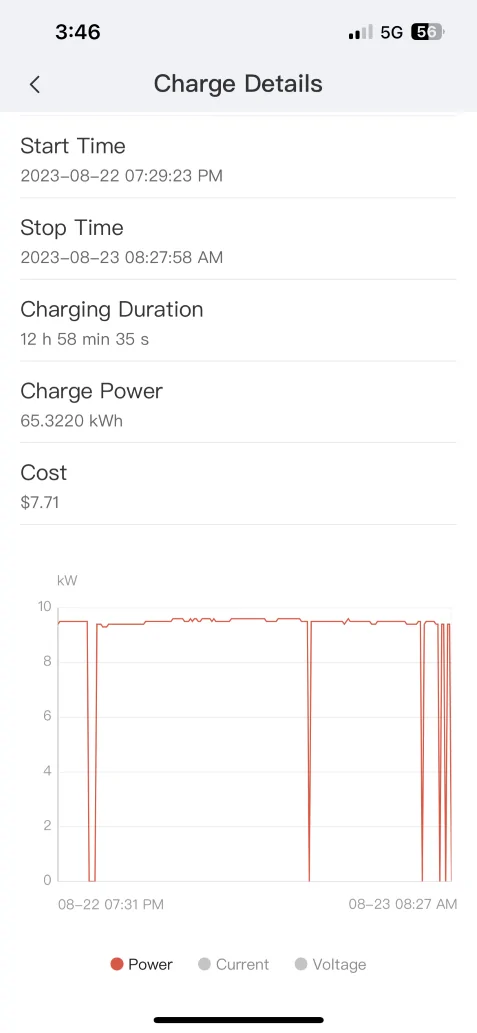
- (example #2, screenshot below): plug in at 25%, with a target of 100% set for next day at 9am: the car will get to 35% first, then stop until 12am. Charge non-stop until 6:30 (well past 85%), and then continue charging on and off until 8:30, when it reached 100%. (The time line/x axis is not to scale.)

In both cases, the car front-loaded the charging to maximize the power drawn during the preferred interval. So they do agree with your take that "earlier is safer", they just chose not do that when the charging fits within the interval.

As to why: I'm speculating that they might have split scenarios into 2 big classes: the a) ASAP - which is served with direct charging, and the b) "can wait", which implies that the user is not worried/rigid about readiness, and so erring on the side of intuitiveness/predictability was the more important characteristic.

Having said all that, I will admit that charging ahead of long trips does induce some trepidation: I usually underestimate the departure time, and so I'll set the car to reach 100% later than would be optimal. Well, every now and then we're on time - and the car is not ready ?, or we're way late, and the car is buzzing at 100% for hours ?. In either case, I blame myself (for either worrying or failing to plan accurately) as it never occurred to me the programming model could (have) prevent(ed) it. (I'm aware some may call that a sign of brainwashing. ?‍♂)

Porsche Taycan New 4S, Low Range… 1693005947459
 

WasserGKuehlt

Well-Known Member
Joined
Sep 7, 2022
Threads
5
Messages
2,066
Reaction score
2,456
Location
WA
Vehicles
4CT, 996C2, MacanS
Country flag

911-TOUR

Member
First Name
Sean
Joined
Feb 28, 2023
Threads
2
Messages
11
Reaction score
16
Location
Abu Dhabi, UAE
Vehicles
2018 911 Carrera T
Country flag
Sort of seems to me that the easy solution here is to (a) figure out your charging rate, (b) calculate how long it takes to charge from your typical arrival SoC (25%) to your desired SoC (80%) and (c) set the timer to be ready at 8pm + time calculated. BTW - if the system can't reach the desired SoC in the time allotted, it continues charging to your desired SoC. So to have "greedy" charging, all you need to do is give it a window at the beginning of your off-peak hours. You can then set another timer in the morning for your cool-down period.

This is exactly how I run my Taycan charging at home, no fuss.
 

AmpedUp

Well-Known Member
First Name
Ryan
Joined
Mar 24, 2021
Threads
7
Messages
87
Reaction score
74
Location
Mesa, Arizona
Vehicles
Taycan Turbo S, Toyota 4Runner
Country flag
Sort of seems to me that the easy solution here is to (a) figure out your charging rate, (b) calculate how long it takes to charge from your typical arrival SoC (25%) to your desired SoC (80%) and (c) set the timer to be ready at 8pm + time calculated. BTW - if the system can't reach the desired SoC in the time allotted, it continues charging to your desired SoC. So to have "greedy" charging, all you need to do is give it a window at the beginning of your off-peak hours. You can then set another timer in the morning for your cool-down period.

This is exactly how I run my Taycan charging at home, no fuss.
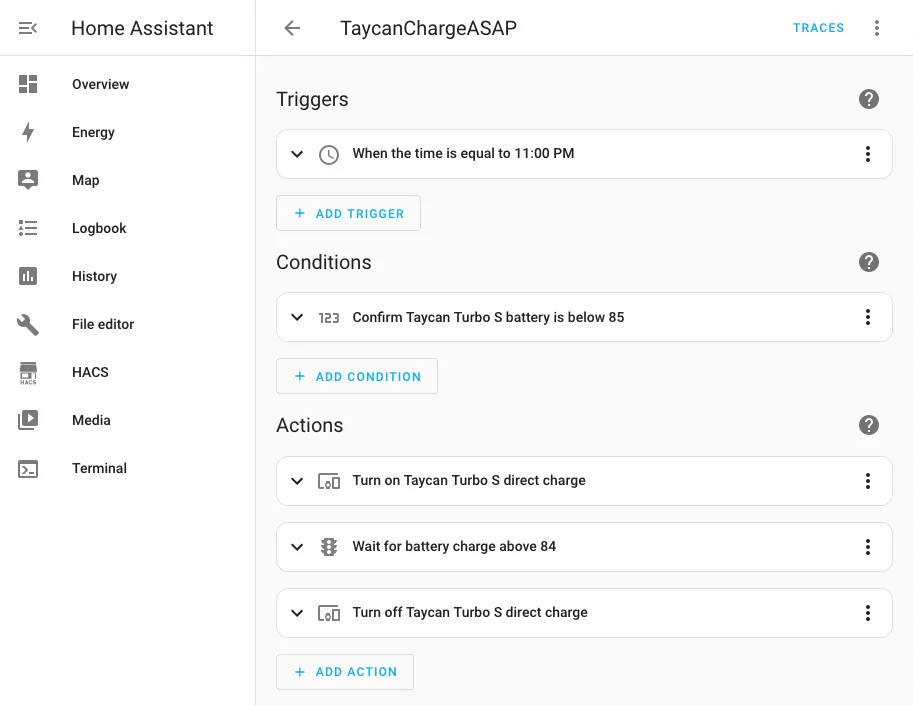
As previously posted, I found my solution with the Home Assistant integration. It just took a simple script and it works exactly as I want. No calculations required!
Sponsored


Top