Sponsored

Clarification on gen1 Taycans charging at 800v stations in US

Flying ace

Well-Known Member
First Name
Mike
Joined
Mar 24, 2024
Threads
41
Messages
1,290
Reaction score
987
Location
SF CA
Vehicles
GTS ST, 997.1 GT3, 991.1 GT3
Country flag
Hi, i have question regarding the gen1 Taycan's DC charging speeds. I shopping for a preownedTaycan, and am conflicted and confused on the necessity of the 150kw/400v onboard charger.

Are these points of understanding correct (correct me where necessary)?:
- the US-spec optional equipment for the 150kw/400v onboard charger is useful at DC chargers that is 400v and upgraded for 150kw speeds. Such a charger can charge the PB+ car from 10%-80% in about 25-30 mins (assuming all SoC, equipment, preconditioning are met).
- cars WITHOUT the 150kw/400v onboard charger option can still achieve 25-30 min 10%-80% charge at any 800v DC chargers
- Electrify America stations that are 150kw or 350kw have all been converted to 800v?
- Tesla v3s are 400v
- EvGo 150kw are 400v?
Sponsored

 
Last edited:

Jonathan S.

Well-Known Member
First Name
Jonathan
Joined
Jan 19, 2023
Threads
43
Messages
2,089
Reaction score
1,908
Location
Amherst MA & Twin Mtn NH
Website
tinyurl.com
Vehicles
'22 4CT, '22 Audi A6 Allroad, '23 BMW i4 M50
Country flag
Bottomline is that this feature matters for right now only at Magic Docks, whose regional coverage varies widely, and then eventually (early 2025?) at all Tesla V3 & 3.5 stations.

In more detail:

Tesla Magic Docks (and eventually V3 and de facto V3.5 stations once VAG is authorized, perhaps early 2025) deliver in the 130s on the car end (and consistently so, until the car's max charging curve falls below that) if your prospective used Taycan was spec'ed with the 150kW/400v option.
(For 400v architecture, those stations top out at 250kW, and they really do deliver above 200kW, every single time for my wife's i4.)

My only personal EVgo experience is with their antediluvian 50kW charger.

EA, all depends on the station, as well as which day of the week, especially days that end in the letter Y. Definitely does not depend though on the Taycan 150kW/400v option. Note that the 150kW charges can actually hit 188kW (our personal max), where the best we've ever gotten from a 350kW is the low triple digits.
EA just has two sets of speeds affixed to a big variety of equipment from its vendors, so many 150kW models are actually capable of higher than that. And many (most?) 350kW units aren't maintained sufficiently to get above the low triple digits.

The best approach from your perspective is probably to:
  1. Download the PlugShare app, look for EA stations along routes you might typically roadtrip, and read the detailed checkins (and not just the single-digit review number, as a perfect 10 can reflect many reviews that entail waiting half-an-hour for an available charger, spending 15 minutes on the phone with EA to address handshake problems, and then charging at in the low triple digits at best for kW).
  2. Dowload the Tesla app, set your vehicle to Taycan, then see what DCFC stations are available to you along routes you might typically roadtrip.
If 1 is good and 2 is bad, then you could risk buying a Taycan sans 150kW/400v option.
But I still think anyone interested in roadtripping is crazy to forego it (unless you have lots of faith in future buildouts under NEVI and/or IONNA).
Although if you're keeping the PHEV X5 for road trips, then perhaps this doesn't matter?
(Either way, wowzers, that is some vehicle fleet you have there!)
 

LonePalmBJ

Well-Known Member
First Name
Brent
Joined
Feb 17, 2020
Threads
10
Messages
335
Reaction score
554
Location
Roswell, Georgia
Vehicles
2020 Taycan 4S Gentian Blue Metallic, Black/Chalk,
Country flag
You are substantially correct. All Electrify America DC fast chargers run at 800V and the Taycan can charge at it's maximum rate (up to an ideal 270kW) regardless of whether or not it has the 400V option. Note that actual charge rate will be limited by the amount of power available by the charger as well as a variety of environmental and vehicle factors including ambient temperature, battery temperature, and state-of-charge. Note that a "350kW" EA charger can deliver more power than a Taycan can accept. A 800V "150kW" charger can actually deliver a little more than 150kWs too depending on the actual voltage and amperage available to the charger.

For 400V DC chargers, such as Tesla Superchargers (which the Taycan can't use yet), and those from several other networks such as EVGo, the rate that the Taycan will charge again depends on all of the factors above but also varies depending on whether or not your Taycan has the 400V charging 'enhancement' specified. If you do not have the "On-Board 150 kW/400V DC Charger" option on your Taycan the most the Taycan will accept from a 400V charger is 50kW regardless of what the charger can provide. If you do have the 400V option you should be able to charge at a theoretical maximum of 150kW regardless of what power is available from the charger. The 400V option became standard on later models of Taycan, so check your spec!
 
OP
OP
Flying ace

Flying ace

Well-Known Member
First Name
Mike
Joined
Mar 24, 2024
Threads
41
Messages
1,290
Reaction score
987
Location
SF CA
Vehicles
GTS ST, 997.1 GT3, 991.1 GT3
Country flag
wow, thanks for the reply guys!

I am so conflicted at the moment, as my search of a preowned GTS ST has been limited to available cars based on the 150kw/400v option!

A bunch of inventory just hit the market and locally a very nicely spec'd car without the 150kw/400v just became available. It's a car that literally hit every must have and nice to have that I am looking for.

Concur that the soon to be available Tesla v3 stations will render a Taycan without 150/400 unpractical when these stations open up, and the likelihood of these stations opening up sooner in California is higher. I'm rationalizing that this will shift a lot of 400v EV owners' over to Tesla and ease the congestion and wear on EA equipment so that us 800v lol! That said, also Tesla has to build and support their 800v truck, so perhaps the 800v at Tesla will be available too.

I'm starting to lean towards faith on EA! haha, I know it's dangerous @Jonathan S.!

I have read lots of reddit and Plugshare comments (specifically targeting Ioniq 5 owners) that CA'sEA 150kw are reasonably reliable.
 

Tooney

Well-Known Member
Joined
Aug 14, 2021
Threads
739
Messages
4,447
Reaction score
3,636
Location
Ohio
Vehicles
2022 Taycan 4S
Country flag
You are substantially correct. All Electrify America DC fast chargers run at 800V and the Taycan can charge at it's maximum rate (up to an ideal 270kW) regardless of whether or not it has the 400V option. Note that actual charge rate will be limited by the amount of power available by the charger as well as a variety of environmental and vehicle factors including ambient temperature, battery temperature, and state-of-charge. Note that a "350kW" EA charger can deliver more power than a Taycan can accept. A 800V "150kW" charger can actually deliver a little more than 150kWs too depending on the actual voltage and amperage available to the charger.
+1 to @LonePalmBJ 's post, particularly the sentence emphasized above. For example, if you are on a road trip, will you really want to wait to charge until your SoC is 10%? What happens if charging site has long lines, broken dispensers, etc.? Will you want to look for a backup charging site within 25-30 miles?

Even if "environmental and vehicle factors" are perfect, when charging output rate from "350kW" dispenser(s) at an EA site is limited, your Taycan's theoretical max charging speed will be irrelevant.

Read this thread: I ask and answer: Why won't my Taycan Charge as fast as I want it to?
 
Last edited:


julianm

Well-Known Member
First Name
Julian
Joined
Mar 4, 2024
Threads
3
Messages
62
Reaction score
22
Location
SF Bay Area
Vehicles
2024 Taycan 4S CT
Country flag
Bottomline is that this feature matters for right now only at Magic Docks
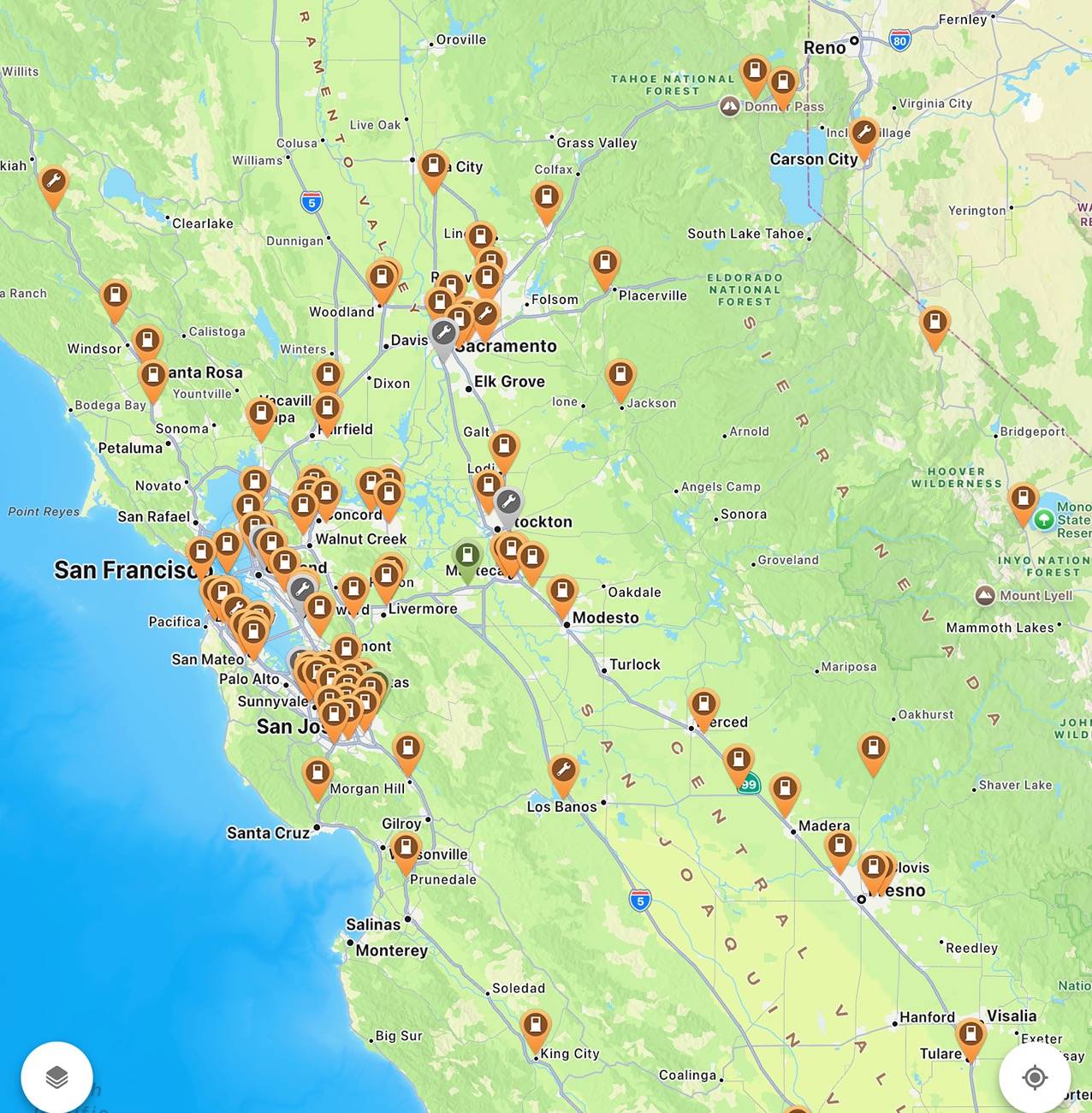
I’ve seen this sentiment expressed in a couple of spots, but I still don’t quite understand why this is. When I go on roadtrips with my Polestar 2 I sometimes end up at non-EA, non-Tesla 125+ kW chargers that I don’t know the voltage of. Are the ChargePoint, EVgo, EVconnect, and various other DCFC all 800v?

In PlugShare I’ve filtered to only 120+ kW, CCS, and excluded EA and Tesla. These are not Magic Docks, they’re not EA, but they’re a lot faster than 50 kW. I don’t know their voltage.

Porsche Taycan Clarification on gen1 Taycans charging at 800v stations in US IMG_1507
 
Last edited:

Jonathan S.

Well-Known Member
First Name
Jonathan
Joined
Jan 19, 2023
Threads
43
Messages
2,089
Reaction score
1,908
Location
Amherst MA & Twin Mtn NH
Website
tinyurl.com
Vehicles
'22 4CT, '22 Audi A6 Allroad, '23 BMW i4 M50
Country flag
^ My understanding (which could be wrong!) is that 400v stations other than Tesla V2, V3, and V3.5 (although only V3 and V3.5 are of potential interest to us) capable at significantly more than 50kW are rare.
Or at least, far more rare than Magic Docks in some regions (e.g., Boston down to Phildelphia), and far (far) more rare compared to all the V3 and V3.5 Tesla chargers that we will access to soon (yes, please, soon, right?)

Trying to search on this led me to .... right back to this forum:
https://www.taycanforum.com/forum/t...adventures-continue-data-is-shared-here.3882/
... which can be interpreted in different ways.

I suspect that the all-too-popular 125kW ChargePoint units are only 400v, but the 125kW claim is a stretch, as the best I've ever seen is 80kw when the paired charger is in use. Plus planning on your roadtrip on the availability of a station with only two chargers is not my idea of a good time.
In addition to what @daveo4EV researched, seems like the only way to know for sure is to check the serial plate, etc. on the charger. (Absent a test with two Taycans, one w/ the option, one w/o!)

Tomorrow I'll bike over to the EVgo near my house with two 100kW charges to see if I can find a voltage tag.

I might also check out the 4x180kW chargers at a NEVI station in VT this weekend. I can't figure out the charger model from the pictures though.
 

Jonathan S.

Well-Known Member
First Name
Jonathan
Joined
Jan 19, 2023
Threads
43
Messages
2,089
Reaction score
1,908
Location
Amherst MA & Twin Mtn NH
Website
tinyurl.com
Vehicles
'22 4CT, '22 Audi A6 Allroad, '23 BMW i4 M50
Country flag


daveo4EV

Well-Known Member
First Name
David
Joined
Jan 28, 2019
Threads
192
Messages
7,003
Reaction score
10,473
Location
Santa Cruz
Vehicles
Cayenne Hybrid, 911(s) GT3/Convertable
Country flag
also an 800V "charger" has to still be compatible with EV's that can only do 400V - so when plugging a car into a station - there is always a "negotiation" between the vehicle and the charger for how this charging session is going to be conducted…

a local 800V charging station in my area (Pruneridge, CA) - had DCFast chargers that were 200 kW and 800V capable - and yet everytime I plugged in my Taycan I would get a 400V charging session - I knew this because this was one of the few stations that would display the charging voltage on it's big screen - these chargers have since been replaced and now have standard EVGo charging stalls in the location…

so just because a car is capable of doing 800V and the charging station is capable of doing 800V doens't mean you're charging at 800V - there are a lot of variables - all of them outside your control that will lead to what ever charging voltage/amps/kW's you will received during any given session…

Porsche "exposing" this particular EE detail via a poorly understand inexpensive option (400V/150kW option) was simply a terrible decision in my opinion - it should've never been an option, it costs nearly nothing, and a premium product should charge as fast as possible in what ever circumstances…the end user has no control over this particular aspect of a charging session - the vehicle should "just work" as fast as possible in all circumstances - they no longer have any such options for the MacanEV and the gen2 Taycan - this is the right call IMHO…

the 400V/150 kW option means what ever charging session you encounter with what ever hardware you happen to encounter that you will always charge as fast as possibel rather than being arbitrarily limited to 50 kW because of a bone headed marketing/pricing decision by someone who didn't understand what they were optmizing for.
 
OP
OP
Flying ace

Flying ace

Well-Known Member
First Name
Mike
Joined
Mar 24, 2024
Threads
41
Messages
1,290
Reaction score
987
Location
SF CA
Vehicles
GTS ST, 997.1 GT3, 991.1 GT3
Country flag
also an 800V "charger" has to still be compatible with EV's that can only do 400V - so when plugging a car into a station - there is always a "negotiation" between the vehicle and the charger for how this charging session is going to be conducted…

a local 800V charging station in my area (Pruneridge, CA) - had DCFast chargers that were 200 kW and 800V capable - and yet everytime I plugged in my Taycan I would get a 400V charging session - I knew this because this was one of the few stations that would display the charging voltage on it's big screen - these chargers have since been replaced and now have standard EVGo charging stalls in the location…

so just because a car is capable of doing 800V and the charging station is capable of doing 800V doens't mean you're charging at 800V - there are a lot of variables - all of them outside your control that will lead to what ever charging voltage/amps/kW's you will received during any given session…

Porsche "exposing" this particular EE detail via a poorly understand inexpensive option (400V/150kW option) was simply a terrible decision in my opinion - it should've never been an option, it costs nearly nothing, and a premium product should charge as fast as possible in what ever circumstances…the end user has no control over this particular aspect of a charging session - the vehicle should "just work" as fast as possible in all circumstances - they no longer have any such options for the MacanEV and the gen2 Taycan - this is the right call IMHO…

the 400V/150 kW option means what ever charging session you encounter with what ever hardware you happen to encounter that you will always charge as fast as possibel rather than being arbitrarily limited to 50 kW because of a bone headed marketing/pricing decision by someone who didn't understand what they were optmizing for.
I read your 2021 thread regarding this. I agree that the 150kw/400v decreases reliance on EA while expanding fast charging options to seemingly Evgo. Further, 150kw is fast enough and not material compared to using a 350kw, approximately only 8 mins of difference, so having the Evgo DC network available is important.

Further, the pending expansion of the Tesla 400v network will further increase options, especially in congested areas (Los Angeles), or locations with high volume and minimum options (I-5 corridor).

However, does it appear EA today is significantly more reliable than it was in 2021? And is EA's trajectory improving materially in 2025-2026? My theory is that the Tesla expansion will shift the burden from EA to Tesla.

I have to think hard about this in the next 72 hrs. I made an offer on a local car without the 150/400
 

Scandinavian

Well-Known Member
First Name
Peter
Joined
Nov 3, 2019
Threads
52
Messages
3,904
Reaction score
3,549
Location
France
Vehicles
Taycan T, Aston Martin DB9, Porsche 996 C4 Cab, i4
Country flag
I read your 2021 thread regarding this. I agree that the 150kw/400v decreases reliance on EA while expanding fast charging options to seemingly Evgo. Further, 150kw is fast enough and not material compared to using a 350kw, approximately only 8 mins of difference, so having the Evgo DC network available is important.

Further, the pending expansion of the Tesla 400v network will further increase options, especially in congested areas (Los Angeles), or locations with high volume and minimum options (I-5 corridor).

However, does it appear EA today is significantly more reliable than it was in 2021? And is EA's trajectory improving materially in 2025-2026? My theory is that the Tesla expansion will shift the burden from EA to Tesla.

I have to think hard about this in the next 72 hrs. I made an offer on a local car without the 150/400
The only Issue to be aware of is that even with the 150kW option, you are unlikely to get more than 130 kW into the car, due to losses.

We have very good coverage of 800 volt stations in Europe, with many excellent networks. But if you ever go to a Tesla station V2 or even V3, I will not get more than 130 kW max. It works fine but takes more time.
 

Jonathan S.

Well-Known Member
First Name
Jonathan
Joined
Jan 19, 2023
Threads
43
Messages
2,089
Reaction score
1,908
Location
Amherst MA & Twin Mtn NH
Website
tinyurl.com
Vehicles
'22 4CT, '22 Audi A6 Allroad, '23 BMW i4 M50
Country flag
I definitely get more than 130kW from Tesla Magic Docks!
Okay, max of 133, maybe 134.
Still though, more than 130, hah!


"However, does it appear EA today is significantly more reliable than it was in 2021? And is EA's trajectory improving materially in 2025-2026? My theory is that the Tesla expansion will shift the burden from EA to Tesla."

My impression is that EA's reliability improved from 2021, but then took a bit hit in 2023.
Since then, some improvement, especially with the Gen 4 design. But any DCFC seems to require regular maintenance, and EA just isn't committed to that:
https://www.yahoo.com/news/california-board-blasts-ev-charger-110058517.html

The EA rpt for the final 36-month investment cycle covering the other 49 states still has not been released, which is puzzling since we're already more than a month into that final cycle.
And even more puzzling since al the different types of EA rpt for CA and the other 49 states are very similar to each other.
One theory -- and a purely evidence-free theory! -- is that EPA is putting more pressure on EA to commit to reliability metrics. Hence the delay in revising the rpt to reflect that.

If you want to get really complex, although the incoming administration definitely will not make EV adoption a priority, EPA might have nothing better to do than to pressure EA to perform better. I have seen this during the prior administration, when EPA and DOJ EES are largely defanged, but when they get the opportunity to sink their teeth into a company, wow! (One was especially ironic b/c the company had been treated amazingly leniently by the administration prior to that.)

The other factor is the timetable for TSCN V3 & V3.5 stations (and eventually V4, once they're built) to open to all CCS1 EV models. And whether drivers will flock to those, relieving pressure on EA, both for lines and maintenance. I've been puzzling by how the Magic Docks I've visited have been mainly empty. Maybe many drivers still succumb to the temptation of free charging plans? I like free kWh as much as anyone else, but the frustration factor just isn't worthwhile.
So you could get really into this by searching vehicle registrations and figuring out what % of EV drivers currently have free EA plans, and when they expire.

IONNA is another major unknown.
NEVI, I think the money has already been committed to the states, so eventually those stations have to be built?

"I have to think hard about this in the next 72 hrs. I made an offer on a local car without the 150/400 "
All depends on how much you plan to roadtrip, and along which routes.

"Porsche "exposing" this particular EE detail via a poorly understand inexpensive option (400V/150kW option) was simply a terrible decision in my opinion [...]"
Yes, so strange that Porsche put so much R&D into the 800v architecture, then essentially didn't integrate as standard a good back-up for 400v stations! IIRC, the 150kW/400v option was standard on its Audi etron GT sibling (stepsibling? ... cousin?)?
 

ShiftyWolf

Well-Known Member
Joined
Nov 16, 2023
Threads
12
Messages
524
Reaction score
656
Location
Central Florida
Vehicles
2021 Porsche Taycan 4S, 2017 Audi Q5 PP
Country flag
@Flying ace I think it's worth restating that, even without the 150KW/400V option, you can still charge at any 400V station. You are just limited to 50KW at those locations without the added option.

My car came with the extra 400V charging capability added in but I really wouldn't consider its absence a deal breaker if you find an otherwise perfect build, unless you expect to frequently DC charge at a 400V station.

YMMV
 
OP
OP
Flying ace

Flying ace

Well-Known Member
First Name
Mike
Joined
Mar 24, 2024
Threads
41
Messages
1,290
Reaction score
987
Location
SF CA
Vehicles
GTS ST, 997.1 GT3, 991.1 GT3
Country flag
@Flying ace I think it's worth restating that, even without the 150KW/400V option, you can still charge at any 400V station. You are just limited to 50KW at those locations without the added option.

My car came with the extra 400V charging capability added in but I really wouldn't consider its absence a deal breaker if you find an otherwise perfect build, unless you expect to frequently DC charge at a 400V station.

YMMV
concur, thank you. I'm taking others advice to think hard about situations whereby time (detour) spent finding fast chargers, or time spent charging at 50kw will sour my ownership experience.

As suggested in https://www.taycanforum.com/forum/t...adventures-continue-data-is-shared-here.3882/
the 400v 150kw EVgo chargers still hold steady charge (up to the point where charge curve decreases) at a reasonable rate of >100 KW. That is still double the speed of a 50kw charger, and renders a 1.5 hr charge to about 45 mins, and that is possibly valuable as I do plan to take the car on road trips to SoCal.

A review of Socal charging situations indicates numerous EVgo 150kw and 100 kw chargers near EA 800v units in the areas of SoCal that I go (LA, Orange + SD county). SoCA EA stations tends to have long queues all hours of the day. That said, I visit SoCal max twice a year, so it may just be that I rent a vehicle instead (i started thinking of flying to SD going foward and renting a car), I also know available to me is the Tesla -> J1772 adapter so I can take advantage of Tesla destination chargers at hotels (though they are not typically the hotels I stay at in SoCal).

My most common road trip is actually Tahoe about 5-6x a year. There are no issues with EA charging at the foothills, with numerous options and high availability and uptime (per plugshare reviews). Up in the mountains in Tahoe, it's trickier as there are just less charging options including EVgo 400v stations.

At this point, I am consider two cars (GTS):

Car 1 (with 150/400) key distinguishing features:
- Mission E wheels (painted in grey, and not color matched to body, a fantastic contrast)
- Full leather seats ( i have kids so this will be a durable interior long term)
- Advanced 4-zone
- Ice grey (starting to rank as my # 1 preferred color after I've seen it in person)

Car 2 (without 150/400), there are many matching features with Car 1 not listed:
- Spyder wheels
- GTS interior package, (Race-tex, w stitching, CF interior trim)
- RAS
- Passenger display
-19.2 kw AC ( I actually have panel room to install 80a, tho my electrician is convincing me it's a waste and not to do it )
- Carmine Red
- 2023 model but with only 3 months difference in warranty expiration with car 1. This was a late 2023 build.


In any case I have more time to think and allow more cars to hit the market place, as there is currently a stop sale for the brake hose recall (anticipation of parts is end of Aug with prioritization of unsold cars).

The key known fact will be the anticipation of Tesla 400v network opening. If I take the chance and not buy a car with the 400v option, I'm relying on continued EA reliability and build, and many high speed 400v capable cars shift their load over to Tesla.

Also unknown is what is going on with Ionna. It appears other manufacturers are abandoning EA to VW?
Sponsored

 
Last edited:


Top