Sponsored

2024 vs 2025 Taycan. Spring vs Air Suspension

f1eng

Well-Known Member
First Name
Frank
Joined
Aug 19, 2021
Threads
48
Messages
4,765
Reaction score
8,335
Location
Oxfordshire, UK
Vehicles
Taycan CT4S, Ferrari 355, Merc 500E, Prius PHV
Country flag
Do you know if your issues were eventually narrowed down to the adaptive, air, or Active Ride?

2wks ago, I went from a 2024 CT4S with Performance Pack (PTV+1, PDCC Sport, rear axle steer) to a 2025 Taycan 4S with standard adaptive/air suspension, and I swear there is something not quite right. Regardless of chassis setting, the ride seems way too firm (and I prefer a firmer ride), as if the active suspension isn't working at all. Same size wheels/tires on both 2024 and 2025. Not sure what's up?? Car only has 300 miles on it, so maybe it will eventually settle in, but I notice quite the difference. Air suspension levels are working as designed however. Could my previous experience with PDCC Sport on the 2024 CT4S simply been far more superior?
This is an intriguing one.
As ane engineer experienced in racing I ticked all the chassis options for my CT4S, it has torque vectoring, rear wheel steer and PDCC.
Twice now I have had a loan Taycan with standard air suspension, once an earlier model and yesterday a new ST.
My car has a ride/handling combination much better than either of those and on the twisty cambered country road I use between the dealer and my house the difference was marked and my car much more fun.
I have bought an extended warranty rather than changed because none of the j1.2 improvements would help my normal use and some things, like the loss of teardrop intakes and manual charge port doors are things I don't like.
I must say driving home yesterday I was really happy with myc choice - though I have no way of knowing if it is only one of those options giving the majority of the ride/handling improvement.
Sponsored

 

prj

Well-Known Member
Joined
Jan 14, 2025
Threads
7
Messages
1,766
Reaction score
2,346
Location
Estonia
Website
www.mapev.net
Vehicles
Taycan CT 4 - 2026
Country flag
But steel suspension still has a very noticeable edge on handling precision/feel, and feels more like a traditional porsche.
That is just subjective feel because the car leans.
And also understood why they would not ever offer air as an option on a 911.
This has nothing to do with handling, rather with packaging and weight. For air suspension you need an accumulator tank, a compressor and much larger struts. This simply would never fit into a 911 or any other true sports car.
When you do back to back driving, air gives you a noticable “dead zone” on the steering wheel at speed vs that milimetric steering precision unique to porsche.
That is the self leveling working, which does not let the car lean. A standard suspension car with very stiff ARB's or adjustable ARB's behaves in a similar way, but since it can't stiffen the spring on the outside it still leans more.

Sorry, but your opinion has little actual engineering merit. A self leveling suspension is objectively better, and the active ride is even better.

You can do self leveling with air or with hydraulics, both are used in production.
 
Last edited:

W1NGE

Well-Known Member
First Name
Adrian
Joined
Jan 11, 2021
Threads
53
Messages
11,017
Reaction score
6,805
Location
Aberdeen, Scotland
Vehicles
992.2, ex GTS ST & 4S owner, Macan T
Country flag
That is just subjective feel because the car leans.

This has nothing to do with handling, rather with packaging and weight. For air suspension you need an accumulator tank, a compressor and much larger struts. This simply would never fit into a 911 or any other true sports car.

That is the self leveling working, which does not let the car lean. A standard suspension car with very stiff ARB's or adjustable ARB's behaves in a similar way.

Sorry, but your opinion has little actual engineering merit. A self leveling suspension is objectively better, and the active ride is even better.

You can do self leveling with air or with hydraulics, both are used in production.
Self levelling prevents a car from squatting or dropping and has little to do with leaning. For lean control you would need PDCC (now replaced with PAR which adds more bells and whistles).

I'm no engineer but that's what I understand the differences are.
 

prj

Well-Known Member
Joined
Jan 14, 2025
Threads
7
Messages
1,766
Reaction score
2,346
Location
Estonia
Website
www.mapev.net
Vehicles
Taycan CT 4 - 2026
Country flag
Self levelling prevents a car from squatting or dropping and has little to do with leaning. For lean control you would need PDCC (now replaced with PAR which adds more bells and whistles).

I'm no engineer but that's what I understand the differences are.
The air suspension used since 2003 in the Audis (started with the D3 Audi A8) very much prevents leaning. An evolution of that system is also in the Taycan.

There is a valve block that can inflate and deflate any corner instantly.
There is also a pressure accumulator that has very high pressure in it, and the compressor works to keep the pressure within a certain tolerance.

When you turn into a corner, the valve block instantly opens and props up the outside corners with more pressure, preventing lean. This has a limit of course, this is why the PDCC and AR is a thing.

If you actually remove the sound deadening in the trunk of a cross turismo and drive it, you can hear the "pshhh" noises of the air suspension every time you take a hard corner or are braking / accelerating rapidly. The valveblock is constantly working the pressure in all four corners to keep the car level.
 
Last edited:

Mr.Smith

Well-Known Member
First Name
PaulS
Joined
Mar 1, 2020
Threads
123
Messages
2,241
Reaction score
2,210
Location
Southern California
Vehicles
Taycan Turbo GT with Weissach VW ID.4
Country flag
That is just subjective feel because the car leans.

This has nothing to do with handling, rather with packaging and weight. For air suspension you need an accumulator tank, a compressor and much larger struts. This simply would never fit into a 911 or any other true sports car.

That is the self leveling working, which does not let the car lean. A standard suspension car with very stiff ARB's or adjustable ARB's behaves in a similar way, but since it can't stiffen the spring on the outside it still leans more.

Sorry, but your opinion has little actual engineering merit. A self leveling suspension is objectively better, and the active ride is even better.

You can do self leveling with air or with hydraulics, both are used in production.
Lucid, which is close to the Taycan in size and weight, does not use air suspension even on its most advanced variant, the Sapphire.

Their engineers said the main benefit of air suspension is the ability to lower the car at higher speeds for increased efficiency, so they opted instead for semi-active dampers and stiffer coil springs.

Do you see a situation where coil springs would be a benefit?


prj

Well-Known Member
Joined
Jan 14, 2025
Threads
7
Messages
1,766
Reaction score
2,346
Location
Estonia
Website
www.mapev.net
Vehicles
Taycan CT 4 - 2026
Country flag
Lucid, which is close to the Taycan in size and weight, does not use air suspension even on its most advanced variant, the Sapphire.
Cost saving. The Taycan uses dual valve dampers for compression and rebound and self leveling air suspension on top of that.

The air suspension is like having springs where you can vary the spring stiffness in each corner in real time. I am sure you can see how this is superior.
 

Avantgarde

Well-Known Member
First Name
Eugene
Joined
Apr 4, 2022
Threads
8
Messages
368
Reaction score
466
Location
Ann Arbor, MI
Vehicles
22' Taycan RWD PB+, 21' X5 Xdrive45e, 09' Cayman
Country flag
This has nothing to do with handling, rather with packaging and weight. For air suspension you need an accumulator tank, a compressor and much larger struts. This simply would never fit into a 911 or any other true sports car.
Cost saving. The Taycan uses dual valve dampers for compression and rebound and self leveling air suspension on top of that.

The air suspension is like having springs where you can vary the spring stiffness in each corner in real time. I am sure you can see how this is superior.
I think you are oversimplifying the trade off between Air and steel suspension. I am an air suspension fan in general and had it in multiple cars. But it simply does not provide the same crisp, direct, and precise handling characteristics of a traditional coilover or steel-spring system. This is pretty established fact nothing I am making up. What surprised me most is how pronounced this difference was in the case of Taycan, which becomes very obvious if you do a back to back driving. And i can tell you it is not "subjective" :) Steel taycan needs considerably less steering input on highway driving to keep it on a perfect straight line.
This is not to say I am saying overall steel is better for Taycan. For most people and many use cases It is a brilliant system. I just don't think it is a hands down winner on every aspect. I am pretty convinced there is no way to replicate a 911 handling feel with air suspension even if you could fit it in and did some other weight savings to offset the extra 20-30 kg it brings.

Also air suspension systems in general including the one in Taycan is not "fast reacting". So don't think there is a way it can "counteract" that quickly to offset lean. (not the expert here but that is my understanding)

PAR is a different animal, i personally never driven one, so I can't comment but on paper it looks like a lot more advanced set up, that does not introduce the "wigglyness" and slower action of gas in between solid components.
 

prj

Well-Known Member
Joined
Jan 14, 2025
Threads
7
Messages
1,766
Reaction score
2,346
Location
Estonia
Website
www.mapev.net
Vehicles
Taycan CT 4 - 2026
Country flag
I think you are oversimplifying the trade off between Air and steel suspension. I am an air suspension fan in general and had it in multiple cars. But it simply does not provide the same crisp, direct, and precise handling characteristics of a traditional coilover or steel-spring system. This is pretty established fact nothing I am making up. What surprised me most is how pronounced this difference was in the case of Taycan, which becomes very obvious if you do a back to back driving. And i can tell you it is not "subjective" :) Steel taycan needs considerably less steering input on highway driving to keep it on a perfect straight line.
This is not supported by any evidence other than your opinion.
The air suspension is not any more "floaty" or worse than steel springs. The Turbo GT is the fastest Taycan around the track, and it runs air.


Avantgarde

Well-Known Member
First Name
Eugene
Joined
Apr 4, 2022
Threads
8
Messages
368
Reaction score
466
Location
Ann Arbor, MI
Vehicles
22' Taycan RWD PB+, 21' X5 Xdrive45e, 09' Cayman
Country flag
This is not supported by any evidence other than your opinion.
The air suspension is not any more "floaty" or worse than steel springs. The Turbo GT is the fastest Taycan around the track, and it runs air.
Turbo GT does not run on air. It runs on PAR, which does not rely on any sort of gas (“air”) to dampen the suspension.

Really don’t think this is up for debate, but just because you asked for evidence, i will respectfully point you to some. Take BMW X5, (which i also own with an air suspension option). You can only order it with air up-to m50. But X5M comes with steel suspension and no air option. Similarly none of the m cars have ever had it even though bmw extensively utilizes the technology in less sporty part if the range. Forget about smaller cars but bmw even did not put it the new m5 which would greatly benefit from the comfort of it.

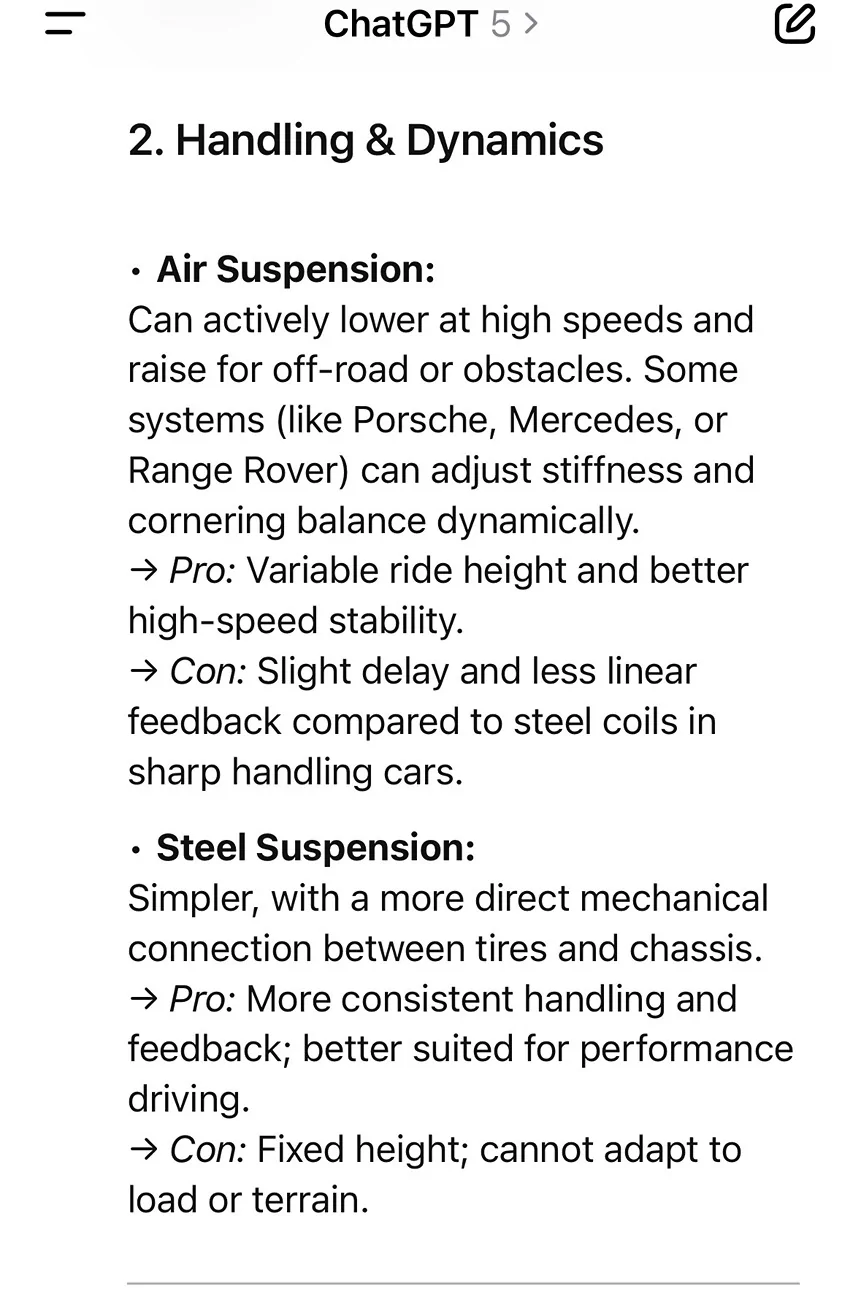
Ask the simple question to any generative ai see what you get. A simple chat gpt ask around “compare air suspension to Steel”:
Porsche Taycan 2024 vs 2025 Taycan. Spring vs Air Suspension IMG_0824
 

prj

Well-Known Member
Joined
Jan 14, 2025
Threads
7
Messages
1,766
Reaction score
2,346
Location
Estonia
Website
www.mapev.net
Vehicles
Taycan CT 4 - 2026
Country flag
Turbo GT does not run on air. It runs on PAR, which does not rely on any sort of gas (“air”) to dampen the suspension.
It very much has air springs in it. They could have gotten rid of them, but they did not.

Saying that a steel spring is somehow better than an air spring means knowing nothing about suspension. The air suspension leveling wise can always be made to be better than steel, the question is in mass producing and tolerances. When you mass produce an air spring, then it has a certain range of spring rates. If you need stiffer spring rate you need a different component. Developing this component for just one top end model is not financially viable. The only reason we can even have the VAG/PAG air suspension is due to economies of scale.

BMW X5 is a ridiculous example, it's a goddamn SUV. No idea about G series, but F series X5M has air suspension in the rear. That said, BMW's system is not at the level of VAG/PAG, never has been.
The reason that air systems are not used in smaller performance cars are weight and packaging, and the fact that you don't care about providing a softer ride, so the default is just stiff. Putting that into a SUV just means you create a SUV with a shit ride. Btw, quick search shows a ton of F95 owners complaining about the ride quality.

As for the rest - spamming ChatGPT is where I stop, since that is a waste of time.
Consider that I've been doing this stuff professionally for well over a decade, I am just not going to lower myself to that level.

The only reason the J1.1 RWD had steel springs is lower price. It does not perform any better whatsoever. It will not set a better laptime, pull more G on the skidpad or anything else of the sort, because unlike on a performance car the springs on the J1.1 RWD are soft.
 
Last edited:

Avantgarde

Well-Known Member
First Name
Eugene
Joined
Apr 4, 2022
Threads
8
Messages
368
Reaction score
466
Location
Ann Arbor, MI
Vehicles
22' Taycan RWD PB+, 21' X5 Xdrive45e, 09' Cayman
Country flag
PAR does not have air springs. Takes two minutes to check porsche website. I am driving but can copy paste the system definition when i get home. But absolutely no air/gas. The whole suspension is like a robot arm.

I used chatGPT because i am driving and you claimed “there is absolutely no evidence other than my personal observation” as if i am just making this up. Just coincidentally chat GPT makes the exact handling point that happens say the exact same thing? The point about X5 is it is ONLY excluded from the most performance oriented version.

I worked for an auto company for a decade. I heard this trade off hundreds of times i am just shocked you haven’t.

Just one quick reference i could find online:

https://www.pasmag.com/auto-knowled...on-in-performance-cars?utm_source=chatgpt.com

And to repeat i did not say “steel is better all round”. I said it is better in terms of handling precision and responsiveness. If it was not, do you really not think one, at least one high performance car manufacturer would not find a way to fit an air chamber in a sports car? The existence of gas in between rigid parts brings an element of unwanted uncertainty and wobbliness in purist handling no matter how you cut it.


It very much has air springs in it. They could have gotten rid of them, but they did not.

Saying that a steel spring is somehow better than an air spring means knowing nothing about suspension.
BMW X5 is a ridiculous example, it's a goddamn SUV. No idea about G series, but F series X5M has air suspension in the rear. That said, BMW's system is not at the level of VAG/PAG, never has been.

The reason that air systems are not used in smaller performance cars are weight and packaging, and the fact that you don't care about providing a softer ride, so the default is just stiff. Putting that into a SUV just means you create a SUV with a shit ride.

As for the rest - spamming ChatGPT is where I stop, since that is a waste of time.
Consider that I've been doing this stuff professionally for well over a decade, I am just not going to lower myself to that level.
It very much has air springs in it. They could have gotten rid of them, but they did not.

Saying that a steel spring is somehow better than an air spring means knowing nothing about suspension.
BMW X5 is a ridiculous example, it's a goddamn SUV. No idea about G series, but F series X5M has air suspension in the rear. That said, BMW's system is not at the level of VAG/PAG, never has been.

The reason that air systems are not used in smaller performance cars are weight and packaging, and the fact that you don't care about providing a softer ride, so the default is just stiff. Putting that into a SUV just means you create a SUV with a shit ride.

As for the rest - spamming ChatGPT is where I stop, since that is a waste of time.
Consider that I've been doing this stuff professionally for well over a decade, I am just not going to lower myself to that level.

The only reason the J1.1 RWD had steel springs is lower price. It does not perform any better whatsoever. It will not set a better laptime, pull more G on the skidpad or anything else of the sort.
 

prj

Well-Known Member
Joined
Jan 14, 2025
Threads
7
Messages
1,766
Reaction score
2,346
Location
Estonia
Website
www.mapev.net
Vehicles
Taycan CT 4 - 2026
Country flag
PAR does not have air springs. Takes two minutes to check porsche website. I am driving but can copy paste the system definition when i get home. But absolutely no air gas or anything else. The whole suspension is like a robot arm.
The hydraulic actuators do not have air, but the cars with PAR still have air springs.
Yes, it's mostly there as a backup during driving. They still didn't dump them even on the Weissach.
You know why? Cost.

And to repeat i did not say “steel is better all round”. I said it is better in terms of handling precision and responsiveness.
Except it's not. It's just much cheaper. By the time you are done with designing a special air spring using special materials and higher pressures than what is available from the supplier parts bin the car will cost an insane amount of money.

It's not about fitting an air chamber to a sports car. It's about having to have the compressor, the solenoid block, the accumulator, all the lines and then way bulkier struts.

Gas or liquid is not a problem with high enough pressure. Put enough pressure into gas and it's going to have less spring rate and movement than steel - that's trivial physics. An air strut can be engineered with different tolerances with regard to side to side movement as well.

Steel is superior in packaging and most importantly price. When you can save 40-60kg on weight (never mind the room), and comfort takes ab ack seat to performance, then steel every time. But not because the spring itself handles better - because it weighs less and takes less room, and a lighter sportscar is a better one.
 

Mr.Smith

Well-Known Member
First Name
PaulS
Joined
Mar 1, 2020
Threads
123
Messages
2,241
Reaction score
2,210
Location
Southern California
Vehicles
Taycan Turbo GT with Weissach VW ID.4
Country flag
The hydraulic actuators do not have air, but the cars with PAR still have air springs.
Yes, it's mostly there as a backup during driving. They still didn't dump them even on the Weissach.
You know why? Cost.


Except it's not. It's just much cheaper. By the time you are done with designing a special air spring using special materials and higher pressures than what is available from the supplier parts bin the car will cost an insane amount of money.

It's not about fitting an air chamber to a sports car. It's about having to have the compressor, the solenoid block, the accumulator, all the lines and then way bulkier struts.

Gas or liquid is not a problem with high enough pressure. Put enough pressure into gas and it's going to have less spring rate and movement than steel - that's trivial physics. An air strut can be engineered with different tolerances with regard to side to side movement as well.

Steel is superior in packaging and most importantly price. When you can save 40-60kg on weight (never mind the room), and comfort takes ab ack seat to performance, then steel every time. But not because the spring itself handles better - because it weighs less and takes less room, and a lighter sportscar is a better one.
Money no object, on a lighter, smaller sports car, springs would be the optimal choice?
Like a GMA T50 or Lotus Elise
 

prj

Well-Known Member
Joined
Jan 14, 2025
Threads
7
Messages
1,766
Reaction score
2,346
Location
Estonia
Website
www.mapev.net
Vehicles
Taycan CT 4 - 2026
Country flag
Money no object, on a lighter, smaller sports car, springs would be the optimal choice?
Like a GMA T50 or Lotus Elise
Always steel, because it's lighter. Adjustability has no benefit when you don't need it. Nobody cares if a small light sports car has a jarring ride.
 

Emm

Well-Known Member
First Name
Mark
Joined
May 8, 2024
Threads
4
Messages
84
Reaction score
52
Location
Sweden
Vehicles
2023 Taycan GTS Sport Turismo MAPEV + 2014 Audi RS6 Avant APR
Country flag
Could it be that steel springs *historically* has offered better driving dynamics than air suspension, while on the Taycan the air suspension has been developed and refined to a point where it supersedes the steel springs?

When I ordered my Audi RS6 Avant 2014 (I still have it! :–), I opted for the optional DRC with steel springs that was included in the Dynamic Package, instead of going with the standard air suspension, simply because I wanted better support for spirited driving. Admittedly, I never tried the air suspension beforehand, I just went straight for the sportier DRC offer, so I can only assume that I made the right choice (being one who generally prefers performance over comfort).

Google AI is of course not always correct, but here is it's answer to "compare the steel springs on the audi rs6 with the air suspension":
The steel suspension on an Audi RS6 offers a more direct, sharp, and "track-ready" handling experience with less body roll and a more connected feel, while the standard air suspension provides superior ride comfort, effortlessly absorbing bumps, but can feel softer and more prone to body lean during spirited driving. The choice depends on priorities: steel for performance and engagement, air for everyday comfort and adjustable ride height.

Again, I do believe the above is true for the Audi RS6, but for the Taycan I trust prj to be correct in his assessment that the air suspension is superior even for spirited driving.

(On a side note, the steel springs on the RS6 are *very* stiff when set in Sport mode, so much so that I practically always drive with the chassis set in Comfort mode... :–)
Sponsored


Top