bsclywilly
Well-Known Member

- Thread starter
- #1
For anyone hitting thermal limits on the track, I did some experiments at a second outing at Laguna Seca with my CT4.
I was interested to see whether improved air flow through the radiators could help extract more heat and keep battery temperatures down, allowing us more laps before reaching the 132F thermal limit and the car cutting power. The summary is that I was able to test 1 out of the 3 modifications I had planned and the gurney flap added to the leading edge of the wheel well resulted in a 20% decrease in battery temp ramp rate. That equates to about 2 extra hot laps around Laguna Seca.
The premise is that by reducing the front wheel well air pressure, we get more airflow and heat transfer through the radiators which vent into the wheel wells. The wheel wells see higher pressures since the wheel and tire creates turbulence, so the rad exit location is not ideal but gives some opportunities to improve cooling. Planned tests consisted of the following:
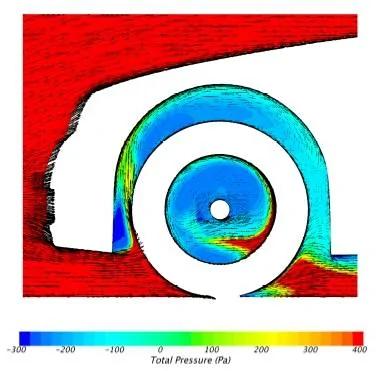
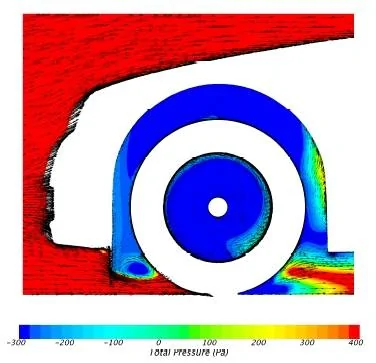
1. Extended wheel deflectors. These reduce the pressure in front of the front tires by directing air around the tire. You instead see higher pressure in front of the deflector and the pressure behind, in the wheel well is reduced. Note the pressure plots below with and without deflectors. The wheel house pressure further reduces the longer the deflector is, at a small detriment to overall drag. See attached for image reference, a good read!


I had made 1" extensions from the existing wheel deflectors but they didn't last 1 lap since I was already bottoming out on the stock deflectors. I would revisit this again with flexible rubber deflectors.

2. Gurney flap to direct air outwards from the wheel well. This feature has been well documented in SAE papers to help extract hot air from the wheel well for brake cooling effect and reduce lift. Penalty again is an increase in drag as the side wake is increased. I made a test prototype out of 1/16" thick PC that extended out 3/4".

3. Taping up the air curtain ports on the sides of the front bumper and also partially closing off the brake ducts were the other planned modifications that would reduce airflow from the front of the car entering the wheel well. I was testing a new set of track pads but on my initial session, I was worried that overheating the brake fluid would be a potential risk so decided against the brake duct blockers. The air curtains, I just forgot to tape up, doh! But you can see the Taycan GT spy pics had the same idea.
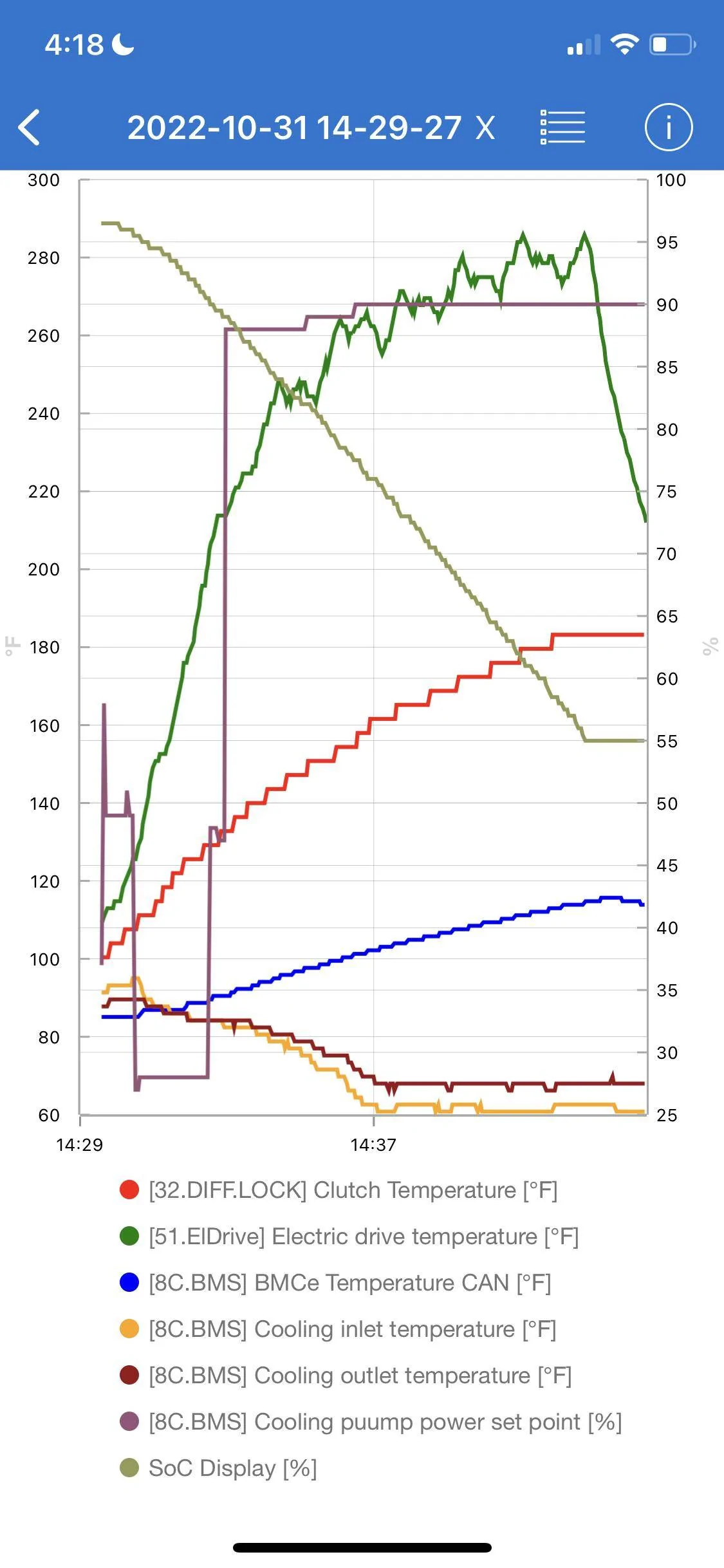
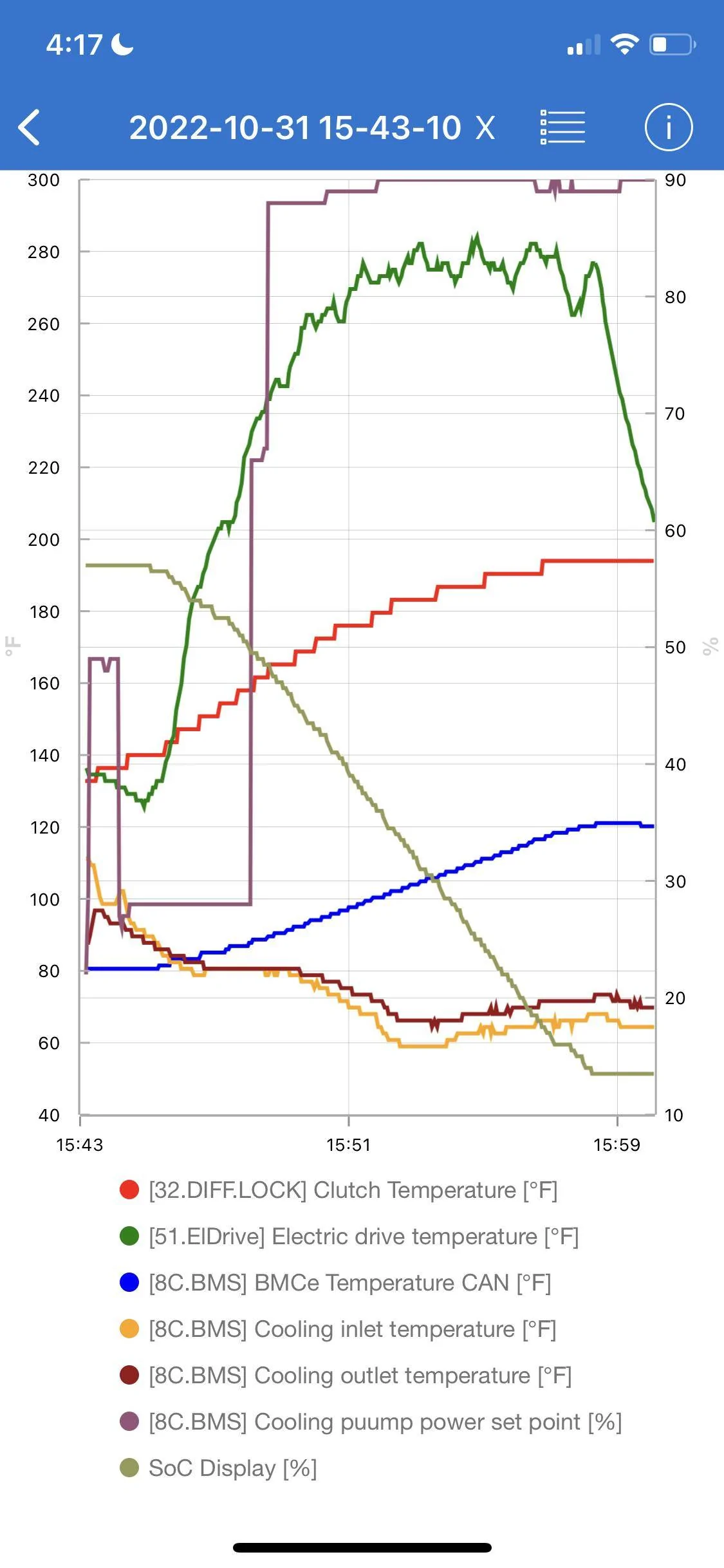
So here's the results that the gurney flap made to cooling. Measurements were logged using the CarScanner app. Both with and without the flap were run in the same weather conditions, partly cloudy 59F in 15 minute sessions. Raw temperature data presented below. With flap on left, without on right.

In and out laps are more variable so I truncated the data to include only the hot laps, 7 laps each session:


x-axis in seconds.
The yellow line represents battery temp and its immediately obvious that the slope, or rate of increase is higher without the flap. In fact, without the flap, the starting battery temp is lower but ends with a higher temp than with the flap.
To make sure we have an equal comparison, I confirmed that the cooling pump was running equally for both sessions, both got up to 90% by the start of the second hot lap. I also wanted to normalize the battery temp ramp according to the energy used. The session without the flap used more energy at 2% higher rate. I added that 2% to the battery temp ramp rate of the no-flap trial. The normalized difference: 20%.
This is good to know because next spring, with higher ambient temps, I'd like to get those other cooling mods ready so that battery temps will not be a limiting factor. If anyone else is interested in testing some of these things out, let me know. I'm particularly interested to see how well they work with a turbo or turbo S, as @daveo4EV found his limit was only about 6 laps, and that's no fun. We need more Taycans on the track!

I was interested to see whether improved air flow through the radiators could help extract more heat and keep battery temperatures down, allowing us more laps before reaching the 132F thermal limit and the car cutting power. The summary is that I was able to test 1 out of the 3 modifications I had planned and the gurney flap added to the leading edge of the wheel well resulted in a 20% decrease in battery temp ramp rate. That equates to about 2 extra hot laps around Laguna Seca.
The premise is that by reducing the front wheel well air pressure, we get more airflow and heat transfer through the radiators which vent into the wheel wells. The wheel wells see higher pressures since the wheel and tire creates turbulence, so the rad exit location is not ideal but gives some opportunities to improve cooling. Planned tests consisted of the following:
1. Extended wheel deflectors. These reduce the pressure in front of the front tires by directing air around the tire. You instead see higher pressure in front of the deflector and the pressure behind, in the wheel well is reduced. Note the pressure plots below with and without deflectors. The wheel house pressure further reduces the longer the deflector is, at a small detriment to overall drag. See attached for image reference, a good read!
I had made 1" extensions from the existing wheel deflectors but they didn't last 1 lap since I was already bottoming out on the stock deflectors. I would revisit this again with flexible rubber deflectors.
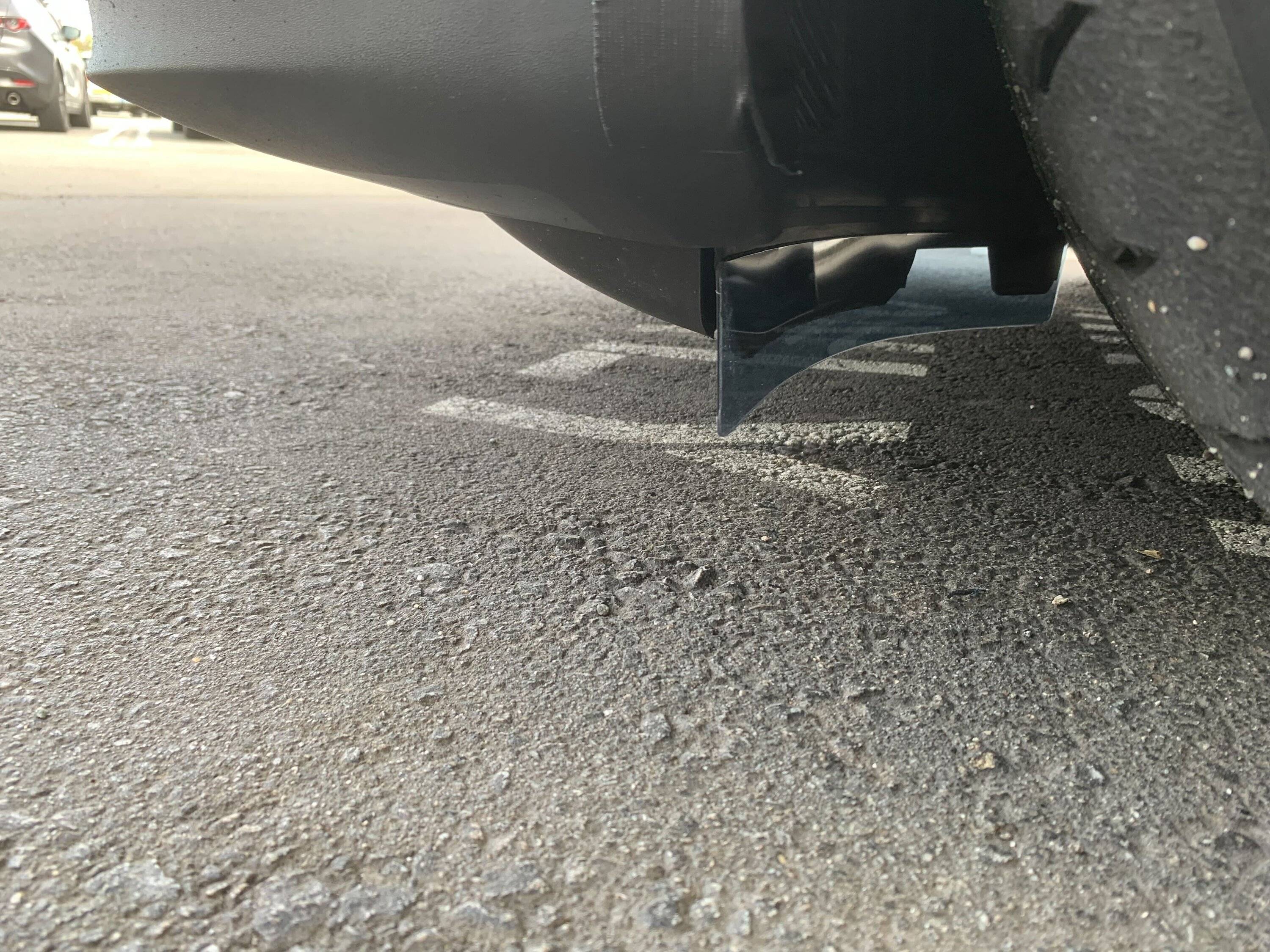
2. Gurney flap to direct air outwards from the wheel well. This feature has been well documented in SAE papers to help extract hot air from the wheel well for brake cooling effect and reduce lift. Penalty again is an increase in drag as the side wake is increased. I made a test prototype out of 1/16" thick PC that extended out 3/4".
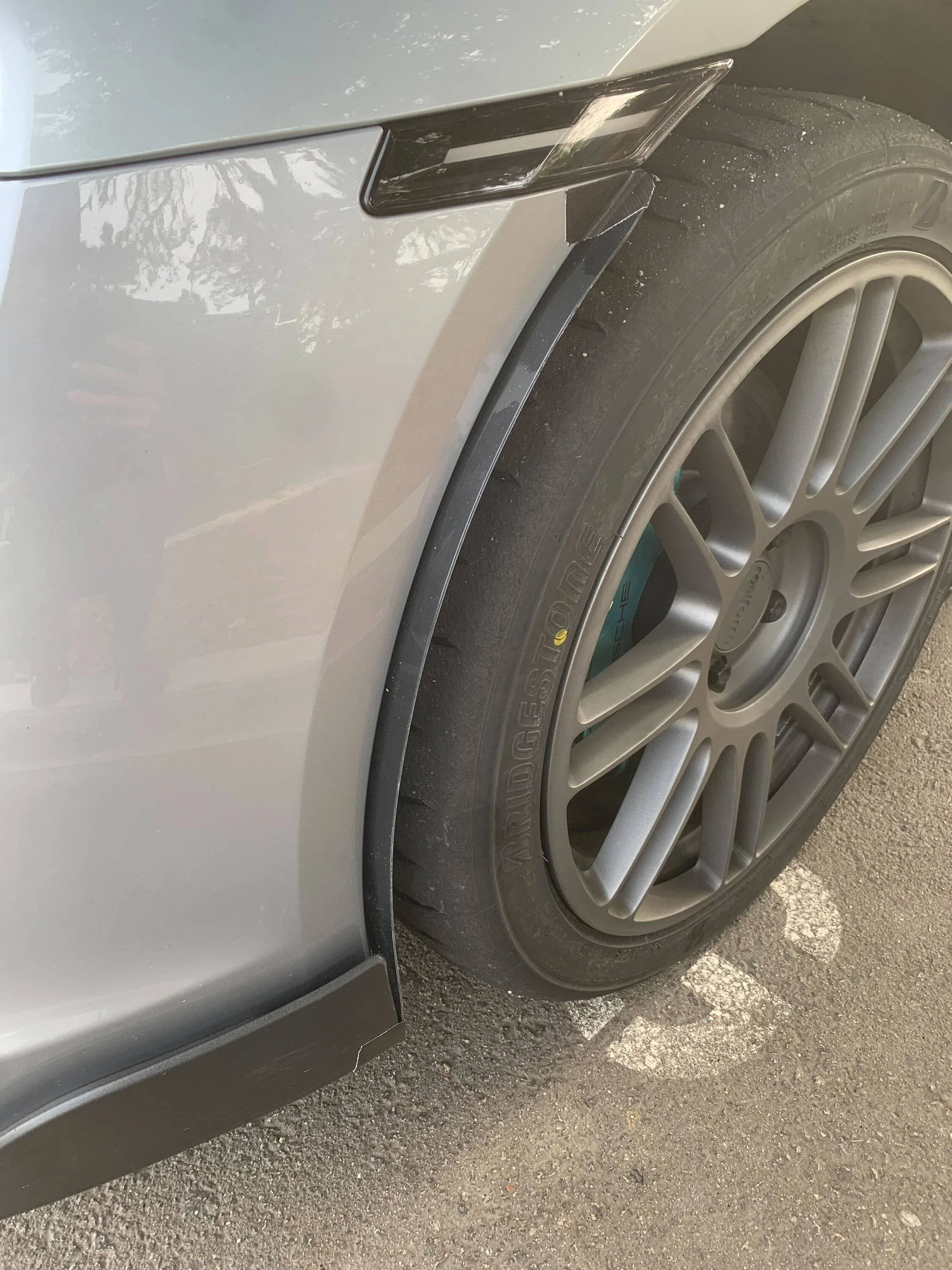
3. Taping up the air curtain ports on the sides of the front bumper and also partially closing off the brake ducts were the other planned modifications that would reduce airflow from the front of the car entering the wheel well. I was testing a new set of track pads but on my initial session, I was worried that overheating the brake fluid would be a potential risk so decided against the brake duct blockers. The air curtains, I just forgot to tape up, doh! But you can see the Taycan GT spy pics had the same idea.
So here's the results that the gurney flap made to cooling. Measurements were logged using the CarScanner app. Both with and without the flap were run in the same weather conditions, partly cloudy 59F in 15 minute sessions. Raw temperature data presented below. With flap on left, without on right.
In and out laps are more variable so I truncated the data to include only the hot laps, 7 laps each session:
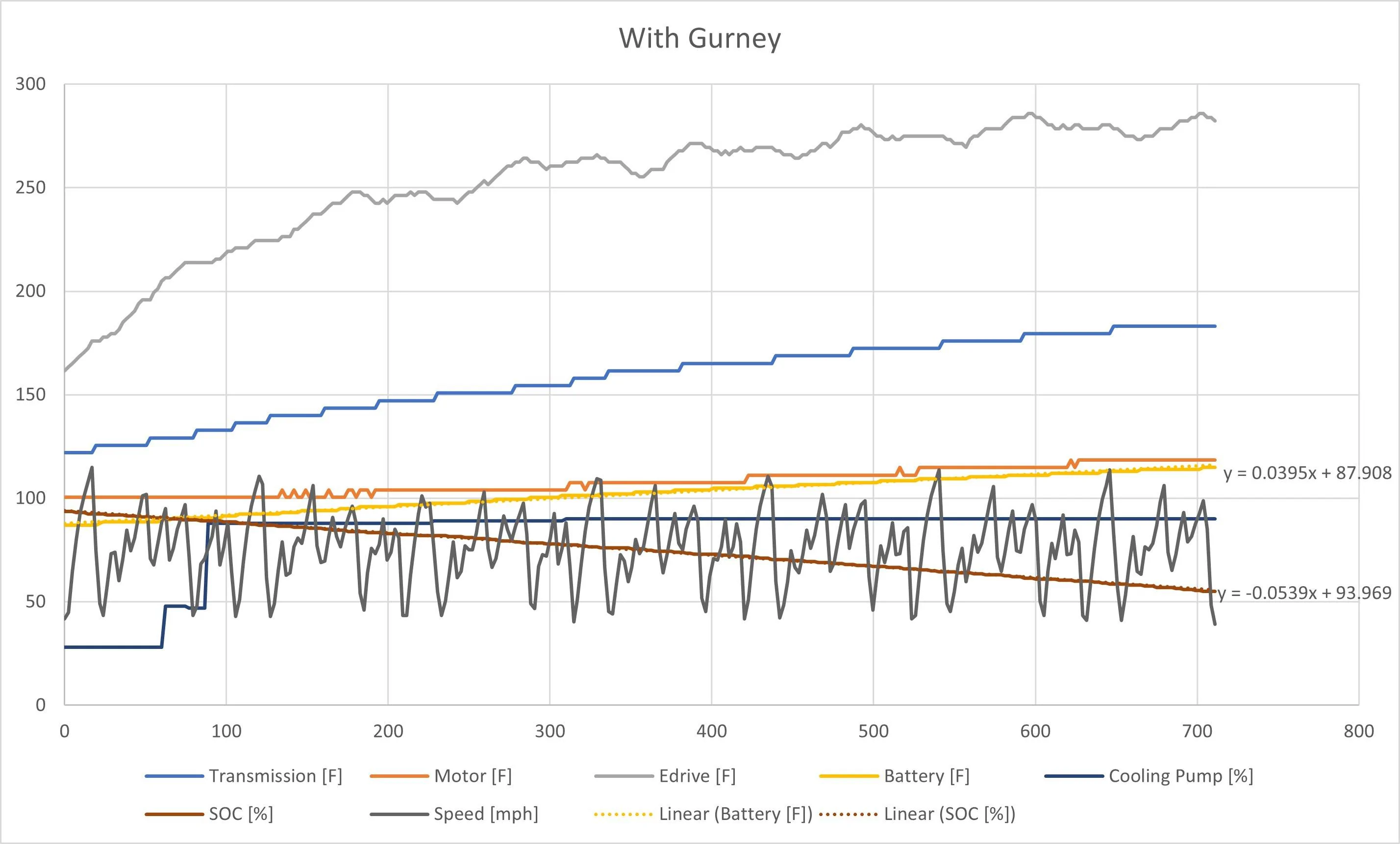
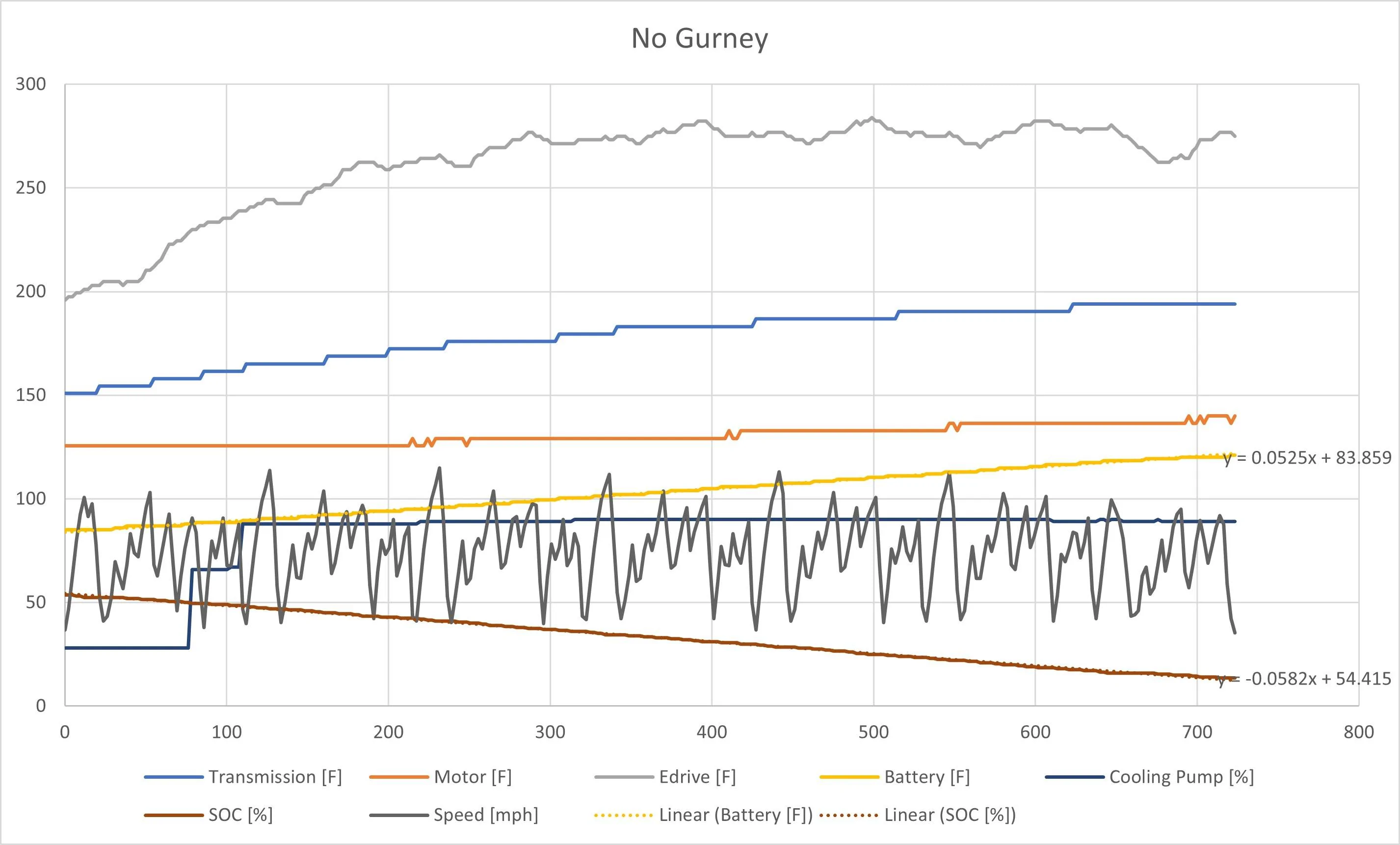
x-axis in seconds.
The yellow line represents battery temp and its immediately obvious that the slope, or rate of increase is higher without the flap. In fact, without the flap, the starting battery temp is lower but ends with a higher temp than with the flap.
Battery temp w/ flap: 87->115F
Battery temp w/o flap: 85->121F
To make sure we have an equal comparison, I confirmed that the cooling pump was running equally for both sessions, both got up to 90% by the start of the second hot lap. I also wanted to normalize the battery temp ramp according to the energy used. The session without the flap used more energy at 2% higher rate. I added that 2% to the battery temp ramp rate of the no-flap trial. The normalized difference: 20%.
Battery temp increase w/flap: 2.40 degF/minute
Battery temp increase w/o flap: 2.99 degF/minute
What does that ramp rate mean? I can extrapolate that to see how much longer (in minutes or laps) it would take for me to hit 132F battery temp, at which the car cuts power. With the gurney flap, I'd be good for another 4 laps, but without, I'd be done at another 1.8 laps. That's a difference of about 3.6 minutes. With the gurney flap I'd be looking at 11 full hot laps in these conditions, a bit more than 23 minutes lapping at full speed with a proper warm up and cool down lap. Perhaps even longer in reality as there's another 10% capacity in the cooling pump that hadn't kicked in yet.This is good to know because next spring, with higher ambient temps, I'd like to get those other cooling mods ready so that battery temps will not be a limiting factor. If anyone else is interested in testing some of these things out, let me know. I'm particularly interested to see how well they work with a turbo or turbo S, as @daveo4EV found his limit was only about 6 laps, and that's no fun. We need more Taycans on the track!
Sponsored
Last edited: