Sponsored

NEMA 14-50 outlet question

IrwinJ

Well-Known Member
First Name
Irwin
Joined
Apr 17, 2022
Threads
43
Messages
197
Reaction score
71
Location
Asheville NC
Vehicles
Mercedes SL550
Country flag
I'm having my electrician come Monday to put a new 50 amp breaker in the panel that is dedicated to a NEMA 14-50 outlet that he'll install in the garage. And I'm doing this so that I can plug in my Mobile Charger Connect (the optional one I'm getting) to power my car.

However I was thinking that in terms of future proofing the wiring, just in case in the future I want to install one of the newest charge units that must be hardwired to deliver 11KW to the car that I should have him install a 60 amp breaker in the panel instead of the 50 amp breaker I've planned. He confirmed that the wire he's using is sufficient to use with a 60 amp breaker should I want that instead of the 50 amp breaker.

My question (in addition to whether you think that this future proofing is a good idea or not) is whether there a problem having a NEMA 14-50 outlet connected to a 60 amp breaker instead of a 50 amp breaker? My electrician says it's not a problem, but I think I read otherwise somewhere on line.
Sponsored

 

Jhenson29

Well-Known Member
First Name
Jeremy
Joined
Feb 9, 2021
Threads
37
Messages
3,014
Reaction score
4,650
Location
St. Louis, MO
Vehicles
2022 Macan S; 2021 Taycan 4S
Country flag
14-50R should be on a 50A breaker.
It’s trivial to change the breaker later if needed as long as the wire is sized appropriately.
 

daveo4EV

Well-Known Member
First Name
David
Joined
Jan 28, 2019
Threads
192
Messages
7,003
Reaction score
10,473
Location
Santa Cruz
Vehicles
Cayenne Hybrid, 911(s) GT3/Convertable
Country flag
install the biggest AMP wire you can - (60/80/100) - then install a NEMA 14-50 or 6-50 plug - and a 50 amp breaker - swapping a breaker and the NEMA plug later on for a hardwired charger (60 amps or more) is trivial once the wire is pulled.

building code required the plug to match the breaker - so a 50 amp plug with a 60 amp breaker might not pass inspection - but "over-spec" wiring is not problem - the breaker protects the wire from overheating, if you have "better" wire it will heat up even less and therefore is less likely to short/melt/catch-fire.

+1 for @Jhenson29 comment.
 

Jhenson29

Well-Known Member
First Name
Jeremy
Joined
Feb 9, 2021
Threads
37
Messages
3,014
Reaction score
4,650
Location
St. Louis, MO
Vehicles
2022 Macan S; 2021 Taycan 4S
Country flag
I wasn’t home to look it up earlier, but it’s NEC 210.21(B)1 for the code cite on the OCPD rating for single receptacle branch circuits.

Depending on how far away your receptacle is from your panel, you may want to consider running a larger 100A or more feed to a subpanel closer to your destination and then branching the 50A breaker and receptacle off of that. That’s what I did with a 125A sub panel in my garage with EVSE circuits off of that. Then you have more options for easier future expansion if you add additional electric vehicles.
 

nickmdp

Well-Known Member
Joined
Nov 18, 2021
Threads
3
Messages
325
Reaction score
555
Location
Midwest
Vehicles
2022 Taycan GTS ST
Country flag
Honestly, I'd stick to 50A and not overthink it. 9.6kW will likely be sufficient for any needs in the near future, and if it isn't you'll probably want to jump to 100A anyways and not just 60A. For reference though, 9.6kW would allow you to charge a 200kWh battery (more than twice as large as the Taycan's) from 20-80% on a daily basis in 12.5 hours, and another way to think of it would be that you'd need to be hitting 300+ miles per day driven and have less than 12 hours to charge on a daily basis.

To me, either of those cases seem so far beyond my use case that I'd never pay extra for a future that those wires might never see, and if in 5-10 years I do need that capacity, you'd probably be better off going the suggested subpanel approach, because I wouldn't be surprised if a good number of electricians will play it safe and say that if you want them to put in a higher breaker that they need to be the ones putting in the wire.


OP
OP
IrwinJ

IrwinJ

Well-Known Member
First Name
Irwin
Joined
Apr 17, 2022
Threads
43
Messages
197
Reaction score
71
Location
Asheville NC
Vehicles
Mercedes SL550
Country flag
okay I decided to just stay with the 50 amp dedicated breaker for my NEMA 14-50 outlet.

two follow-up questions:

First, my electrician is using #6 wire. The run from panel to outlet is about 80'. Is #6 wire good for that purpose?

Second: in the future if I decide to add a hardwired 11kW charger in place of the NEMA 14-50 outlet, and I replace the 50 amp breaker with a 60 amp breaker, can I continue to use the #6 wire that's in place?
 

daveo4EV

Well-Known Member
First Name
David
Joined
Jan 28, 2019
Threads
192
Messages
7,003
Reaction score
10,473
Location
Santa Cruz
Vehicles
Cayenne Hybrid, 911(s) GT3/Convertable
Country flag
okay I decided to just stay with the 50 amp dedicated breaker for my NEMA 14-50 outlet.

two follow-up questions:

First, my electrician is using #6 wire. The run from panel to outlet is about 80'. Is #6 wire good for that purpose?

Second: in the future if I decide to add a hardwired 11kW charger in place of the NEMA 14-50 outlet, and I replace the 50 amp breaker with a 60 amp breaker, can I continue to use the #6 wire that's in place?
https://upgradedhome.com/what-size-wire-for-sixty-amp-breaker/

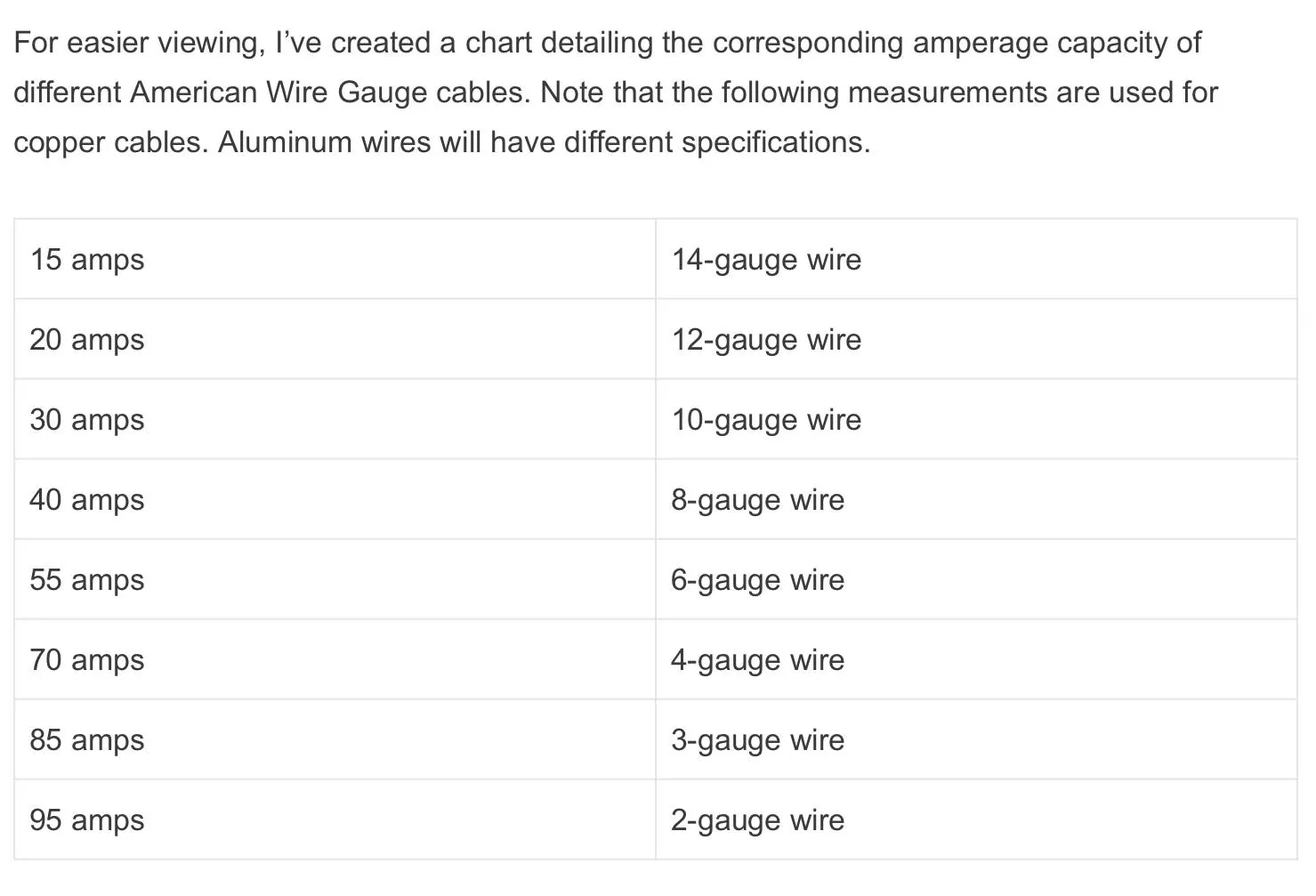
Technically speaking, you should use a 4-gauge wire for a 60-amp circuit breaker. A 6-gauge wire, which is the next gauge, is suitable for up to 55 amps. However, some 60-amp circuit breakers still use a 6-gauge wire because many appliances that are rated for a 60-amp breaker rarely ever draws the full 60 amps.
EV chargers are the "rare" appliance that _DO_ pull current continuously - so I would not wimp out on the wire - this is a one time expense and will be used for decades - higher amp wire gauge (smaller numbers) will run cooler and have less voltage loss

6 gauge may be sufficient, but 4 gauge would be the better call for a future breaker swap - I believe 4 gauge would also handle a 80 amp breaker (64 amp charge rate) for future EV's that may charge faster than than the Taycan.

the Porsche Wall Charger is an excellent EVSE (EV charger) that has adjustable AMP's and can be hardwired for the North American Market - it's $15xx which is competitively priced for a 100/80 amp configurable J-1772 EV charger - I'd seriously consider it.


ciaranob

Well-Known Member
Joined
Jul 3, 2021
Threads
83
Messages
3,547
Reaction score
2,639
Location
Houston, TX
Vehicles
CT4S 2022 Mini Cooper S 2024 Electric in 2025/6
Country flag
I have 60A fuse setup with 60A rated 6 AWG wire on a hard wired ChargePoint Homeflex charger and consistently get 10.5A to the car (11A at charger) and without any doubt shave a couple of hours minimum off full charging times - super happy that I went that route for essentially no extra cost as was initially planning identical wire setup for a 40A setup plug in with a 50A fuse. Have an additional 40-50 Nema plug in adjacent bay for the future Mini electric :). I went for the hard wire as of course have the Porsche portable charger and obviously was never planning on moving the ChargePoint.
 

daveo4EV

Well-Known Member
First Name
David
Joined
Jan 28, 2019
Threads
192
Messages
7,003
Reaction score
10,473
Location
Santa Cruz
Vehicles
Cayenne Hybrid, 911(s) GT3/Convertable
Country flag
6 gauge may be sufficient given the "short" distance - consult with your local certified/bonded electrician for local building codes…

smaller gauge wire (4 vs. 6 etc) always improved the circuit rating but may be overkill…

myself and/or the Internet is _NOT_ a certified/bonded/licensed electrician - please do not use this information to make any building/install decisions - if you burn down your home the advice your received here was worth what you paid for it…
 

daveo4EV

Well-Known Member
First Name
David
Joined
Jan 28, 2019
Threads
192
Messages
7,003
Reaction score
10,473
Location
Santa Cruz
Vehicles
Cayenne Hybrid, 911(s) GT3/Convertable
Country flag
if it were me I'd do the following
  1. purchase a dedicated wall mounted charger (ClipperCreek 60/80/100 or Porsche Wall Charger)
  2. Install a 125 amp breaker in the main panel
  3. run appropriate wire gauge from the new breaker to a new sub-panel in the garage
  4. Install a 60 amp breaker in the new subpanel
  5. Hang the ClipperCreek or Porsche Wall Charger off the new 60 amp breaker - configure as appropriate
  6. Install a 50 amp breaker in the new Subpanel
  7. Install a NEMA 6-50 plug off the new 50 amp breaker in the subpanel
  8. purchase a NEMA 6-50 to NEMA 14-50 adapter pig-tail from amazon - EV charger only for this adapter - but with that adapter you can use either 6-50 or 14-50 EV chargers in North America
  9. call the whole thing done for the next 10-15 years - cause now you can support one or more EV's charging overnight
but it's not my money
I'm certifiably crazy
the above recommendations are _OVERKILL_

but it gives you both a dedicated and plug-able EV charging solution - and supports both NEMA 14-50/6-50 chargers

again a NEMA 14-50/6-50 plug in your garage on a 50 amp breaker with 6 gauge wire is _ALL_ you need!!

but you can "upgrade" and have a bit more head room for your future multi-EV/Hybrid Household.

it's not my money I'm spending - so you do what is best for your circumstance and future considerations.

the NEMA 14-50/6-50 route is very very viable and more than sufficient.
 

ciaranob

Well-Known Member
Joined
Jul 3, 2021
Threads
83
Messages
3,547
Reaction score
2,639
Location
Houston, TX
Vehicles
CT4S 2022 Mini Cooper S 2024 Electric in 2025/6
Country flag
In my case 10ft length from box to ChargePoint (clearly OP’s distance of 80ft a lot more) and certified electrician with warranted contract stating specifically wiring and hard wired setup - def agree with above to not rely on Forum discussions to guarantee what’s appropriate nor on work done :)
 
OP
OP
IrwinJ

IrwinJ

Well-Known Member
First Name
Irwin
Joined
Apr 17, 2022
Threads
43
Messages
197
Reaction score
71
Location
Asheville NC
Vehicles
Mercedes SL550
Country flag
6 gauge may be sufficient given the "short" distance - consult with your local certified/bonded electrician for local building codes…

smaller gauge wire (4 vs. 6 etc) always improved the circuit rating but may be overkill…

myself and/or the Internet is _NOT_ a certified/bonded/licensed electrician - please do not use this information to make any building/install decisions - if you burn down your home the advice your received here was worth what you paid for it…
my distance from panel to outlet is about 50’. Is that to long for use of #6 wire to a 60 amp outlet?
 

Jhenson29

Well-Known Member
First Name
Jeremy
Joined
Feb 9, 2021
Threads
37
Messages
3,014
Reaction score
4,650
Location
St. Louis, MO
Vehicles
2022 Macan S; 2021 Taycan 4S
Country flag
Darn my electrician already bought the #6 wire, so according to that chart if I ever want to have a 60 amp breaker I'll need it rewired.
Wire ampacity is dependent on insulation, installation, and and ambient conditions in addition to gauge. There are cases where 6AWG can be used for >100amps (not this case though…). My EVSE is 75A and uses 6AWG.

Can you tell us what type of wire? Are they individual wires, like THHN?

For example, three current carrying 6AWG THHN in a raceway would be 75A (without temperature derating).

Or is it a cable? And if cable, what type?

I also agree with Dave on consulting with a local electrician. Unless that electrician wants to put your 14-50R on a 60A breaker.
Sponsored


Top