Sponsored

How does launch control help acceleration

JimBob

Well-Known Member
First Name
James
Joined
Jan 26, 2021
Threads
75
Messages
950
Reaction score
1,109
Location
Toronto Canada
Vehicles
Taycan 4S
Country flag
Power and torque on the Taycan are controlled by the pulse controlled inverters. They convert the DC current from the battery to AC current with the characteristics required by motors.

As for launch control, Porsche says this:
Launch Control enables maximum acceleration from a stand-still. It’s a standard feature on Taycan. It uses an overboost function where the two electric motors are provided with more power. in the Taycan Turbo S, a power output of up to 560 kW (761 PS*) is delivered during launch control.

The increased power comes from the higher current provided to the motors in overboost. From Watt's law : Power (in watts) = Current * Volts.
Sponsored
 

Skilly

Well-Known Member
First Name
Matt
Joined
Sep 12, 2021
Threads
6
Messages
492
Reaction score
381
Location
Livermore CA
Vehicles
2020 Taycan Turbo
Country flag
Seems to me, a trip to the all wheel drive dyno would tell the story.
 
OP
OP
David Bennett

David Bennett

Well-Known Member
Joined
Mar 9, 2021
Threads
10
Messages
138
Reaction score
166
Location
UK
Vehicles
Taycan 4S, Golf 8r
Country flag
This guy tried it, too much torque to use LC on the rig..

 
OP
OP
David Bennett

David Bennett

Well-Known Member
Joined
Mar 9, 2021
Threads
10
Messages
138
Reaction score
166
Location
UK
Vehicles
Taycan 4S, Golf 8r
Country flag
The only other way I think it could even be done is to increase voltage above base RPM, but A) I don’t know that the batteries could provide that and B) it doesn’t do anything below base speed and C) I’ve never seen any electric motor controlled that way.

This was basically where I was at. If the peak torque did not increase during launch then it must be held through to higher revs to produce more power. Then I got the question about the time it would take to generate those revs given, lets say, max power would start around 5000revs equating to around 20mph in first gear at the rear and 40mph at the front. This would eat into the 2.5 second window.

It's much easier to assume that non LC torque is lower but I've never seen any data. Anyone?


Jhenson29

Well-Known Member
First Name
Jeremy
Joined
Feb 9, 2021
Threads
37
Messages
3,014
Reaction score
4,650
Location
St. Louis, MO
Vehicles
2022 Macan S; 2021 Taycan 4S
Country flag
@David Bennett
I don’t think the non-LC torque is reduced as much as the LC torque (current) is increased.

Semantics, maybe, but the thing is, assuming the rotor shaft can handle the torque mechanically (which it should) a motor can typically withstand overloading above 100% full load amps (FLA) for some period of time. How long depends on how much over.

It can sit at 2% over much longer than 50% over. There’s a thermal model for the motor and we don’t want the motor to exceed some maximum temperature. So, you can typically go over 100% for some period of time intermittently.

It’s actually extremely common to size motors such that accel requires > 100% FLA. If you need a 100HP motor for continuous duty, but the torque of a 150HP motor for some accelerations, you can use the 100HP motor and allow higher current for accel. This allows a smaller, less expensive motor to be used. Numbers are for example only. Actual values are application dependent.
 
OP
OP
David Bennett

David Bennett

Well-Known Member
Joined
Mar 9, 2021
Threads
10
Messages
138
Reaction score
166
Location
UK
Vehicles
Taycan 4S, Golf 8r
Country flag
@David Bennett
I don’t think the non-LC torque is reduced as much as the LC torque (current) is increased.

Semantics, maybe, but the thing is, assuming the rotor shaft can handle the torque mechanically (which it should) a motor can typically withstand overloading above 100% full load amps (FLA) for some period of time. How long depends on how much over.

It can sit at 2% over much longer than 50% over. There’s a thermal model for the motor and we don’t want the motor to exceed some maximum temperature. So, you can typically go over 100% for some period of time intermittently.

It’s actually extremely common to size motors such that accel requires > 100% FLA. If you need a 100HP motor for continuous duty, but the torque of a 150HP motor for some accelerations, you can use the 100HP motor and allow higher current for accel. This allows a smaller, less expensive motor to be used. Numbers are for example only. Actual values are application dependent.

Thanks for this. Yes, understood. Luckily earlier in my career I was on the leadership team of a company selling drives so my technical understanding of drives and motors is OK. I think I could have phrased the question better last night (there was red wine involved). Really I'd just like to understand the torque curves for LC and non LC. The rest of my answers would just follow from there.


Jhenson29

Well-Known Member
First Name
Jeremy
Joined
Feb 9, 2021
Threads
37
Messages
3,014
Reaction score
4,650
Location
St. Louis, MO
Vehicles
2022 Macan S; 2021 Taycan 4S
Country flag
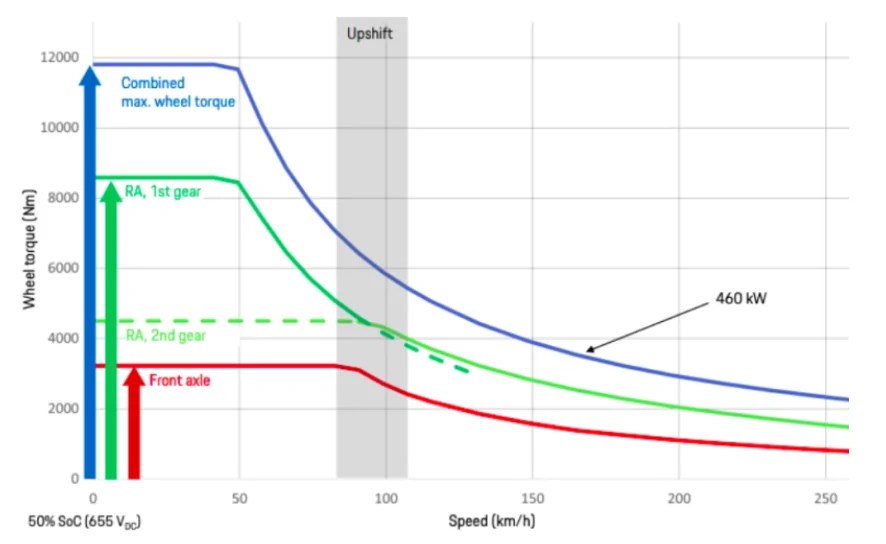
Really I'd just like to understand the torque curves for LC and non LC.
Maybe I’m misunderstanding, but below is the torque curve:

Porsche Taycan How does launch control help acceleration C08032D6-E5AA-4EB5-A5FD-69E6BD8D033F


Below base speed, the current/torque is constant while voltage increases proportional to speed.

Above base speed, current is still constant, but so is voltage, so it’s constant HP and torque falls off.

The difference between non-LC and LC HP varies from 8.5% (Turbo) to 25% (RWD) depending on model. The torque curve should stay the same shape, just higher.
 
OP
OP
David Bennett

David Bennett

Well-Known Member
Joined
Mar 9, 2021
Threads
10
Messages
138
Reaction score
166
Location
UK
Vehicles
Taycan 4S, Golf 8r
Country flag
Maybe I’m misunderstanding, but below is the torque curve:

C08032D6-E5AA-4EB5-A5FD-69E6BD8D033F.png


The torque curve should stay the same shape, just higher.
Thanks, yes this is the question, is the torque curve the same shape just higher or does the constant torque part of the curve extend to higher revs. Either could make more power for launch. It looks like there is nothing published on this.
 

Avantgarde

Well-Known Member
First Name
Eugene
Joined
Apr 4, 2022
Threads
8
Messages
368
Reaction score
466
Location
Ann Arbor, MI
Vehicles
22' Taycan RWD PB+, 21' X5 Xdrive45e, 09' Cayman
Country flag
Thanks, yes this is the question, is the torque curve the same shape just higher or does the constant torque part of the curve extend to higher revs. Either could make more power for launch. It looks like there is nothing published on this.
Interesting discussion. My guess is in overboost mode, the left side of the torque curve is the same and right side of the torque curve is "flatter", in other words does not go down as drastically with revs as they would under non-overboost mode, which would result in higher peak HP with no change to peak Torque. Peak power comes in at higher revs (like 10K rpm), and at that point the torque is way lower than peak, so by simply increasing torque at those RPMs, they could bump up the HP. (and that likely is the way to get more HP from the engine for brief periods without creating excessive heat). Porsche clearly distinguishes between Peak HP between over-boost/non-overboost modes, they could have done the same with peak torque if there was really a difference there.
Sponsored


Top